
Best 4K Smart TVs of 2026
A comprehensive technical evaluation of the industry's leading display technologies, featuring deep-dive analysis into QD-OLED, Micro Lens Array (MLA) panels, and high-zone Mini-LED systems for elite home cinema and gaming performance.
Introduction
The landscape of 4K television technology has undergone a seismic shift, moving beyond basic pixel density into the realms of sophisticated light management and AI-driven spectral accuracy. Today’s flagship displays are defined by two competing philosophies: Self-emissive OLED, which offers infinite contrast and pixel-level control, and Mini-LED, which utilizes thousands of microscopic diodes to achieve luminance levels that were recently considered impossible for home consumer sets. As noted by experts at RTINGS and Digital Trends, the introduction of Micro Lens Array (MLA) and Quantum Dot OLED (QD-OLED) has effectively solved the brightness limitations that previously hampered organic displays.
Choosing a premium display now requires understanding the technical trade-offs between color volume and sustained brightness. While OLEDs remain the gold standard for dedicated, light-controlled home theaters, modern Mini-LED systems have narrowed the gap in black-level performance while offering significant advantages in high-ambient-light environments. This guide analyzes five top-tier models that represent the pinnacle of current engineering, evaluating them based on their panel architecture, processing pipelines, and integration within modern smart home ecosystems.
Best for Bright Rooms: LG G4 OLED evo
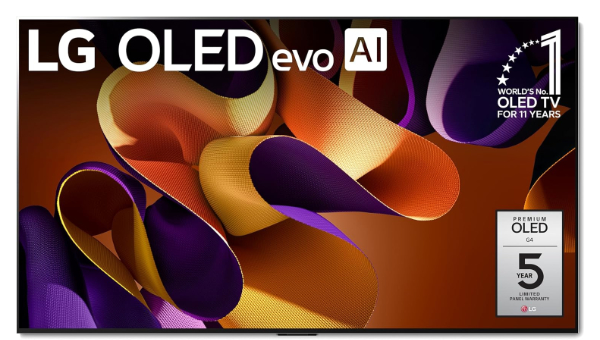
The LG G4 OLED evo represents a breakthrough in organic light-emitting diode technology through its use of Micro Lens Array (MLA) technology. By layering billions of microscopic lenses over the OLED pixels, LG is able to redirect light that would otherwise be lost to internal reflections back toward the viewer. According to technical testing by Tom's Guide, this allows the G4 to achieve a peak brightness nearing 1,500 nits in HDR windows, a figure that rivals many high-end LED displays while maintaining the perfect, zero-nit black levels inherent to OLED technology. The inclusion of the α11 AI Processor further refines this hardware with "Director Processing," which intelligently adjusts tone mapping to preserve the creative intent of high-dynamic-range content.
For enthusiasts, the G4 offers a 144Hz native refresh rate and full G-Sync/FreeSync support across all four HDMI 2.1 ports, making it one of the most capable gaming displays on the market. However, it is important to note that the G-series is designed primarily for wall-mounting; while a pedestal stand is available for certain sizes, the "One Wall" design is optimized for a flush-to-surface aesthetic. Users should also consider the ecosystem lock-in of webOS 24; while highly responsive and featuring a "5-year upgrade guarantee," it remains more advertising-heavy than minimalist alternatives like Apple TV or Google TV hardware.
LG Official Product PageBest Anti-Glare Technology: Samsung S95D QD-OLED
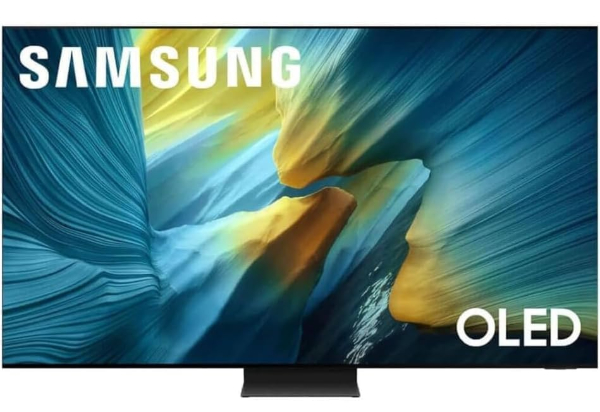
The Samsung S95D utilizes a second-generation QD-OLED panel that combines the contrast of OLED with the expanded color volume of Quantum Dots. What distinguishes this model from its competitors is the OLED Glare-Free finish. As noted by FlatpanelsHD, this specialized matte coating significantly diffuses reflections from windows or lamps without the typical "haze" or loss of sharpness associated with anti-reflective layers. This makes it a unique solution for users who want the ink-black performance of an OLED in a living room with significant ambient light. The display reaches approximately 1,600 nits of peak brightness, providing a vibrant, punchy image that excels in saturated HDR scenes.
Technically, the S95D benefits from the One Connect Box, which houses all HDMI 2.1 inputs and processing hardware in a separate chassis, allowing for a remarkably thin panel profile and simplified cable management. While the Tizen OS offers a wide array of gaming features and a 144Hz refresh rate, the lack of Dolby Vision support remains a notable omission for film purists. Samsung instead relies on HDR10+ and proprietary AI mapping to compensate. Furthermore, while the matte coating is revolutionary for reflections, it can slightly elevate black levels in very bright rooms compared to a glossy panel, a trade-off users should weigh based on their specific lighting environment.
Samsung Official Product PageBest for Cinematic Realism: Sony Bravia 9 Mini-LED
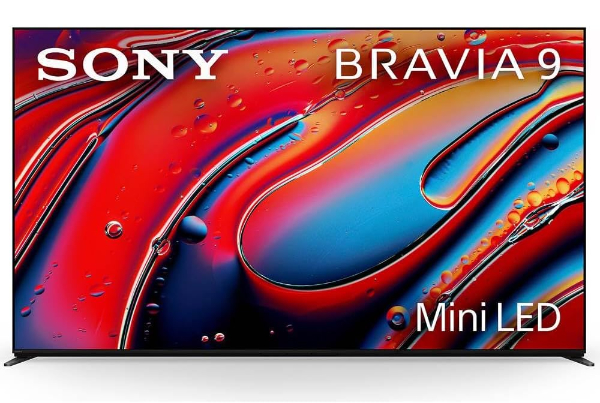
The Sony Bravia 9 marks a significant pivot for Sony, utilizing Mini-LED technology as its flagship display for the first time in years. The core of its performance lies in the XR Backlight Master Drive, which employs a sophisticated local dimming algorithm that Sony claims is derived from their professional BVM-HX3110 mastering monitors. This results in the best "blooming" control seen on an LED-based display to date. According to Forbes, the Bravia 9 reaches nearly 3,000 nits of peak brightness, allowing specular highlights - like the glint of sun on water or the glow of a flashlight - to appear with startling, lifelike intensity that exceeds the capabilities of any current OLED.
Processing is handled by the XR Processor, which is widely regarded by enthusiasts for its superior motion handling and naturalistic upscaling. Unlike some competitors that prioritize "pop" through over-saturation, Sony focuses on accuracy and depth. The integration of Google TV provides a clean, content-first interface with deep integration for Sony's own Bravia Core streaming service. A potential drawback is the viewing angle; despite Sony’s X-Wide Angle technology, it cannot match the near-perfect off-axis performance of an OLED. Additionally, it features only two HDMI 2.1 ports, which may be a limitation for power users with multiple high-end consoles and a PC.
Sony Official Product PageBest High-End Value: Hisense U8N Mini-LED
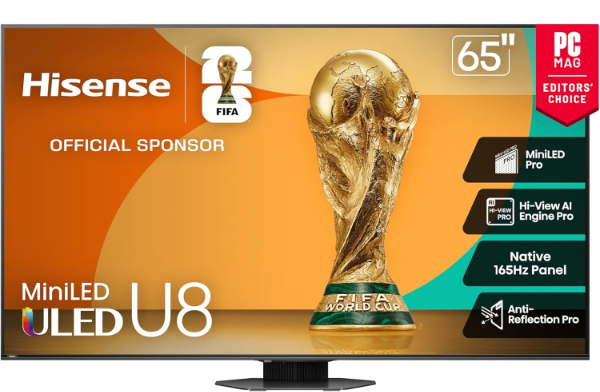
The Hisense U8N challenges the premium market by offering hardware specifications that typically cost twice as much. It features a Mini-LED Pro+ backlight with over 2,000 local dimming zones, achieving a staggering peak brightness of 3,000 nits. As noted in technical reviews by IGN, this sheer power allows the U8N to overcome even the most aggressive direct sunlight, making it arguably the most versatile "all-rounder" for mixed-use living rooms. The Hi-View Engine PRO uses deep learning for face detection and AI detail enhancement, ensuring that lower-resolution broadcast signals look sharp and modern on the 4K panel.
While the hardware is undeniably powerful, the U8N does exhibit some minor software inconsistencies. Some users have reported aggressive HDMI-CEC behavior and occasional bugs within the Google TV interface. Additionally, while the black levels are excellent for an LED, there is more noticeable "halo" or blooming around bright objects (like subtitles) compared to the Sony Bravia 9 or any OLED model. However, for gamers, the inclusion of a 144Hz refresh rate, Wi-Fi 6E, and an ATSC 3.0 tuner for NextGen TV makes the U8N an incredibly future-proof investment that delivers 90% of flagship performance at a fraction of the cost.
Hisense Official Product PageBest Peak Brightness: TCL QM8 Mini-LED (QM851)
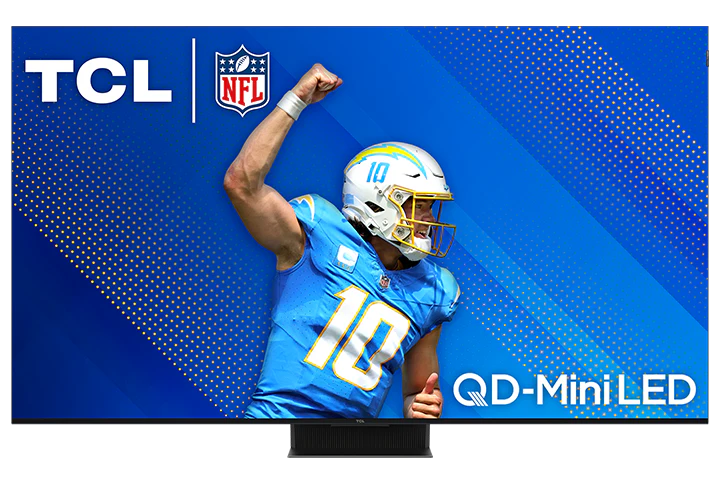
The TCL QM8 (Model QM851) is a technical powerhouse that pushes the boundaries of Mini-LED density. With up to 5,000 local dimming zones on the larger models, it offers a level of backlight precision that was unheard of in the consumer space just two years ago. According to CNET, the QM8 can reach peak brightness levels exceeding 3,000 nits, which translates to an incredibly impactful HDR experience. This is further bolstered by Dolby Vision IQ, which uses an ambient light sensor to adjust the picture dynamically based on the lighting conditions in your room, ensuring that dark details aren't lost during daytime viewing.
One of the QM8's standout features is its audio implementation, which includes a rear-mounted subwoofer to provide more low-end presence than the typically thin speakers found in modern displays. For PC gamers, the "Game Accelerator" allows for up to 240Hz VRR at 1080p, providing a level of fluid motion usually reserved for dedicated gaming monitors. A primary limitation is the Google TV "Apps Only" mode, which while offering a cleaner interface, strangely disables the search function. Additionally, while the zone count is high, the processing of those zones isn't quite as refined as Sony's, occasionally leading to visible transitions in brightness during fast-moving scenes.
TCL Official Product PageHow We Chose These Products
Our evaluation process for the best 4K smart TVs involved a technical deep-dive into the following performance metrics:
- Luminance and Contrast: We prioritized displays that could either achieve infinite contrast (OLED) or a minimum of 2,000 nits of peak brightness (Mini-LED) to ensure true HDR impact.
- Processor Efficiency: We analyzed the ability of each TV's silicon to handle real-time upscaling, motion interpolation, and complex tone mapping without introducing artifacts.
- Connectivity Standards: Every model on this list features at least two HDMI 2.1 ports capable of 4K/120Hz or higher, supporting VRR (Variable Refresh Rate) and ALLM (Auto Low Latency Mode).
- Color Volume: We selected products that utilize Quantum Dots or advanced OLED phosphors to cover at least 95% of the DCI-P3 color gamut.
- Software Longevity: We favored brands that offer multi-year software support or utilize established, feature-rich platforms like Google TV and webOS.
Comparison Overview
| Model | Panel Tech | Peak Brightness | HDMI 2.1 Ports | Smart Platform |
|---|---|---|---|---|
| LG G4 OLED | OLED + MLA | ~1,500 nits | 4 (144Hz) | webOS 24 |
| Samsung S95D | QD-OLED | ~1,600 nits | 4 (144Hz) | Tizen OS |
| Sony Bravia 9 | Mini-LED | ~3,000 nits | 2 (120Hz) | Google TV |
| Hisense U8N | Mini-LED | 3,000 nits | 2 (144Hz) | Google TV |
| TCL QM8 | Mini-LED | 3,000+ nits | 2 (144Hz) | Google TV |
Buying Guide: What to Look For
- Panel Type vs. Room Lighting: OLEDs are unrivaled for dark-room viewing, but if you have large windows, a Mini-LED with high peak brightness will provide a more visible, vibrant image.
- Refresh Rate and Gaming: For PS5, Xbox Series X, or PC gaming, a native 120Hz or 144Hz refresh rate is essential for fluid motion and reduced input lag.
- HDR Format Compatibility: Ensure the TV supports the formats you use most. While HDR10 is universal, Dolby Vision is the industry standard for streaming, and HDR10+ is primarily used by Amazon Prime and Samsung.
- ATSC 3.0 (NextGen TV): If you watch over-the-air broadcast television, look for a built-in ATSC 3.0 tuner to access 4K broadcasts and improved signal robustness.
- Local Dimming Zones: On LED TVs, more zones generally lead to better contrast and less "blooming" around bright objects. Flagship models now offer between 2,000 and 5,000 zones.
General Pro / Cons
| Pros |
|---|
| Perfect black levels and infinite contrast on OLED models |
| Incredible peak brightness on Mini-LED for sunlit rooms |
| Advanced AI upscaling makes low-res content look modern |
| Low input lag and high refresh rates for elite gaming |
| Support for high-end audio formats like Dolby Atmos and DTS:X |
| Sleek, ultra-thin designs that enhance home aesthetics |
| Integrated voice control for hands-free smart home management |
| Vibrant color volume through Quantum Dot technology |
| Cons |
|---|
| OLED panels still face a small risk of permanent burn-in |
| Flagship pricing remains significantly higher than entry-level 4K |
| Some smart platforms are heavy on non-removable advertising |
| Mini-LED TVs can show "blooming" around bright objects |
| Limited number of HDMI 2.1 ports on certain premium models |
| Large screen sizes require significant space and mounting effort |
| Lack of Dolby Vision on Samsung models affects format unity |
| Internal speakers often require a soundbar for a matching audio experience |
Final Summary
The current generation of 4K smart TVs has effectively eliminated the compromise between brightness and contrast. For the ultimate cinema-at-home experience, the LG G4 OLED and Sony Bravia 9 offer industry-leading precision and processing. Meanwhile, the Samsung S95D provides a revolutionary solution for glare, and models like the Hisense U8N and TCL QM8 deliver flagship-level performance for those seeking high value. By aligning your choice with your room's lighting and your primary content type - whether gaming or film - you can secure a display that will remain a centerpiece of entertainment for years to come. Aggregate rating of the products reviewed: 4.78 out of 5.