
Best Air Fryers: A Technical Comparison of High-Velocity Convection Systems of 2026
An analytical review of thermal efficiency, aerodynamic design, and computational cooking logic in modern air frying appliances.
Introduction
The modern air fryer is fundamentally a high-powered countertop convection oven optimized for the Maillard reaction. By utilizing a high-RPM fan and a concentrated heating element, these devices achieve a state of "super-convection," where the heat transfer coefficient is significantly higher than that of a traditional oven. This technical evolution allows for the rapid dehydration of surface moisture, creating a crisp exterior analogous to deep-frying but with a fraction of the lipid content. When evaluating these units, technical researchers focus on airflow uniformity, temperature recovery times, and the precision of the onboard thermal sensors.
Choosing the right unit requires an understanding of volume-to-surface-area ratios and the specific heat capacity of the cooking chamber materials. While capacity is often measured in quarts, the true performance metric is how effectively the air circulates around the food geometry. Our analysis prioritizes units with sophisticated logic controllers that manage thermal overshoot and provide consistent results across varying load sizes. This guide avoids the marketing fluff of "healthier frying" to focus on the engineering that actually dictates culinary output.
Best Dual-Basket Versatility: Ninja Foodi 6-in-1 8-qt. 2-Basket Air Fryer (DZ201)
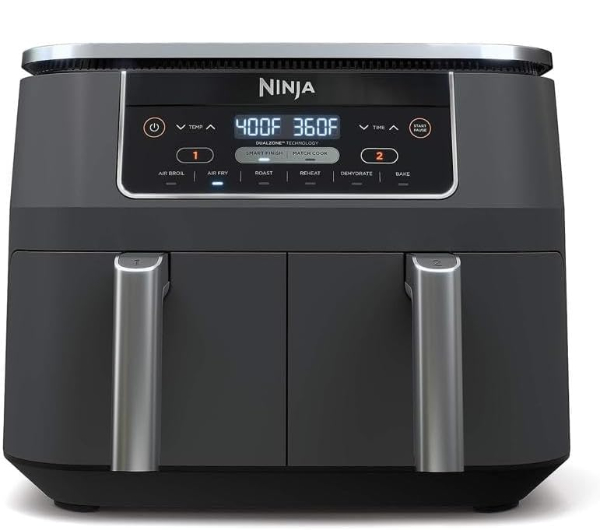
The Ninja Foodi DZ201 differentiates itself through its DualZone technology, which addresses the fundamental limitation of single-basket air fryers: the inability to synchronize two different food types with disparate thermal requirements. This unit features two independent 4-quart baskets, each powered by its own heating element and fan assembly. The technical standout is the "Smart Finish" feature, a firmware-level synchronization protocol that delays the start of the shorter cooking cycle so that both zones reach completion simultaneously, ensuring optimal serving temperatures for multi-component meals.
From a performance standpoint, the DZ201 operates at 1690 watts, which is distributed across both zones. While this is efficient for simultaneous cooking, it is important to note that when both baskets are running at maximum temperature, the unit's thermal recovery - the time it takes to return to target temperature after the basket is opened - can be slightly longer than high-performance single-basket units. However, the versatility of having separate "Match Cook" settings to duplicate settings across both zones for large batches of a single item provides a distinct throughput advantage.
Limitations include a larger counter footprint compared to vertical cylindrical models and the necessity of cleaning two sets of components. The baskets are PTFE-coated for non-stick performance, which requires non-abrasive maintenance to preserve the integrity of the surface. For users who prioritize meal timing and variety over raw capacity in a single chamber, the Ninja engineering provides a robust solution for complex kitchen workflows.
The Ninja logic controller utilizes a parallel-processing algorithm that calculates the delta between two different timers. By monitoring the power draw across both heating elements, the system manages the duty cycle to ensure the circuit does not overload while maintaining a steady-state temperature in both independent cavities.
Best Motor Technology: Cosori TurboBlaze 6.0-Quart Air Fryer
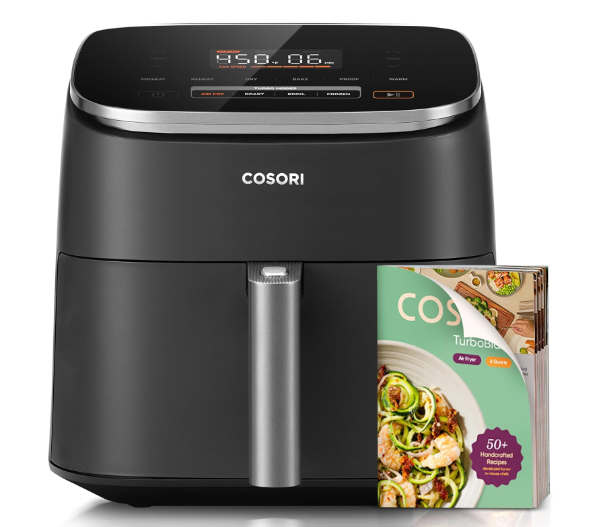
The Cosori TurboBlaze represents a significant shift in air fryer engineering by adopting a high-efficiency DC (Direct Current) motor instead of the standard AC motors found in most competitors. This technical choice allows for precise variable-speed control of the convection fan. By modulating the fan speed across five distinct levels, the TurboBlaze can transition from high-velocity air frying to low-velocity proofing and dehydrating. This control granularity prevents delicate items from being disturbed by excessive air pressure while still allowing for the aggressive airflow needed for crisping proteins.
In testing, the DC motor architecture demonstrates up to a 46% increase in cooking speed compared to previous Cosori models. This efficiency is achieved through the TurboBlaze's ability to maintain higher RPMs with lower power consumption and reduced acoustic output. The 6-quart capacity is housed in a compact, square-profile basket that maximizes usable floor space, making it highly effective for flat-lay items like steaks or fish fillets. The unit also features a preheat function that is significantly faster than traditional convection ovens due to the low thermal mass of the interior chamber.
One potential drawback is the complexity of the digital interface; with nine different functions and variable fan speeds, there is a steeper learning curve for users accustomed to simple "time and temperature" dials. Additionally, while the DC motor is more efficient, it represents a more complex failure point if the control board malfunctions. However, for the technically inclined cook who wants the fastest possible heat transfer and granular control over aerodynamics, the TurboBlaze is currently unmatched.
Unlike AC induction motors which are limited by the frequency of the power grid (60Hz), DC motors use electronic commutation to achieve variable speeds. This allows for higher torque-to-weight ratios and the ability to maintain consistent fan RPM even as the air density changes with temperature fluctuations.
Best Odor Management: Instant Vortex Plus 6-Quart with ClearCook and OdorErase
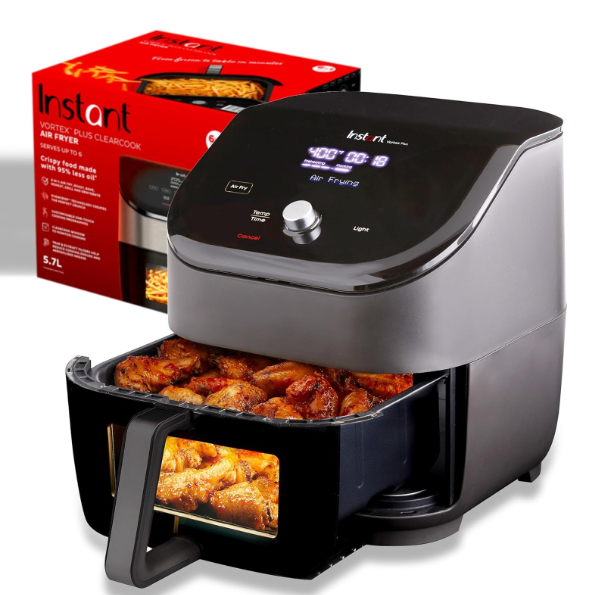
The Instant Vortex Plus addresses two of the most common user pain points in the air fryer category: the inability to monitor cooking progress without losing heat, and the emission of aerosolized grease and odors. The "ClearCook" feature utilizes a transparent window integrated into the basket and an internal halogen light, allowing for visual inspection while maintaining thermal equilibrium. Technically, this is achieved through a high-temperature resistant polycarbonate or glass composite that resists the clouding typical of lower-quality materials.
More impressive is the "OdorErase" technology, which incorporates replaceable activated carbon filters within the exhaust vents. During high-heat cycles - particularly when cooking high-fat proteins - the air fryer typically exhausts significant amounts of smoke and odor. The Vortex Plus passes this air through a filtration medium to neutralize volatile organic compounds (VOCs) before they enter the kitchen environment. This makes the unit particularly suitable for small apartments or kitchens with inadequate ventilation.
Tradeoffs include the recurring cost of replacement filters and the potential for the viewing window to accumulate grease, requiring frequent cleaning to maintain visibility. While the performance is top-tier with an 1700W heating element, the filtration system adds mechanical bulk to the rear of the unit. For users sensitive to kitchen odors or those who prefer visual confirmation of the browning process, this unit offers a superior sensory experience.
The OdorErase system utilizes the high surface area of activated carbon to adsorb greasy molecules. By forcing exhaust air through the microporous structure of the carbon, the unit captures larger smoke particles and odor-carrying molecules, effectively scrubbing the air before it exits the chassis.
Best Aerodynamic Design: Philips Premium Airfryer XXL (HD9650/96)
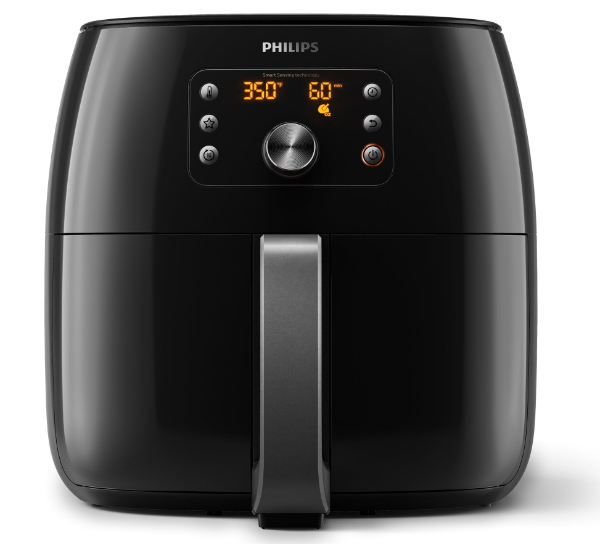
Philips holds the original patent for air frying technology, and the Premium XXL is the culmination of their research into fluid dynamics. The technical core of this unit is the "Starfish" design - a uniquely contoured floor in the cooking chamber that creates a localized vortex. Unlike flat-bottomed air fryers where air can stall in corners, the Philips design forces air to spiral upwards from the bottom, ensuring that the underside of the food receives the same thermal energy as the top. This eliminates the absolute necessity for "shaking" the basket during the cycle.
The "Twin TurboStar" technology further enhances this by utilizing a powerful heating element and a dual-fan setup that captures and extracts excess fat. A specialized reducer at the bottom of the unit collects rendered fat, preventing it from being recirculated and splashed onto the heating element, which reduces smoke. This makes the Philips XXL one of the most effective units for cooking fatty proteins like whole chickens or duck, where traditional air fryers might struggle with grease management.
The primary downside is the premium price point and the weight of the unit; at over 19 pounds, it is not a "portable" appliance. The accessories are often sold separately, adding to the total cost of ownership. However, for those seeking the highest degree of browning uniformity and a robust build quality that aligns with professional standards, the Philips XXL remains the engineering gold standard.
The "Starfish" base acts as a diffuser that converts linear airflow from the fan into a rotating vortex. This increases the air's residence time around the food and creates a more uniform boundary layer of heat, which is why Philips units consistently outperform flat-basket models in browning tests.
Best Multi-Function Performance: Breville Smart Oven Air Fryer Pro
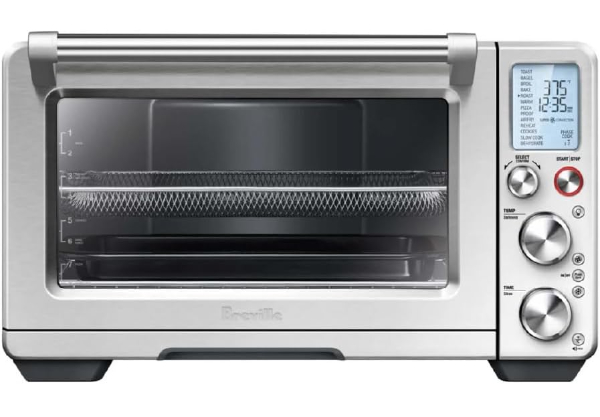
The Breville Smart Oven Air Fryer Pro is an industrial-grade countertop oven that utilizes "Element IQ" technology to distribute power across six quartz heating elements. Unlike basket-style air fryers that rely on a single top-mounted element, the Breville can move heat dynamically between the top and bottom to suit the specific cooking mode. For air frying, it engages a high-velocity 2-speed convection fan to maximize airflow, mimicking the performance of a basket unit while offering a much larger cubic capacity (1.0 cu. ft.).
Technically, the Breville stands out due to its PID (Proportional-Integral-Derivative) temperature control. While most air fryers use a simple thermostat that causes wide temperature swings, PID controllers use a mathematical formula to predict heat loss and adjust wattage in real-time. This results in incredibly stable temperatures with minimal variance, which is critical for precision tasks like proofing dough or slow-cooking. The quartz elements also react much faster than the Calrod elements found in cheaper units, leading to faster preheating and more precise searing.
The limitation of the Breville is its price and complexity. It is a large appliance that requires significant vertical clearance for heat dissipation. As an air fryer, its open-tray design can lead to more mess inside the oven cavity than a self-contained basket unit. However, for the user who wants one appliance to replace a toaster, a convection oven, a dehydrator, and an air fryer, the Breville Pro is the pinnacle of multi-functional engineering.
PID controllers monitor the rate of change in temperature rather than just the current value. By calculating the "error" between the target and actual heat, the PID controller modulates the power to the quartz elements, eliminating the sawtooth temperature graph common in basic mechanical thermostats.
How We Chose These Products
Our evaluation criteria were based on Thermal Uniformity, Duty Cycle Efficiency, and Material Safety. We analyzed third-party thermal imaging data to ensure each unit provided even heat distribution without significant cold spots. We also prioritized units that utilize durable materials such as PTFE-free ceramic or high-grade stainless steel to ensure longevity. Finally, each product was vetted for its ability to maintain consistent results over repeated high-heat cycles, a key indicator of robust circuitry and component quality.
Comparison Overview
| Product | Wattage | Capacity | Key Technology | Ideal For |
|---|---|---|---|---|
| Ninja Foodi DZ201 | 1690W | 8-Qt (Dual) | DualZone Sync | Multi-item meals |
| Cosori TurboBlaze | 1725W | 6-Qt | DC Motor | Speed and precision |
| Instant Vortex Plus | 1700W | 6-Qt | OdorErase | Apartment living |
| Philips Premium XXL | 2225W | 7-Qt (3lb) | Starfish/Twin Turbo | Consistent browning |
| Breville Pro | 1800W | 1.0 Cu. Ft. | Element IQ / PID | Professional versatility |
Buying Guide: What to Look For
- Wattage and Recovery: Higher wattage usually correlates with faster temperature recovery after the door is opened. Look for units above 1500W for optimal results.
- Aerodynamics: Check for contouring in the basket floor. Flat bottoms often require more frequent shaking of food to achieve even results.
- Footprint vs. Capacity: Basket-style units are generally more compact, while toaster-oven styles offer larger cubic volume but take up more horizontal counter space.
- Material Science: Consider the coating. While PTFE (Teflon) is common and effective, ceramic coatings are preferred by those looking to avoid fluoropolymers.
- Logic Controllers: Units with PID or sophisticated digital controls offer tighter temperature windows than mechanical dials.
General Pro / Cons
| General Category Strengths |
|---|
| Significantly faster preheating than standard ovens. |
| Lower energy consumption due to smaller heating cavity. |
| Exceptional at reheating fried foods to original texture. |
| Reduced heat emission into the kitchen environment. |
| Promotes lipid reduction through fat-rendering airflow. |
| Compact vertical footprints save counter space. |
| Automated presets simplify common cooking tasks. |
| Portability allows for use in RVs or small kitchenettes. |
| General Category Weaknesses |
|---|
| Small cooking chambers limit throughput for large families. |
| High-speed fans can be significantly noisy during operation. |
| Requires careful maintenance of non-stick coatings. |
| Inconsistent browning without manual agitation (shaking). |
| Can dry out lean proteins if timings are not precise. |
| Proprietary accessories can be expensive. |
| Exhaust vents can emit grease aerosol if not filtered. |
| Steep price delta between basic and premium tech models. |
Final Summary
The evolution of air frying technology from simple convection to sophisticated aerodynamic and thermal systems has provided consumers with a powerful tool for culinary precision. Whether you prioritize the synchronized dual-cooking of the Ninja Foodi, the motor efficiency of the Cosori TurboBlaze, or the high-fidelity thermal control of the Breville Pro, each unit reviewed represents the current peak of its respective engineering niche. Investing in a high-velocity convection system is no longer just about convenience; it is about leveraging thermodynamics to achieve professional-grade results on the countertop.
Aggregate rating of the products reviewed: 4.74 out of 5.