
Best All-in-One Home Gyms of 2026
High-performance strength training has migrated from the commercial floor to the living room. We’ve analyzed the mechanics, pulley ratios, and digital resistance engines of the market's top systems to help you reclaim your floor space and your time.
Introduction
The "All-in-One" home gym category has undergone a radical transformation. For decades, the choice was limited to clunky, plate-loaded towers or bodyweight benches that lacked the resistance necessary for significant hypertrophy. Today, the landscape is divided between high-fidelity digital resistance systems and precision-engineered functional trainers. The goal of a modern home gym isn't just to provide weight, but to manage "friction points" like the footprint of a squat rack, the mess of loose iron, and the lack of professional guidance during a lift.
When selecting a system, the technical specifications - such as pulley ratios, steel gauge, and motor hertz - dictate the safety and effectiveness of your workout. A 1:2 pulley ratio, for instance, provides smoother cable travel for athletic movements but requires double the weight stack for the same resistance. Digital systems, meanwhile, eliminate the momentum of moving iron, providing a constant tension that can be more taxing on the central nervous system. This guide demystifies these technical trade-offs to ensure you invest in a system that fits your biomechanics as well as your square footage.
Best Smart Gym: Tonal
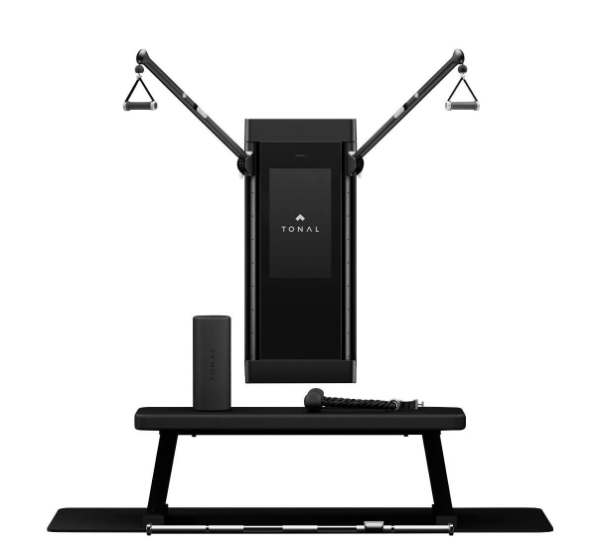
Tonal is the definitive leader in the digital strength category, replacing up to 200 lbs of physical iron with a pair of electromagnetic motors. The primary advantage is the "dynamic weight" capability. Unlike a traditional dumbbell that remains static, Tonal’s software can adjust resistance in real-time, offering "Spotter Mode" which detects when you are struggling and reduces the weight, or "Eccentric Mode" which adds resistance during the lowering phase of a lift. This allows for a level of intensity and safety that usually requires a human training partner.
Technically, the system is a marvel of electromagnetic field control. By varying the current to the motors 60 times per second, it creates a "smooth" pull that mimics gravity without the jerky momentum often found in cheaper cable machines. This is particularly beneficial for joint health, as it prevents the "shock" at the top of a movement. Its footprint is nearly zero, as it mounts directly to wall studs, making it the premier choice for luxury apartments or small bedrooms where a cage or rack is impossible.
The honest trade-off with Tonal is its ecosystem lock-in. To unlock the AI-driven weight adjustments and the expansive library of coach-led programs, a monthly subscription is required. Furthermore, the 200-lb limit is a "digital 200," which feels significantly heavier than 200 lbs of iron due to the lack of momentum, but elite powerlifters may still find the upper ceiling limiting for heavy deadlifts. Professional installation is mandatory, which addresses the setup complexity but adds to the initial investment.
Tonal uses digital "ghost" weight. Why it matters: By sampling your output 60 times per second, the AI can detect a 1ms lapse in force (a "fail"). This allows the Spotter Mode to kick in instantly, preventing injury. Furthermore, removing gravity's momentum means the muscle is under constant tension for 100% of the rep, rather than 70% in traditional lifting.
Best Professional Multi-Gym: Inspire Fitness FT2
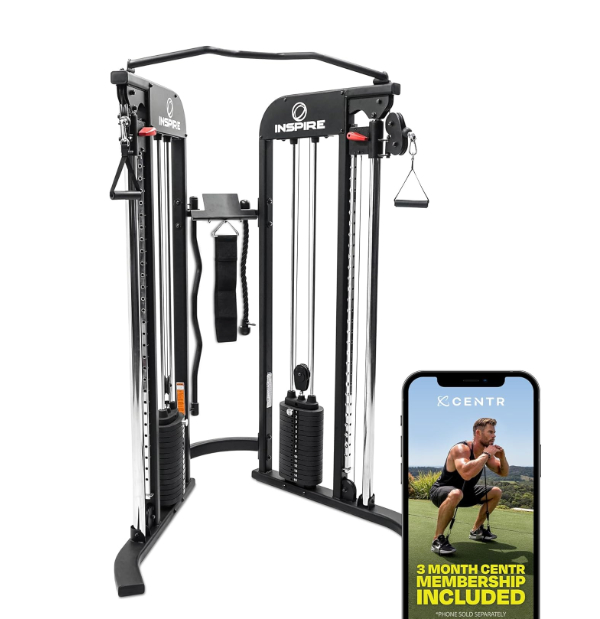
The Inspire Fitness FT2 is a mechanical masterpiece that bridges the gap between a cable machine and a Smith machine. Its standout feature is a patented system that integrates a selectorized Smith bar directly into the two 165-lb weight stacks. This eliminates the need for Olympic plates entirely, removing the friction of loading and unloading iron. For the user, this means you can transition from cable flys to heavy squats in seconds by simply moving a pin.
From a technical perspective, the FT2 uses a 1:2 resistance ratio on its pulleys. While this means 100 lbs on the stack feels like 50 lbs at the handle, it provides significantly more cable travel. This is crucial for explosive, "functional" movements like a golf swing or a baseball pitch, where a 1:1 ratio would likely "bottom out" the weight stack. The frame is constructed from heavy-duty rectangular and round tubular steel, powder-coated to prevent the oxidation common in garage environments.
The limitation here is the ceiling. The FT2 is a tall unit, and those with basement gyms with 7-foot ceilings may find it won't clear the rafters. Additionally, while the integrated Smith bar is revolutionary, it lacks the "free-weight" stabilization requirement of a traditional barbell. It is best suited for those who prioritize safety and versatility over pure powerlifting totals, providing an entire commercial gym experience in a 61" x 58" footprint.
The FT2 utilizes a 1:2 ratio. Why it matters: This ratio doubles the length of cable you can pull. In a 1:1 system, a 4-foot pull moves the weights 4 feet; in the FT2, a 4-foot pull moves the weights only 2 feet. This creates a smoother, more fluid motion that is essential for high-velocity athletic training and prevents the weights from crashing between reps.
Best Plate-Loaded Hybrid: Force USA G3
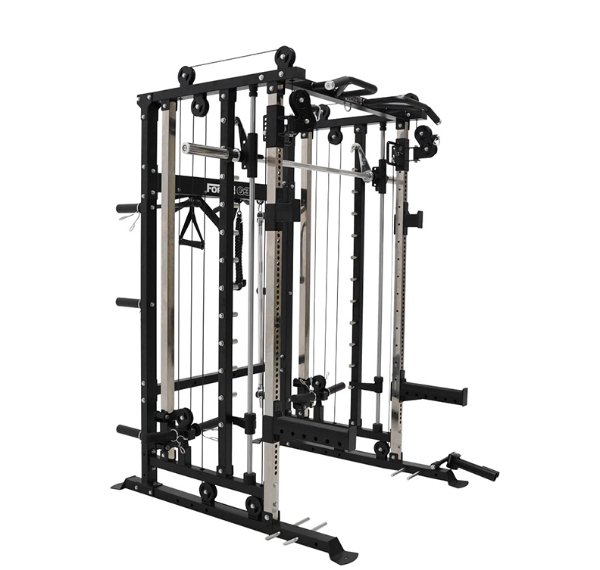
The Force USA G3 is designed for the person who refuses to give up their Olympic plates but doesn't have room for a dedicated squat rack, Smith machine, and cable crossover. It is a "5-in-1" system that combines a power rack, functional trainer, Smith machine, chin-up station, and core trainer. By using a plate-loaded system for the cables rather than a selectorized stack, the G3 significantly reduces the entry price while allowing the user to leverage the weights they likely already own.
Technically, the G3 is built like a tank. It uses 12-gauge rolled steel tubing, which is thick enough to handle a 990-lb rating on the J-hooks. This structural integrity is vital for safety; cheaper "rack" systems often use 14 or 16-gauge steel, which can flex or "walk" during a heavy re-rack. The pulleys are aircraft-quality with a 2,000-lb pressure rating, ensuring that the cable system won't snap under high-tension rows or pulldowns.
The primary friction point is the manual labor. Because it is plate-loaded, you will spend a significant portion of your workout time moving iron around. It also has a larger footprint once you account for the "working area" needed to load plates onto the sides. However, for the "old school" lifter who wants the tactile feel of iron but only has a single-car garage to work with, the G3 is the most cost-effective way to get a commercial-grade squat experience.
The G3 uses 12-gauge (2.6mm thick) steel. Why it matters: In structural engineering, the "deflection" of steel under load is determined by thickness. 12-gauge steel is roughly 30% thicker than 14-gauge. This prevents the uprights from bowing when you drop a 300-lb barbell onto the safety pins, protecting both the machine and your floor.
Best Low-Impact Compact: Total Gym FIT
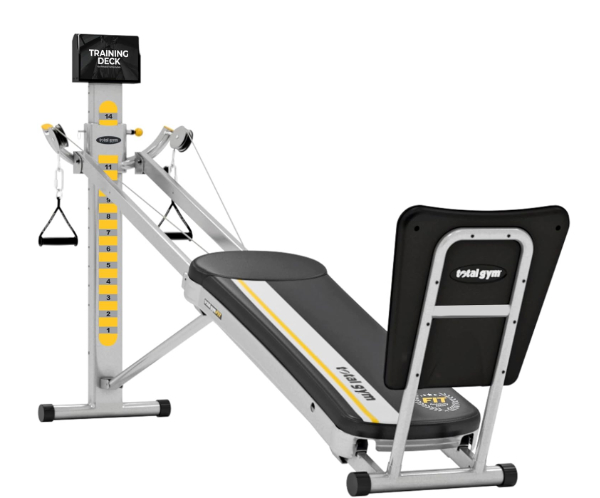
The Total Gym FIT is the refined version of the classic incline trainer. It operates on the principle of an adjustable incline plane: you sit on a rolling glideboard and pull against your own body weight using a cable system. This is a "gravity-based" digital equivalent; by changing the angle of the rails, you increase or decrease the percentage of your body weight you are lifting. At the highest setting, you're lifting roughly 54% of your mass, which provides a surprisingly intense workout for the legs and back.
Technically, the FIT stands out due to its 12 levels of resistance and its 450-lb weight capacity. It utilizes a reinforced slide rail and high-grade rollers that create a near-silent operation. Unlike weight stacks that "clack" and "bang," the Total Gym is silent enough to use while others are sleeping. Because your spine is supported by the glideboard during almost every exercise, it is the gold standard for individuals with lower back issues or those recovering from injury who need to avoid vertical loading.
The downside is the "plateau effect." If you are a 200-lb man, your maximum resistance on this machine is capped at about 108 lbs of tension. For high-volume metabolic conditioning or "toning," it is incredible, but it will not replace a heavy bench press for pure strength athletes. However, it folds in half in about 15 seconds and can be slid under a bed or into a closet, solving the "permanent furniture" friction point better than any other machine on this list.
Total Gym uses variable incline. Why it matters: By changing the angle ($\theta$), the machine alters the force required ($F = m \cdot g \cdot \sin(\theta)$). This allows for "micro-loading," where you can increase intensity by just a few pounds by moving the rail up one notch, which is much safer for tendons and ligaments than jumping by 10-lb plates.
Best Digital Value: Speediance Gym Monster
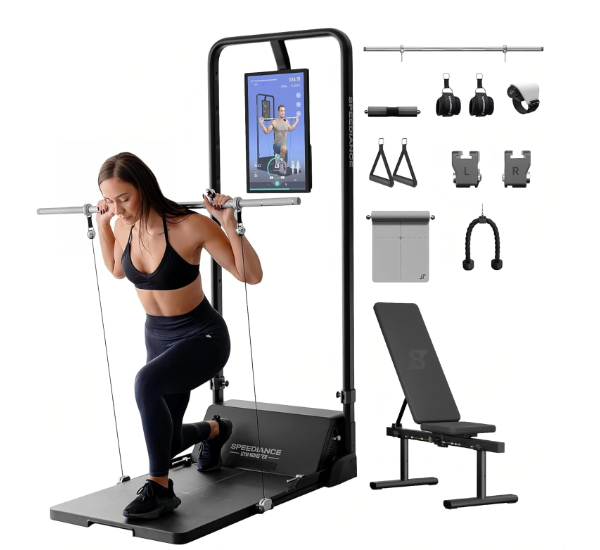
Speediance is the "disruptor" in the smart gym space, offering a digital resistance system that does not require wall mounting. It uses a floor-based platform with dual motors that generate up to 220 lbs of resistance. The primary practical benefit is portability; you can wheel it into a corner or move it to a different room, which solves the "permanent modification" friction point associated with Tonal. It includes a built-in 21.5-inch screen that tracks your reps, power output, and form in real-time.
Technically, the Speediance utilizes Brushless Direct Current (BLDC) motors. These are superior to brushed motors because they have higher torque-to-weight ratios and generate significantly less heat. This allows the machine to maintain a constant 220 lbs of pull for long durations without thermal throttling. It also features a "Partner Mode" for the cables, allowing two people to work out simultaneously - a feature that is rare in digital systems. The platform itself acts as a scale, weighing you and adjusting your suggested weights automatically.
The trade-off is the ergonomics of the floor-pull. While Tonal's arms can move up and down a track for overhead presses, Speediance's pulleys are fixed at the base. It comes with a "smart bar" that connects to the cables to allow for bench presses and squats, but the angle of the pull is always from the floor. This makes some movements, like lat pulldowns, feel less natural than on a wall-mounted or cable tower system. However, for a digital gym that requires zero assembly and no holes in your wall, the value is unmatched.
Speediance uses BLDC (Brushless) motors. Why it matters: Brushed motors rely on physical contact to transfer electricity, which creates heat and friction. BLDC motors use a computer-controlled magnetic field. This allows for "Zero-Inertia" resistance - the weight doesn't feel lighter as you move faster, ensuring the muscle is fully engaged throughout the entire range of motion.
How We Chose These Products
We evaluated the home gym market using a "Force-per-Square-Foot" metric. Our selection criteria included:
- Resistance Quality: We looked for systems that provide either constant tension (digital) or smooth mechanical travel (precision pulleys).
- Footprint Efficiency: Every machine on this list provides at least 50 unique exercises while occupying less than 25 square feet of floor space.
- Assembly Friction: We prioritized machines that either offer professional installation (Tonal) or can be assembled by one person in under two hours (Speediance, Total Gym).
- Structural Integrity: For mechanical gyms, we only considered units using 12-gauge steel or higher to ensure safety under load.
Comparison Overview
| Model | Type | Max Resistance | Key Strength |
|---|---|---|---|
| Tonal | Smart Digital | 200 lbs (Dynamic) | AI Spotting & Wall-Mounting |
| Inspire Fitness FT2 | Functional Trainer | 330 lbs (Total) | Integrated Smith Bar (No Plates) |
| Force USA G3 | Plate-Loaded Hybrid | 990 lbs (Rack Rating) | Commercial Squat Rack Power |
| Total Gym FIT | Incline Bodyweight | ~54% Bodyweight | Joint-Friendly & Foldable |
| Speediance Gym Monster | Digital Floor-Base | 220 lbs (Digital) | Portability & No-Install Tech |
Buying Guide: What to Look For
- Pulley Ratio (1:1 vs 1:2): A 1:1 ratio feels "heavier" but the cable moves slower. A 1:2 ratio feels "smoother" and is better for athletic speed work. Know your goals before you buy.
- Mounting Requirements: Wall-mounted systems like Tonal require specific stud spacing (usually 16 inches). If you have metal studs or non-standard spacing, you may need a workaround.
- The "Ghost" Weight Effect: 100 lbs of digital weight feels roughly 25-30% heavier than 100 lbs of iron because you cannot use momentum to "swing" the weight up. Adjust your expectations accordingly.
- Subscription Costs: Most smart gyms (Tonal, Speediance) require a monthly fee to access tracking and classes. Factor this $40-$60/month into your long-term budget.
General Pro / Cons
| Why You’ll Love Them |
|---|
| Replaces hundreds of square feet of gym equipment. |
| Digital tracking provides exact proof of progress. |
| Safer than free weights for solo home workouts. |
| Constant tension (Digital) leads to faster muscle fatigue. |
| Significantly more aesthetic than a pile of rusted iron. |
| Selectorized or digital weight allows for rapid circuit training. |
| Increases the value of your home or living space. |
| The Honest Downsides |
|---|
| High initial investment compared to basic barbells. |
| Software updates can occasionally interrupt a workout. |
| Most digital units are useless during a power outage. |
| Cable systems require periodic lubrication and inspection. |
| Total Gym/Incline models have a lower resistance ceiling. |
| Moving a wall-mounted unit requires professional re-install. |
| Ecosystem lock-in for smart coaching features. |
Final Summary
The best all-in-one home gym is the one that removes the most barriers between you and your workout. If you have the budget and the wall space, the Tonal offers a futuristic, data-rich experience that is effectively a personal trainer in a box. For the traditionalist who wants commercial-grade iron without the footprint, the Inspire Fitness FT2 provides the most elegant mechanical solution. If your priority is space-saving and joint health, the Total Gym FIT remains an unbeatable value. By choosing a system that respects your technical needs and physical constraints, you ensure that your home gym becomes a permanent part of your routine rather than an expensive clothes rack. Aggregate rating of the products reviewed: 4.74 out of 5.