
Best Battery-Powered Lawn Mowers of 2026
A technical evaluation of the high-voltage, cordless mowers finally capable of replacing gas-powered engines without sacrificing torque or cut quality.
Introduction
The transition from internal combustion to battery power in lawn care is no longer a matter of "if," but "when." For years, the primary friction point for consumers was the fear that a battery couldn't handle thick, wet grass or that the runtime wouldn't cover a standard quarter-acre lot. Today’s high-performance platforms, utilizing 56V, 60V, and even 80V systems, have largely solved the power gap. These machines now produce torque levels equivalent to 160cc-200cc gas engines, providing the "grunt" needed to maintain blade speed under load without the maintenance headache of spark plugs, air filters, and winterizing fuel.
When shopping in this category, the technical specs that actually matter are often obscured by marketing buzzwords. You shouldn't just look at Voltage; you need to look at Watt-hours (Wh) for capacity and Foot-pounds (ft-lbs) for cutting strength. This guide focuses on the "prosumer" tier - mowers that offer steel or high-impact composite decks, advanced mulching capabilities, and sophisticated battery management systems that prevent overheating during mid-summer mows. We have analyzed these tools not just as gadgets, but as long-term investments in your home infrastructure.
Best Overall: EGO Power+ Select Cut XP (LM2156SP)
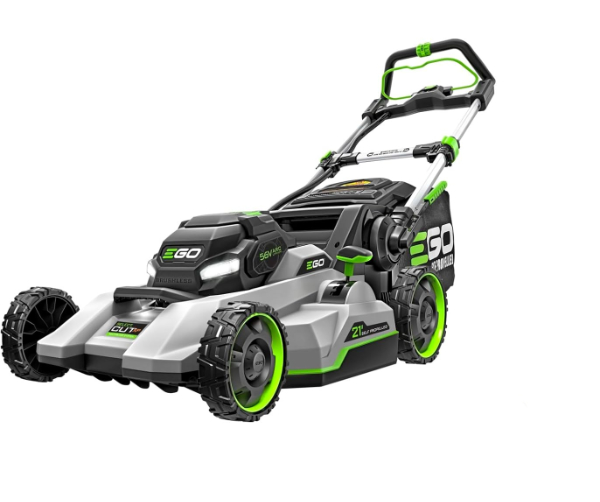
The EGO LM2156SP is widely considered the benchmark for the battery-powered mower category. Its primary technical advantage is the "Select Cut" multi-blade system. Unlike most mowers that use a single blade to do everything, EGO utilizes two interchangeable lower blades - an edge-mowing blade for bagging and a high-lift blade for mulching. This allows the user to prioritize either suction (to get every leaf) or fine clipping reduction (to fertilize the lawn naturally). Powered by a 56V Arc Lithium battery, it delivers 8.3 foot-pounds of torque, which is more than enough to handle overgrown fescue without the motor "bogging down" and stalling.
Practically, this mower solves the storage friction point. It features a telescoping handle and a "vertical fold" design that reduces its footprint by nearly 70%, allowing it to be tucked into a corner like a vacuum cleaner. The self-propulsion system is controlled via a variable-speed dial that is intuitive and doesn't require "death-gripping" the handle. However, the most impressive feature is the 10.0 Ah battery included in the XP kit. It provides approximately 60-75 minutes of real-world runtime, which is a significant buffer for those with larger yards who suffer from "range anxiety."
The honest limitation of the EGO is the polymer deck. While it is rust-proof and highly durable against rocks, it lacks the sheer mass of a steel deck. On extremely uneven terrain, the lighter weight can lead to minor "bouncing" that results in an uneven cut if the user isn't careful with their pace. Furthermore, EGO’s ecosystem is massive; once you buy this mower, you are likely locked into their blowers and trimmers because of the high cost of individual batteries. It is the best choice for the homeowner who wants the most refined, tech-forward mowing experience available.
EGO's batteries use a patented "Arc" shape where the cells are arranged in a ring rather than a brick. This allows for significantly more surface area for heat dissipation. Why it matters: Heat is the primary enemy of lithium-ion cells. By keeping the cells cool, the battery can maintain a high-current output for the duration of the mow without the "thermal throttling" that causes other mowers to lose power when the grass gets thick.
Most Powerful: Milwaukee M18 FUEL 21" Self-Propelled (2823-22HD)
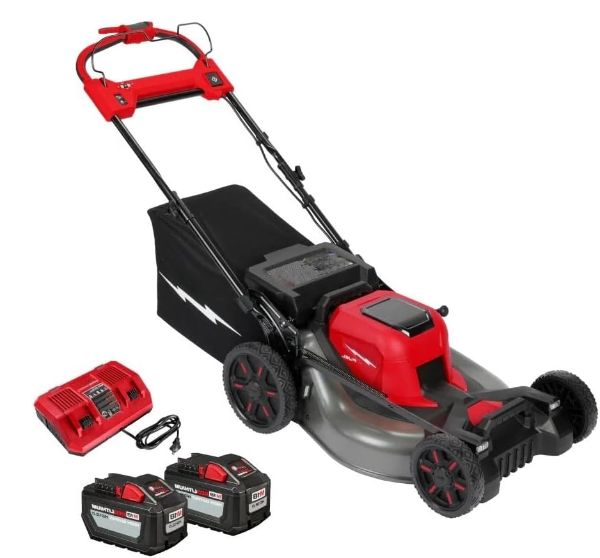
The Milwaukee M18 FUEL mower is an outlier in the industry. While most competitors use higher-voltage batteries (40V-80V) to achieve power, Milwaukee uses two 18V batteries in series. This is a massive advantage for anyone already on the Milwaukee M18 power tool platform. Despite the lower nominal voltage, this mower produces an incredible 10 foot-pounds of peak torque. This allows it to reach full blade speed (3,300 RPM) in under a second, providing the instantaneous lift required to vacuum up flat grass and debris that other battery mowers might leave behind.
Unlike the plastic-heavy designs of its peers, the Milwaukee features a heavy-duty steel deck and all-steel adjustment linkages. It feels "industrial." The "High Lift" mode is particularly impressive; it increases the motor’s RPM specifically for bagging, ensuring that even wet, heavy clippings are forced into the bag rather than clogging the chute. This is the mower for the "prosumer" who has a yard with thick St. Augustine or Bermuda grass that requires significant force to cut cleanly.
The tradeoff for this power is weight and price. At over 80 pounds, it is significantly heavier than the EGO, which makes it less nimble around tight flower beds if the self-propulsion isn't engaged. It is also one of the most expensive units on the market. Furthermore, because it draws so much current, it requires the massive 12.0 Ah High Output batteries to function effectively; using standard 5.0 Ah drill batteries will result in extremely short runtimes and potential overheating. It is best suited for the user who already owns Milwaukee tools and values "commercial-grade" build quality over lightweight convenience.
The Milwaukee motor is tuned for "High-Torque" output. It uses a larger stator and more copper windings than standard consumer mowers. Why it matters: Most mowers slow down when they hit a thick patch of grass, which causes the blade to "tear" rather than "cut." The Milwaukee’s high torque ensures the blade speed stays constant even under 10 ft-lbs of resistance, resulting in a cleaner cut and a healthier lawn.
Best Cut Quality: Toro 60V Max Super Recycler (21491)
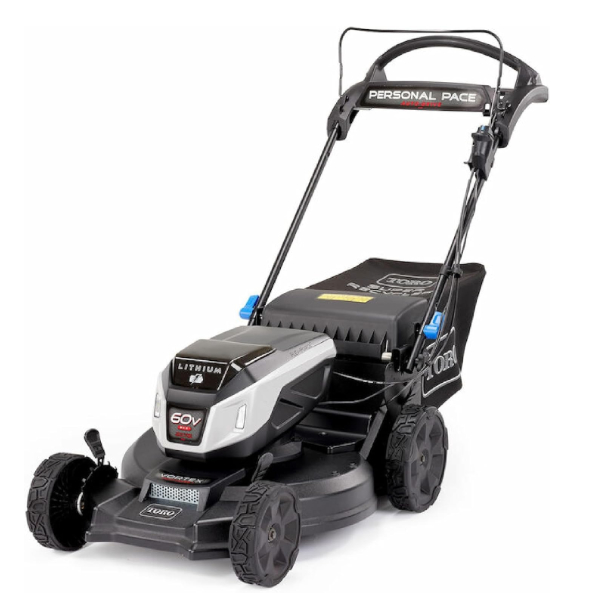
Toro has spent decades perfecting the aerodynamics of a mower deck, and the 60V Super Recycler is the culmination of that research. While other brands focus on motor wattage, Toro focuses on airflow. The "Vortex" technology uses intake vents at the front of the deck to increase air volume. This creates a high-pressure environment that stands the grass upright before the blade strikes it, and then keeps the clippings suspended in the air longer so they can be chopped into fine "lawn vitamins" (mulch) that disappear into the turf.
The "Personal Pace" drive system is arguably the most intuitive in the industry. There are no levers or dials; you simply push the handle, and the mower matches your walking speed automatically. This eliminates the "jerky" starts common with other self-propelled units. The aluminum deck is another standout feature - it’s lighter than steel but far more rigid than plastic, and it will never rust. This makes it a multi-decade tool for those who maintain their equipment well.
The limitation here is the "smart" motor tuning. Toro’s software is designed to save battery by lowering the RPM when the grass is thin. While this extends the runtime of the 7.5 Ah battery, there is a slight "lag" when moving from a thin patch to a thick patch of grass, which can occasionally leave a stray blade behind. It’s also important to note that Toro’s 60V batteries are larger and heavier than EGO's, which can make the mower feel "back-heavy" when the bag is full. This is the top choice for the "lawn enthusiast" who prioritizes a golf-course finish above all else.
Aerodynamics inside a mower deck are determined by "Lift" and "Volume." Toro’s Vortex vents allow more air into the chamber, increasing the "CFM" (Cubic Feet per Minute) of the internal whirlwind. Why it matters: Without enough air, clippings clump together and fall out of the deck in wet piles. The Vortex system keeps clippings suspended until they are small enough to be invisible, preventing "clumping" and promoting faster decomposition.
Best Technology: Ryobi 40V HP Brushless 21" CrossCut (RY401210)
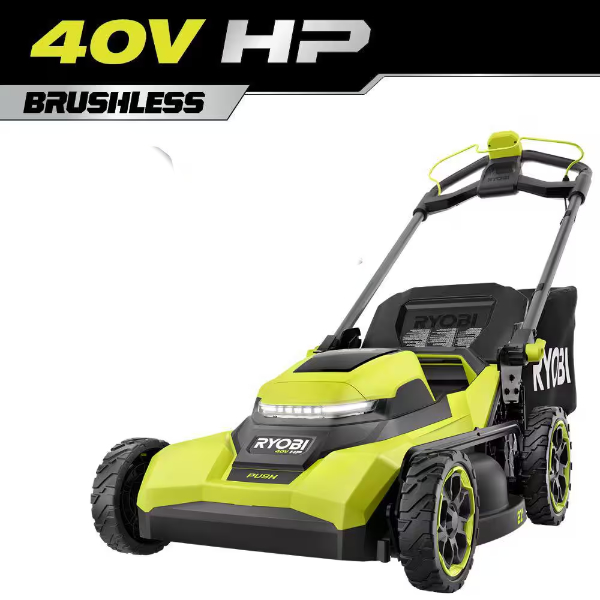
Ryobi’s 40V HP (High Performance) line is designed to deliver maximum features for the dollar. The RY401210 features a "CrossCut" multi-blade system similar to EGO’s, but with a focus on extreme mulching. What makes this unit technically unique is the "Dual Active Battery Ports." Many mowers have space for two batteries, but one is just a storage slot. Ryobi’s system draws from both batteries simultaneously, which reduces the electrical "load" on each individual battery. This lowers the temperature of the cells and can actually increase the lifespan of the batteries over several years.
From a usability standpoint, Ryobi includes things other brands charge extra for: high-intensity LED headlights for late-evening mows, a single-point height adjustment that is exceptionally smooth, and an on-board storage area for a spare blade. The "HP" brushless motor is noticeably quiet - at about 70 decibels, it’s comparable to a loud conversation, meaning you can mow on a Sunday morning without bothering the neighbors. It’s an incredibly polite machine that doesn't compromise on functionality.
The "friction point" with Ryobi is the sheer amount of plastic. While it’s high-impact material, the handle hinges and adjustment points have more "flex" than the Milwaukee or Toro. Over several years of heavy use, this can lead to minor rattles or a feeling of "looseness." Additionally, Ryobi's 40V batteries take significantly longer to charge than EGO’s (unless you buy their separate "Rapid Charger"). It is the best choice for a tech-savvy homeowner with a standard-sized yard who wants a feature-rich experience without the premium "pro" price tag.
Drawing power from two batteries in parallel halves the "C-rate" (discharge rate) for each battery. Why it matters: High discharge rates generate exponential heat (Joule heating). By splitting the work between two batteries, Ryobi keeps the internal chemistry stable, preventing the batteries from hitting their "thermal cutoff" and ensuring you get every last Watt-hour of capacity out of the cells.
Best Value: Greenworks Pro 80V 21" Brushless (2506802)
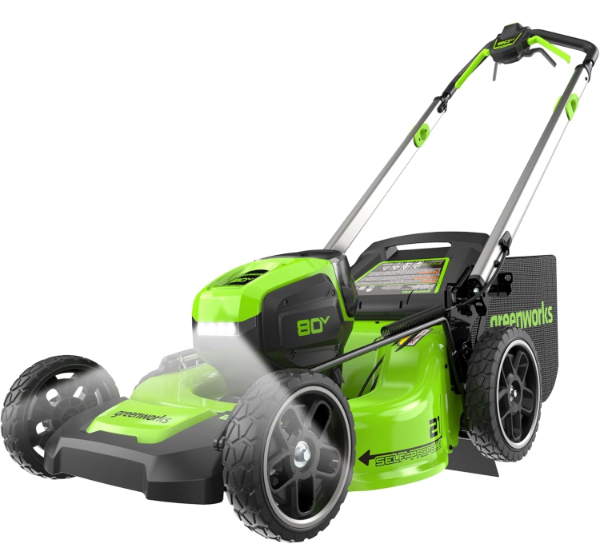
Greenworks was one of the first brands to move into high-voltage territory, and their 80V Pro platform remains one of the most cost-effective ways to get "gas-like" performance. By using an 80-volt architecture, the motor can achieve high power levels while drawing less current (Amps) than a 40V system. This makes the entire system more efficient and allows Greenworks to use a heavy-duty steel deck without the mower becoming sluggish. It is a "no-frills" powerhouse that focuses on the core task: cutting grass reliably.
One of the most practical features of the Greenworks 80V is the "Smart Cut" technology. This is a load-sensing motor that monitors the resistance on the blade 1,000 times per second. If you hit a patch of thick weeds, you can actually hear the motor "turbo up" to maintain its 2,800-3,200 RPM range. The vertical storage capability is also standard here, and because the design is relatively simple, there are fewer proprietary electronic "gimmicks" to fail over time. It’s a very honest, straightforward machine.
The tradeoff for the lower price point is ergonomics. The handle isn't quite as comfortable as the Toro or EGO, and the height adjustment lever requires a bit more muscle to move. Furthermore, the 80V batteries are physically large and heavy, making the mower feel a bit more like a traditional gas unit in terms of weight distribution. It’s the perfect choice for someone moving from a gas mower who wants a familiar, steel-deck feel and maximum power-to-dollar ratio.
Power (Watts) is Voltage multiplied by Amps. By increasing the Voltage to 80V, Greenworks can produce the same power as a 40V mower using half the Amperage. Why it matters: Electrical resistance in wires generates heat based on the square of the Amps. Half the Amps means one-fourth the heat generated in the motor's copper windings, allowing the motor to run cooler and last longer under heavy work cycles.
How We Chose These Products
Our evaluation process for battery mowers goes beyond a simple test cut. We analyzed these products based on:
- Torque-to-Weight Ratio: We prioritized mowers that can handle "overgrown" conditions without stalling, while remaining light enough for the average person to maneuver.
- Thermal Management: We looked for battery designs (like EGO's Arc Lithium or Ryobi's Dual Port) that actively manage heat to prevent premature battery failure.
- Cut Quality (Mulching vs. Bagging): We evaluated deck aerodynamics and blade design to ensure the mower provides a clean cut that prevents lawn disease.
- Ecosystem Value: We considered the cost and availability of additional batteries and compatible tools, as most buyers will stick to one brand.
Comparison Overview
| Model | Voltage | Torque (ft-lbs) | Deck Material | Runtime (Est.) |
|---|---|---|---|---|
| EGO LM2156SP | 56V | 8.3 | Polymer | 60-75 min |
| Milwaukee M18 FUEL | 18V x 2 (36V) | 10.0 | Steel | 45-60 min |
| Toro Super Recycler | 60V | 7.2 (Smart) | Aluminum | 50-60 min |
| Ryobi CrossCut HP | 40V | 7.8 | Composite | 45-70 min (Dual Port) |
| Greenworks Pro 80V | 80V | 8.0 | Steel | 45-60 min |
Buying Guide: What to Look For
- Brushless vs. Brushed Motors: Never buy a brushed motor mower today. Brushless motors are more efficient, produce more torque, and have no wear parts to replace.
- Deck Size: Most battery mowers are 21 inches. A wider deck (like EGO's 22-inch options) saves time but requires more power, potentially reducing runtime.
- Steel vs. Aluminum vs. Poly: Steel is durable but rusts. Aluminum is the pro choice (light/rigid/rust-proof). Polymer is best for storage and weight but can feel "cheap" to some.
- Battery Amp-Hours (Ah): Think of Ah as the size of the "gas tank." A 5.0 Ah battery is standard, but a 7.5 Ah or 10.0 Ah is required for yards over 1/3 acre.
- Storage Requirements: If you have a small garage, prioritize "Vertical Storage" models that allow the mower to be stored on its rear wheels.
General Pro / Cons
| General Strengths |
|---|
| Push-button start eliminates the "pull-cord" struggle. |
| Zero localized emissions (no gas fumes). |
| Significantly quieter (65-75 dB vs. 90+ dB for gas). |
| Vertical storage options save significant garage floor space. |
| No oil changes, air filters, or spark plugs to replace. |
| Batteries can be shared with string trimmers and blowers. |
| Instant torque delivery for better "lift" in wet grass. |
| Reduced vibration reduces operator fatigue during long mows. |
| General Weaknesses |
|---|
| High upfront cost compared to entry-level gas mowers. |
| Batteries have a finite lifespan (usually 5-8 years). |
| Replacement batteries are expensive (often 50% of the mower's cost). |
| Runtime is affected by grass thickness and moisture. |
| Charging takes 60-120 minutes if you run out mid-mow. |
| Repairing electronic motherboards is harder than fixing a carburetor. |
| May struggle with extreme "brush" or woody stalks. |
| Ecosystem lock-in makes switching brands difficult later. |
Final Summary
The EGO Power+ LM2156SP remains the most well-rounded machine for the modern homeowner, combining intuitive controls with a smart dual-blade system. However, if your yard demands raw power and a steel deck that can take a beating, the Milwaukee M18 FUEL is the clear industrial-grade choice. For those obsessed with the perfect "manicured" look, the Toro Super Recycler offers airflow science that no other brand has yet matched. Regardless of your choice, the current generation of battery mowers has finally eliminated the performance gap with gasoline, making the switch a matter of "when" you want to stop dealing with fuel, not "if" the machine will work. Aggregate rating of the products reviewed: 4.7 out of 5.