
Best Bread Makers for Beginners of 2026
Introduction
Entering the world of home baking can be intimidating due to the variables of yeast activity, ambient temperature, and hydration levels. A bread maker acts as a controlled environment - a micro-climate that manages the proofing temperature and kneading torque required to develop gluten structure. For beginners, the goal is consistency. By automating the "knead, rise, punch, rise, bake" cycle, these machines eliminate the manual labor and guesswork that often lead to dense, unrisen bricks.
When selecting a machine, technical specifications like motor wattage and heating element placement are critical. A higher wattage motor (usually 450W to 600W) provides the necessary force to handle heavy whole-grain flours without stalling. Additionally, the shape of the baking pan determines the loaf's final geometry; traditional machines often produce tall "vertical" loaves, while premium models utilize horizontal pans to mimic store-bought sandwich bread. We have analyzed the leading models based on their thermal stability and user interface to find the most approachable options for new bakers.
Best Premium Performance: Zojirushi Home Bakery Virtuoso Plus (BB-PDC20)
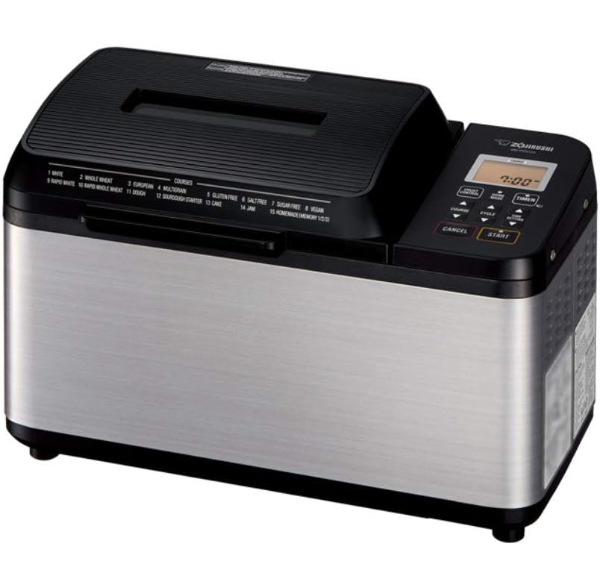
The Zojirushi Virtuoso Plus is widely considered the gold standard for home bread machines due to its dual-blade system. Most beginner machines use a single paddle, which can leave unmixed flour in the corners of the pan. The Virtuoso Plus utilizes two paddles to ensure thorough gluten development across a full 2-lb horizontal loaf. This results in a texture that is remarkably similar to professionally kneaded dough, with a consistent crumb and no "dry spots."
Technically, the standout feature is the additional heating element located in the lid. In many machines, the heat only comes from the bottom, leading to a pale, undercooked top crust. The lid heater ensures an even 360-degree bake, providing a golden-brown finish across the entire loaf. For a beginner, this removes the frustration of "sunken" or soggy tops. It also features a "Course" setting for gluten-free and vegan options, which often require specific temperature curves to rise correctly.
The primary downside is the physical footprint and the investment cost. It is a large, heavy appliance that requires significant counter real estate. However, for a beginner who wants to buy their "forever" machine and avoid the learning curve of cheaper, less consistent models, the Virtuoso Plus offers an unmatched success rate. It simplifies the process without sacrificing the quality of the final product.
The BB-PDC20 uses synchronized dual-motors to drive two paddles. Why it matters: This creates a "stretching" motion rather than just spinning the dough, which is essential for developing the long-chain proteins (gluten) that make bread airy rather than dense.
Best Value Choice: Oster ExpressBake 2-Pound Bread Maker
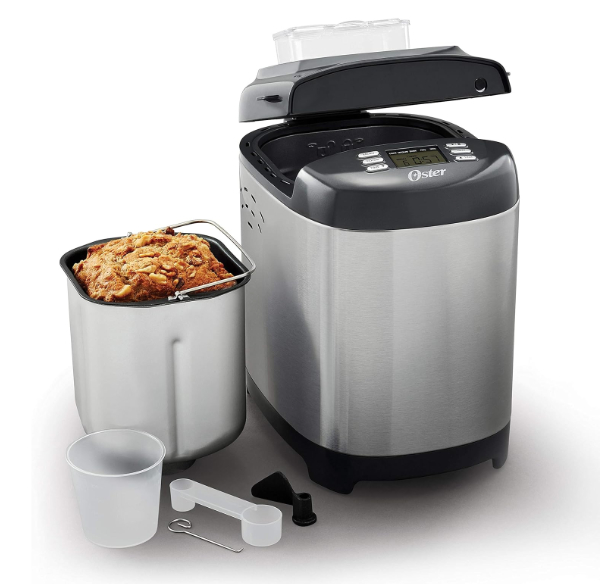
For beginners who are hesitant to spend hundreds of dollars on a new hobby, the Oster ExpressBake offers a low-barrier entry point. It features a 650-watt motor, which is surprisingly powerful for a budget model. This wattage allows the machine to handle denser doughs like whole wheat or rye without overheating the motor. It follows a vertical loaf format, which creates the classic "mushroom" top associated with home bread machines.
The namesake feature is the "ExpressBake" setting, which can produce a finished loaf in under an hour. While bread purists might argue that a shorter rise time sacrifices flavor depth, for a busy beginner, the ability to have fresh bread for dinner on short notice is a major benefit. The interface is straightforward, with 12 preset cycles that cover everything from basic white bread to jam and cake settings.
The trade-off for the lower price is the build material and noise levels. The housing is primarily plastic, which can vibrate more than stainless steel models during the heavy kneading phase. It also lacks a "delay start" for the rapid cycles (as the yeast needs to be active immediately). However, as an introductory tool, it performs its core duties reliably and is easy to clean thanks to the non-stick internal pan.
The motor provides higher-than-average torque for its price bracket. Why it matters: High torque prevents the paddle from getting stuck in heavy doughs, reducing the risk of a "half-mixed" loaf or motor burnout during the first 15 minutes of operation.
Best for Small Spaces: Hamilton Beach Premium Bread Maker (2 lb)
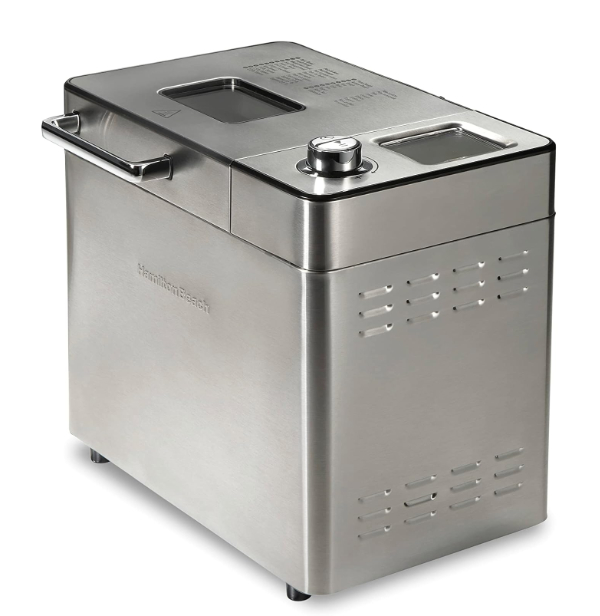
The Hamilton Beach Premium model is an excellent choice for apartment dwellers or those with limited cabinet space. It uses a vertical design that minimizes its counter footprint while still offering a 2-lb capacity. The stainless steel exterior is not just for looks; it provides better insulation and heat retention than plastic, leading to a more consistent internal temperature during the proofing stages.
What makes this particularly beginner-friendly is the automatic nut and fruit dispenser. One of the common mistakes beginners make is adding mix-ins too early, which causes them to be crushed by the kneading paddle. This machine holds the ingredients in a separate lid compartment and drops them into the dough at the precise technical moment. It ensures that raisins or walnuts remain whole and evenly distributed throughout the crumb.
An honest limitation of this model is the "crust control" sensitivity. Even on the "Light" setting, the vertical pan design tends to bake the bottom and sides a bit darker than some might prefer due to the proximity of the heating coil to the pan. Users may need to experiment with removing the loaf 5 minutes early to find their perfect crust. However, the versatility of its 14 settings, including an "Artisan" dough cycle, makes it a very capable machine for its size.
The dispenser uses a solenoid latch triggered by the microprocessor during the secondary knead. Why it matters: This ensures inclusions are added after the gluten structure is already formed, preventing the fruit from "bleeding" into the dough and turning your loaf an unappealing gray or purple.
Best Aesthetic Design: Cuisinart Compact Automatic Bread Maker (CBK-110)
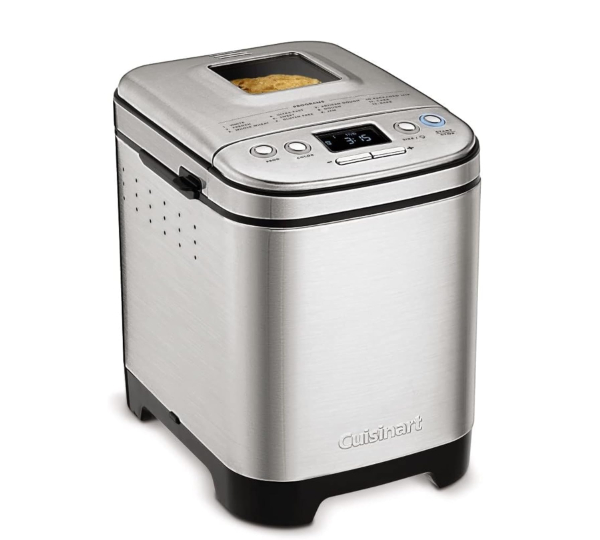
Cuisinart has mastered the "compact" category with the CBK-110. This machine is designed for the modern kitchen, featuring a vertical orientation and a sleek stainless steel finish. It is significantly taller than it is wide, allowing it to sit neatly alongside other appliances. Despite its smaller size, it still produces a standard 2-lb loaf, though the loaf is very tall and square.
For a beginner, the interface is one of the most intuitive on the market. It features a large LCD screen that clearly indicates which stage of the process the machine is in (Knead, Rise, or Bake). This transparency is helpful for those who are curious about the "how" of bread making. It also includes a 13-hour delay start timer, which is technically stable enough to leave overnight for fresh bread in the morning, provided the liquid and dry ingredients are layered correctly to keep the yeast dormant.
The downside of the compact design is that it can "walk" on the countertop. Because the base is narrow and the machine is relatively light, the centrifugal force of kneading a large dough ball can cause it to shift. It is recommended to keep it back from the edge of the counter. Additionally, the viewing window is somewhat small, making it difficult to monitor the dough consistency without opening the lid - which can cause a drop in proofing temperature.
The CBK-110 features an air-gapped stainless steel housing. Why it matters: This creates a thermal buffer that protects the rising dough from cold kitchen drafts, which is a common reason why bread fails to rise in less insulated plastic machines.
Best for Specialty Doughs: Zojirushi Home Bakery Maestro (BB-SSC10)
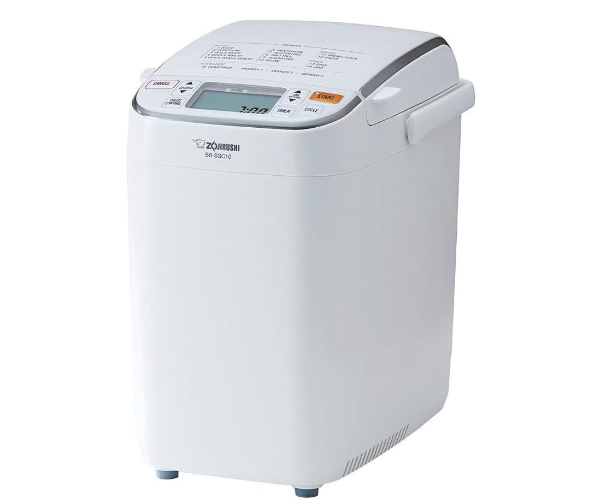
If you live alone or in a two-person household, a 2-lb loaf can often go stale before it is finished. The Zojirushi Maestro is specifically engineered for 1-lb loaves. For a beginner, this is a lower-risk way to bake; if a loaf fails, you have wasted half the ingredients of a larger machine. Despite its smaller size, it carries the high-end sensors and programming found in Zojirushi's larger models.
The Maestro stands out for its "Homemade" setting, which allows you to program custom times for kneading, rising, and baking. While beginners might not use this on day one, it provides a "path to mastery" that other machines lack. It also includes specialized cycles for European-style breads and sourdough starters. The machine utilizes a high-precision internal thermometer to adjust the proofing time based on the ambient room temperature, which is a major technical upgrade over timer-based machines.
The primary trade-off is the price-to-size ratio. You are paying a premium for a smaller machine. However, the build quality is significantly higher than most 1-lb machines, and the vertical pan is designed to prevent "dough climbing," a common issue where the dough wraps around the paddle and doesn't knead properly. It is the best choice for a beginner who values quality over quantity and wants to experiment with non-standard recipes.
The Maestro uses a thermistor to measure room temperature and adjusts the heating cycle. Why it matters: Yeast is highly temperature-sensitive. This sensor prevents the machine from over-proofing in a hot summer kitchen or under-proofing in a cold winter one, ensuring consistent results year-round.
How We Chose These Products
Our selection process focused on thermal stability and kneading efficiency. We evaluated machines based on their ability to maintain a consistent 80?F to 90?F environment for yeast fermentation, regardless of external conditions. We also prioritized machines with accessible manuals and intuitive interfaces, as a beginner's success often depends on following the manufacturer's specific loading order (usually liquids first, then solids, then yeast). Finally, we looked for products with verifiable longevity and manufacturer-backed warranties to ensure the appliance wouldn't end up in a landfill after six months of use.
Comparison Overview
| Model | Loaf Size | Loaf Shape | Key Feature | Best For |
|---|---|---|---|---|
| Zojirushi Virtuoso Plus | 2 lb | Horizontal | Dual Blades + Lid Heater | Pro Results |
| Oster ExpressBake | 2 lb | Vertical | 1-Hour Cycle | Budget-Conscious |
| Hamilton Beach Premium | 2 lb | Vertical | Auto-Dispenser | Mix-in Breads |
| Cuisinart Compact | 2 lb | Vertical | Small Footprint | Modern Kitchens |
| Zojirushi Maestro | 1 lb | Vertical | Custom Programming | Small Households |
Buying Guide: What to Look For
- Loaf Orientation: Horizontal pans produce slices like a store-bought loaf. Vertical pans save counter space but result in "tall" slices that might not fit in all toasters.
- Paddle Type: Look for non-stick paddles. Some machines include a paddle removal tool; this is a sign that the machine is designed with user maintenance in mind.
- Program Variety: Even if you only want to make white bread now, look for "Dough Only" settings. This allows the machine to knead and proof dough that you can then shape and bake in a regular oven (like pizza crust or rolls).
- Acoustics: Bread makers are loud during the knead phase. If you plan to use the "Delay Start" overnight, look for models with heavier housing which dampens vibrations.
General Pro / Cons
| Pros | Cons |
|---|---|
| Automates the physically taxing kneading process. | Vertical loaves can be awkwardly shaped for sandwiches. |
| Provides a controlled proofing environment for consistent rising. | Appliances are generally bulky and require storage space. |
| Significant cost savings compared to artisanal bakery bread. | The kneading paddle leaves a small hole in the bottom of the loaf. |
| Full control over ingredients (important for allergies/dietary needs). | Acoustic noise can be disruptive during the kneading phase. |
| Fresh bread scent and warmth on demand. | Non-stick coatings on pans can wear out over time. |
| Delay timers allow for "wake-up" baking. | Most machines aren't dishwasher safe. |
| Multifunctional (many make jam, cake, or yogurt). | Learning the correct ingredient order is a steep requirement. |
Final Summary
For a beginner, the right bread maker is one that removes the "friction" of failure. The Zojirushi Virtuoso Plus is the most technically advanced and reliable option, though its price reflects that status. For those testing the waters, the Oster ExpressBake provides a powerful motor at a fraction of the cost. Regardless of the choice, moving away from preservative-heavy store bread toward home-baked loaves is a rewarding transition for both health and flavor. Aggregate rating of the products reviewed: 4.54 out of 5.