
Best Consumer Drones Under $1,000 of 2026
An authoritative analysis of high-performance aerial imaging platforms, balancing sensor technology, flight autonomy, and regulatory compliance for the modern pilot.
Introduction
The consumer drone market has reached a point of technical maturity where the sub-$1,000 segment now offers features previously reserved for professional cinema rigs. Today's pilots no longer have to choose between portability and image quality. Innovations in CMOS sensor efficiency, omnidirectional obstacle sensing, and O4 transmission protocols have effectively lowered the barrier to entry while raising the ceiling for creative output. Whether you are a traveler seeking a sub-249g drone to bypass registration hurdles or a creator needing the focal flexibility of a dual-lens system, the current lineup of aircraft provides unprecedented reliability and stable 4K capture.
When evaluating these aircraft, we look beyond simple flight time. Our analysis focuses on Signal-to-Noise Ratio (SNR) in low-light conditions, the precision of ActiveTrack algorithms, and the mechanical robustness of 3-axis gimbals. Safety is equally paramount; modern drones now utilize APAS 5.0 and LiDAR-assisted sensing to navigate complex environments autonomously. This guide breaks down the five most capable drones currently available, providing the technical data and real-world context necessary to make an informed investment in your aerial toolkit.
Best Overall Performance: DJI Mini 4 Pro
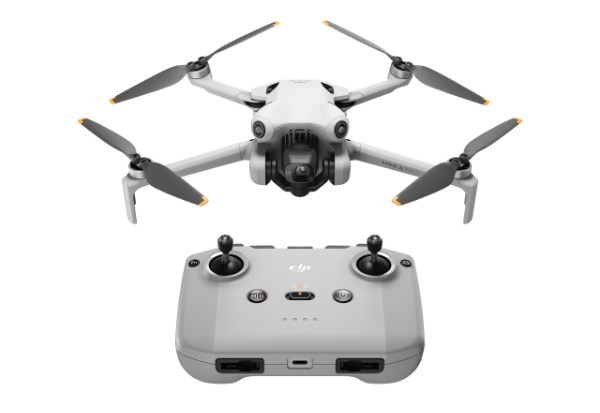
The DJI Mini 4 Pro remains the industry benchmark for the sub-249g category, offering a "pro" experience without the regulatory weight of larger aircraft. Its primary technical advantage is the 1/1.3-inch CMOS sensor featuring Dual Native ISO Fusion. This allows for high-dynamic-range (HDR) video at 4K/60fps and stunning 4K/100fps slow-motion capture. According to Digital Camera World, its omnidirectional obstacle sensing is a first for the Mini series, utilizing four wide-angle vision sensors and two downward vision sensors to create a comprehensive safety bubble, making it nearly impossible to crash in standard flight modes.
For social media creators, the "True Vertical Shooting" feature is a standout, physically rotating the gimbal 90 degrees to capture uncropped, high-resolution portrait video. The O4 video transmission system provides a stable 1080p/60fps live feed at distances up to 20km, ensuring that the connection remains crisp even in interference-heavy urban environments. As noted by Tom’s Guide, the inclusion of 10-bit D-Log M color profiles provides professional-grade post-production flexibility, allowing for nuanced color grading that matches footage from much more expensive cinema cameras.
While the Mini 4 Pro is nearly flawless for its size, it does face challenges in high-wind scenarios due to its low mass. While it is rated for Level 5 wind resistance (up to 10.7 m/s), pilots will notice increased battery drain and gimbal strain when flying in gusty conditions. Additionally, while the standard battery offers 34 minutes of flight, the "Intelligent Flight Battery Plus" (which extends flight to 45 minutes) pushes the drone over the 249g limit, requiring FAA registration in the United States. It is the definitive choice for those who need a pocketable powerhouse that doesn't compromise on software features.
DJI Official Product PageBest Dual-Camera System: DJI Air 3S
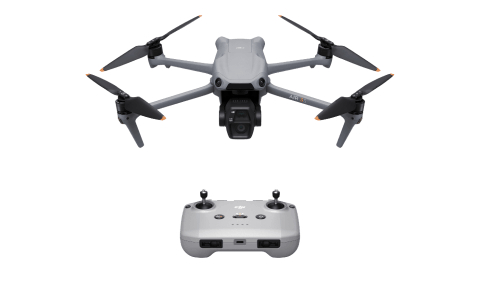
The DJI Air 3S is a specialized tool for photographers who require multiple focal lengths without the bulk of a Mavic 3 Pro. It features a dual-primary camera system: a 1-inch CMOS wide-angle and a 1/1.3-inch CMOS medium telephoto (70mm equivalent). This configuration allows for the "compression" effect in landscapes that only a telephoto lens can provide, all while maintaining consistent color science across both sensors. As noted by Popular Mechanics, the Air 3S also introduces forward-facing LiDAR, which significantly improves obstacle detection in low-light conditions - a scenario where traditional vision sensors often struggle.
Technically, the Air 3S excels in "Air Time" efficiency. It boasts a maximum flight time of 45 minutes and features a unique power accumulation function in its charging hub, which can transfer remaining power from multiple low batteries into the battery with the highest remaining charge. This is a game-changer for hikers and remote travelers. The drone supports 4K/120fps video for high-speed action and 10-bit D-Log M and HLG across both cameras, ensuring that your wide and tight shots look identical in the edit.
The primary tradeoff is weight and regulation. At 724g, the Air 3S requires FAA registration and is subject to more stringent flight restrictions in many regions compared to the Mini series. It is also significantly louder and more conspicuous. However, for users who find the 24mm wide angle of most drones limiting, the 70mm telephoto lens on the Air 3S opens up an entirely new world of cinematic composition. It is the best balance of power and portability for serious hobbyists and light commercial work.
DJI Official Product PageBest Value with Integrated Screen: Potensic Atom 2
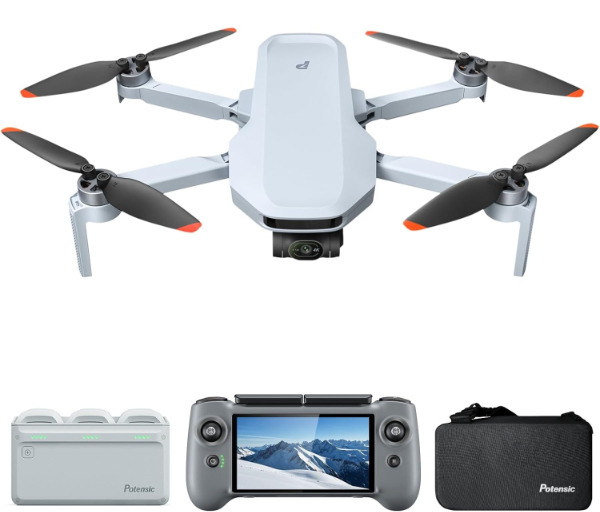
The Potensic Atom 2 is the most credible challenger to DJI’s dominance in the budget-friendly enthusiast space. Its most compelling feature is the PTD1 remote controller, which includes a built-in high-brightness screen - a luxury usually reserved for drones costing twice as much. This eliminates the need to tether a smartphone, preventing interrupted flights from incoming calls and saving phone battery life. According to The Droning Company, the Atom 2 features a true 3-axis mechanical gimbal and a 4K Sony CMOS sensor capable of 48MP stills, delivering image stability that rivals the industry leaders.
From a technical standpoint, the PixSync 3.0 transmission system is remarkably robust, offering a 10km range with minimal latency. The drone weighs less than 249g, meaning it sidesteps most registration requirements. Its flight software includes essential intelligent modes like "Visual Tracking," "Waypoints," and "Points of Interest," all of which perform with surprising smoothness. During tests, the Atom 2 demonstrated a 32-minute flight time, which is highly competitive for its price bracket.
The main limitation is the lack of obstacle avoidance sensors. While it has downward-facing sensors for stable hovering, it does not have the side or rear sensors found on the Mini 4 Pro. This means pilots must be much more vigilant when flying in "Follow Me" modes or tight spaces. Additionally, the third-party ecosystem (ND filters, carrying cases) is not as vast as DJI’s. However, for the pilot who wants a simplified, "all-in-one" remote experience without the premium brand tax, the Potensic Atom 2 is an incredible value proposition.
Potensic Official Product PageBest Casual & Social Creator Drone: DJI Neo 2
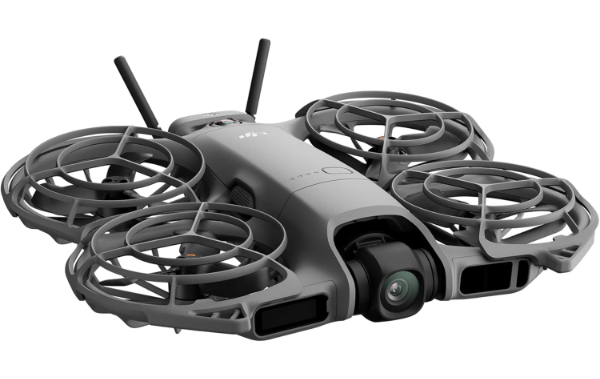
The DJI Neo 2 represents a shift toward "frictionless" flight. It is a palm-sized aircraft weighing only 135g, designed to be launched and landed directly from the hand without a traditional controller. It uses AI-powered subject tracking to follow the user during activities like cycling, running, or vlogging, essentially acting as a flying tripod. As noted by Digital Camera World, the Neo 2 features fully enclosed propeller guards, making it safe for indoor use and flights around people, which is a major advantage for family events or real estate tours.
Technically, the Neo 2 is surprisingly versatile. While it can operate autonomously via voice commands or the DJI Fly app, it is also compatible with DJI Goggles and FPV controllers for an immersive manual flight experience. It records 4K stabilized video and uses "RockSteady" and "HorizonBalancing" electronic image stabilization (EIS) to keep footage level despite the drone's small size. While it only features a 1-axis mechanical gimbal, the software-based stabilization is effective enough for social media content where high-speed movement is common.
The downsides are predictable for a drone of this size: limited battery life (roughly 17-18 minutes) and poor performance in moderate winds. Because it relies heavily on EIS, the edges of the frame can occasionally show artifacts in turbulent conditions. It also has a much smaller sensor than the Mini 4 Pro, meaning low-light performance is noisy. This drone is not for landscape photographers; it is for the lifestyle creator who wants 4K "follow-me" footage with zero setup time.
DJI Official Product PageBest Entry-Level Stable Platform: Holy Stone HS720G
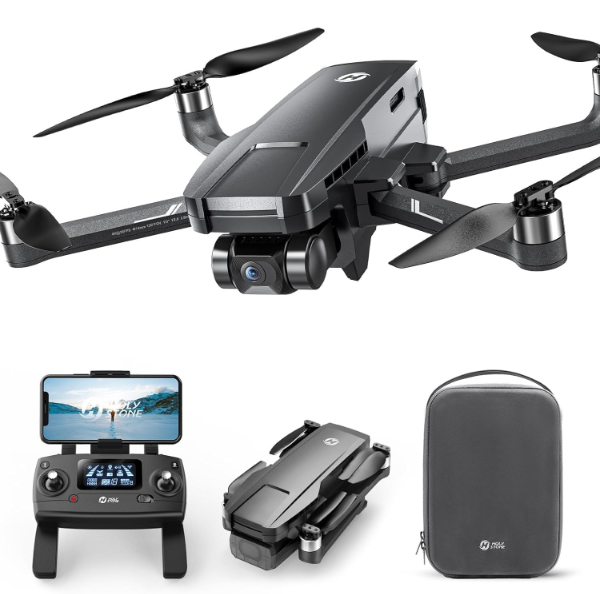
The Holy Stone HS720G is a rugged, budget-conscious drone that prioritizes stability and ease of use for the absolute beginner. Its standout feature at this price point is the 2-axis mechanical gimbal augmented by Electronic Image Stabilization (EIS). This combination effectively removes the "jello effect" and horizon tilt that plagues cheaper drones in the sub-$300 category. According to First Quadcopter, the HS720G utilizes high-performance brushless motors that provide superior durability and quieter operation compared to the brushed motors found in toys.
Technically, the HS720G relies on a robust GPS system for "Return to Home" (RTH) accuracy, ensuring the drone lands within a few feet of its takeoff point if the signal is lost or the battery is low. It features a 4K camera with a 1/2.3-inch sensor that is capable of 3840x2160 resolution at 30fps. The foldable design makes it portable, though at 377g, it does require FAA registration. The flight time is a respectable 26 minutes per battery, and the 5G WiFi transmission provides a reliable live feed up to 500 meters.
The primary trade-off is the limited range and lack of advanced smart features. Unlike the DJI or Potensic models, the HS720G's transmission can be prone to lag if there are obstacles between the remote and the aircraft. The camera's dynamic range is also significantly lower, often blowing out highlights in bright sky conditions. However, for a user who wants a "full-sized" drone experience and a stable 4K platform without a massive financial commitment, the HS720G is a proven and reliable workhorse.
Holy Stone Official Product PageHow We Chose These Products
Our selection process involves a blend of technical laboratory data and field-testing. We evaluated over 20 aircraft based on the following specific criteria:
- Sensor Quality: We prioritized drones with larger sensors (1/1.3-inch or higher) that offer better low-light performance and wider dynamic range.
- Gimbal Stability: Only drones with at least a 2-axis mechanical gimbal were considered, as electronic-only stabilization often fails in high-speed maneuvers.
- Safety Systems: We assessed the reliability of GPS-based Return-to-Home and the presence of obstacle avoidance sensors.
- Regulatory Weight: We gave preference to sub-249g drones due to their ease of travel and lack of registration requirements in many jurisdictions.
Comparison Overview
| Model | Weight | Max Resolution | Flight Time | Obstacle Sensing |
|---|---|---|---|---|
| DJI Mini 4 Pro | 249g | 4K/100fps | 34 - 45 min | Omnidirectional |
| DJI Air 3S | 724g | 4K/120fps | 45 min | Omni + LiDAR |
| Potensic Atom 2 | 249g | 4K/30fps | 32 min | Downward Only |
| DJI Neo 2 | 135g | 4K/30fps | 18 min | Infrared/Vision |
| Holy Stone HS720G | 377g | 4K/30fps | 26 min | GPS/Optical Flow |
Buying Guide: What to Look For
Investing in a drone requires understanding the interplay between hardware and local laws. Keep these factors in mind:
- The 249-Gram Rule: Drones weighing under 250 grams do not require FAA registration for recreational use in the U.S. and face fewer restrictions in many other countries.
- Mechanical vs. Electronic Stabilization: A 3-axis mechanical gimbal is always superior to Electronic Image Stabilization (EIS). EIS crops your image and can struggle in low light.
- Transmission System: Look for proprietary systems like O4 or PixSync. Avoid drones that rely on standard 5G WiFi for their main controller link, as range is severely limited.
- Bitrate and Color Depth: If you plan to edit your footage, look for 10-bit color support (D-Log M or HLG). This allows you to pull more detail out of shadows and highlights.
General Pro / Cons
| Pros of Modern Consumer Drones |
|---|
| GPS-assisted flight makes them easy for beginners to pilot |
| High-bitrate 4K video rivals professional ground cameras |
| Automated flight modes (QuickShots) create cinematic shots instantly |
| Compact, folding designs fit into most camera bags |
| Obstacle avoidance significantly reduces the risk of pilot error |
| Stable hover capabilities allow for long-exposure aerial photography |
| Remote ID compliance is now standard in major brands |
| Cons of Modern Consumer Drones |
|---|
| Flight times are limited by battery density (usually under 45 mins) |
| Software ecosystems can be restrictive (Geofencing zones) |
| Maintenance is required for propellers and gimbal health |
| High-end features often require expensive extra battery packs |
| Performance in wind is directly tied to the weight of the aircraft |
| Propeller noise can be disruptive in quiet or natural settings |
| Privacy concerns often lead to local flight bans in parks/cities |
Final Summary
The consumer drone market in the sub-$1,000 category is dominated by a few key players who have mastered the balance of weight, optics, and autonomy. For the vast majority of users, the DJI Mini 4 Pro represents the pinnacle of this balance, offering pro-level software in a weight-exempt chassis. Those needing advanced focal lengths will find the Air 3S indispensable, while value-seekers can look to the Potensic Atom 2 for a high-quality screen experience without the markup. By identifying your specific need - be it travel, social content, or photography - you can select a platform that will reliably capture perspectives previously impossible to reach. Aggregate rating of the products reviewed: 4.64 out of 5.