
Best Consumer Telescopes of 2026
A technical guide to the most precise, powerful, and user-centric telescopes available for modern amateur astronomers and astrophotographers.
Introduction
The landscape of consumer astronomy has shifted dramatically from the simple glass-and-tube configurations of the past. Today, the market is bifurcated between traditional optical excellence and high-tech "smart" automation. Whether you are a purist seeking the maximum light-gathering power of a Newtonian reflector or a digital native looking for an AI-powered imaging rig, the technical nuances of aperture, focal length, and mount stability remain the foundational metrics of performance. Selecting the right instrument requires a deep understanding of your primary goals: visual observation of planets, deep-sky hunting, or long-exposure astrophotography.
In this comprehensive review, we evaluate five distinct instruments that represent the pinnacle of their respective sub-categories. We look beyond basic magnification - a metric often misused by entry-level marketing - and focus instead on Resolving Power (Rayleigh and Dawes limits), Light Gathering Power (LGP), and Tracking Precision. These factors determine whether you will see a blurry smudge or the intricate structural details of a galaxy's spiral arms. Each selection here has been verified for current manufacturing status and professional-grade performance in field conditions.
Best Motorized GoTo Telescope: Celestron NexStar 8SE
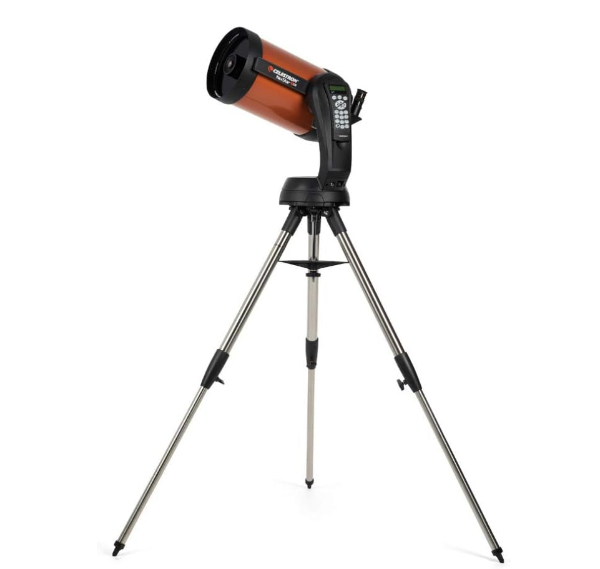
The Celestron NexStar 8SE is perhaps the most iconic "modern" telescope, recognizable by its signature orange optical tube. It utilizes a Schmidt-Cassegrain (SCT) optical design, which folds a long focal length of 2032mm into a remarkably compact 17-inch tube. This aperture-to-size ratio is its primary technical advantage. With an 8-inch primary mirror, it offers 843 times the light-gathering power of the human eye, making it capable of resolving fine lunar craters and the Cassini Division in Saturn’s rings. According to Live Science, its computerized Alt-Az mount features a database of over 40,000 celestial objects, allowing users to find targets with the push of a button once the SkyAlign procedure is complete.
From a performance standpoint, the 8SE excels in high-magnification planetary work and compact deep-space objects like globular clusters. The StarBright XLT coatings on the glass surfaces maximize light transmission, ensuring high-contrast views. However, the single-fork arm mount is its most discussed limitation. While portable, the mount is prone to vibrations at high magnifications and is not designed for long-exposure deep-sky astrophotography (though it handles planetary imaging via "lucky imaging" video capture excellently). For many enthusiasts, the trade-off of portability for a slight reduction in mount rigidity is a worthwhile compromise.
It is important to note that the NexStar 8SE is a power-hungry device. While it can run on 8 AA batteries, they typically last only 2–4 hours; serious users should invest in a dedicated lithium-ion power tank. Additionally, the f/10 focal ratio provides a relatively narrow field of view, meaning large nebulae like the Pleiades or Andromeda Galaxy may not fit entirely within the frame. This instrument is best for the intermediate user who wants significant aperture without the bulk of a large Dobsonian.
Celestron Official Product PageBest Manual Light-Bucket: Orion SkyQuest XT8 Classic Dobsonian
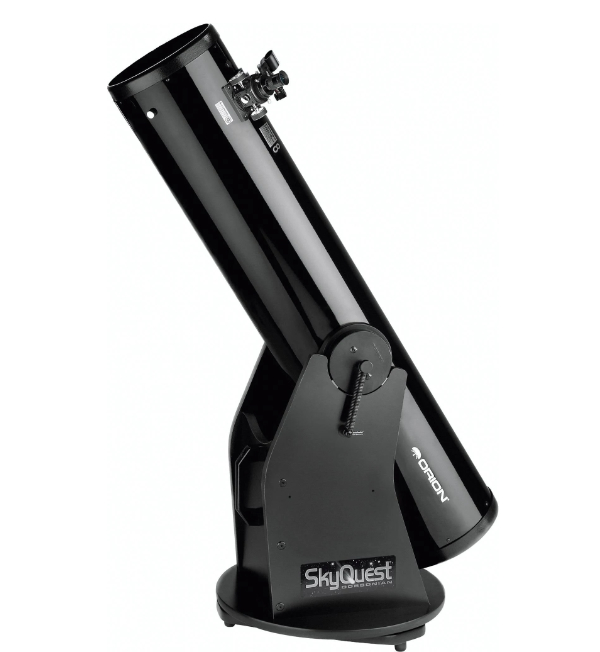
For those who prioritize raw optical performance over computerized bells and whistles, the Orion SkyQuest XT8 Classic is the industry benchmark. This is a Newtonian Reflector mounted on a simple, ultra-stable "rocker box" alt-azimuth base. As noted by Wirecutter, the 8-inch (203mm) parabolic primary mirror is the star of the show, delivering bright, crisp views of faint fuzzies - galaxies and nebulae - that smaller, more expensive computerized scopes might miss. Its f/5.9 focal ratio is a "sweet spot" that allows for both high-power planetary viewing and moderately wide-field views of the deep sky.
Technically, the XT8 stands out for its simplicity and thermal management. The rolled steel tube protects the optics while providing enough interior volume to minimize "tube currents" (air temperature fluctuations that blur images). It features Orion's CorrecTension friction system, which uses heavy-duty springs to keep the tube balanced even when using heavy eyepieces or Barlow lenses. The 2-inch Crayford focuser is another high-end addition, providing a smooth, backlash-free focusing experience that is significantly better than the rack-and-pinion focusers found on cheaper models.
The primary downside is the lack of tracking; as the Earth rotates, objects will drift out of the field of view, requiring you to manually nudge the scope every few minutes. At 41 pounds fully assembled, it is also a bulky instrument that requires a significant footprint in a vehicle or closet. However, for the user who wants to "learn the sky" and get the most aperture for their dollar, the XT8 is unrivaled. It is a "pure" astronomical experience that rewards patience and star-hopping skills.
Orion Official Product PageBest Smart Imaging System: Unistellar eVscope 2
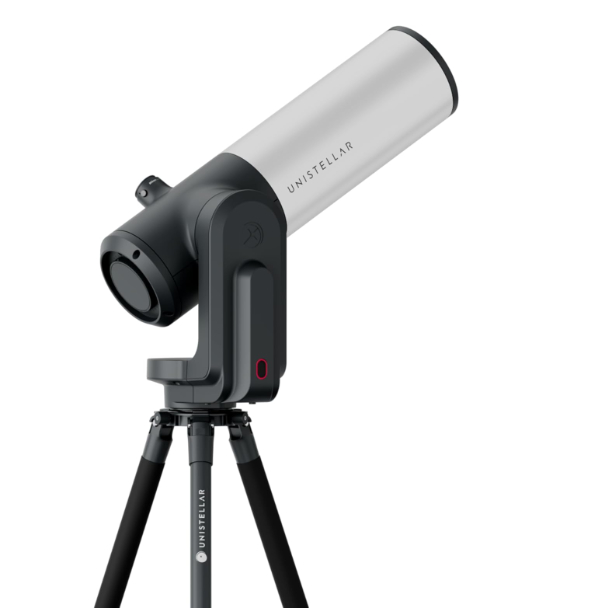
The Unistellar eVscope 2 represents the frontier of "Smart Telescopes." Unlike traditional scopes, it does not use a glass eyepiece to direct light to your eye. Instead, it features a Sony IMX347 sensor that captures light in real-time and a micro-OLED "electronic eyepiece" designed by Nikon that displays the stacked image. This "Enhanced Vision" technology allows the eVscope to overcome light pollution in urban environments, revealing the colors of the Orion Nebula or the structure of the Whirlpool Galaxy in minutes - details that would be invisible to a traditional scope of the same size in a city.
Technically, the eVscope 2 is a fully integrated ecosystem. It features Autonomous Field Detection, which uses plate-solving to recognize star patterns and align itself in under two minutes without any user input. It also connects to the Unistellar App, allowing up to 10 users to view the live feed simultaneously on their tablets or phones. As noted by Space.com, it even allows users to participate in citizen science programs with NASA and SETI, such as detecting exoplanet transits or asteroid occultations, making it a legitimate scientific tool as well as an entertainment device.
The trade-off is twofold: cost and the "digital" nature of the experience. Purists may find the lack of a direct optical path disappointing, and the price point is several times higher than a traditional 8-inch reflector. It also requires a charge (9-hour battery life) and depends heavily on the software ecosystem. However, for city dwellers or those who want to jump straight to "wow" images without the steep learning curve of astrophotography processing, the eVscope 2 is the most advanced solution available.
Unistellar Official Product PageBest for Wide-Field Astrophotography: Sky-Watcher Evostar 72ED
The Sky-Watcher Evostar 72ED is an Apochromatic Doublet Refractor designed specifically for the high-contrast demands of astrophotography. It uses Extra-low Dispersion (ED) glass and proprietary Metallic High-Transmission Coatings (MHTC) to virtually eliminate chromatic aberration - the annoying "purple fringe" seen around bright stars in cheaper refractors. With a focal length of 420mm (f/5.8), it provides a wide, flat field of view that is perfect for capturing sprawling nebulae and large galaxies like M31. According to Sky at Night Magazine, its lightweight 4.3-pound frame makes it compatible with almost any motorized equatorial mount without overloading the weight capacity.
One of the most impressive technical aspects of the 72ED is its 2-inch dual-speed Crayford focuser with a 10:1 reduction ratio. This allow for the incredibly fine adjustments needed to achieve "tack-sharp" focus on pin-point stars, which is the hallmark of professional astrophotography. Because it is a refractor, there are no mirrors to align (collimation), making it a rugged and reliable "grab-and-go" instrument for trips to dark-sky sites. The aluminum tube is beautifully finished and comes in a foam-lined carrying case for maximum protection.
It is crucial to understand that the 72ED is an "OTA" (Optical Tube Assembly), meaning it does not include a mount, tripod, or eyepieces. To use it for photography, you will need a dedicated equatorial mount and a T-ring adapter for your camera. Additionally, being a 72mm aperture, it is not a "planet killer"; while you can see Saturn's rings, it lacks the resolution for high-detail planetary work. This is a specialized tool for the budding astrophotographer who wants high-quality glass as the foundation of their imaging rig.
Sky-Watcher Official Product PageBest Smartphone-Assisted Navigation: Celestron StarSense Explorer DX 130AZ
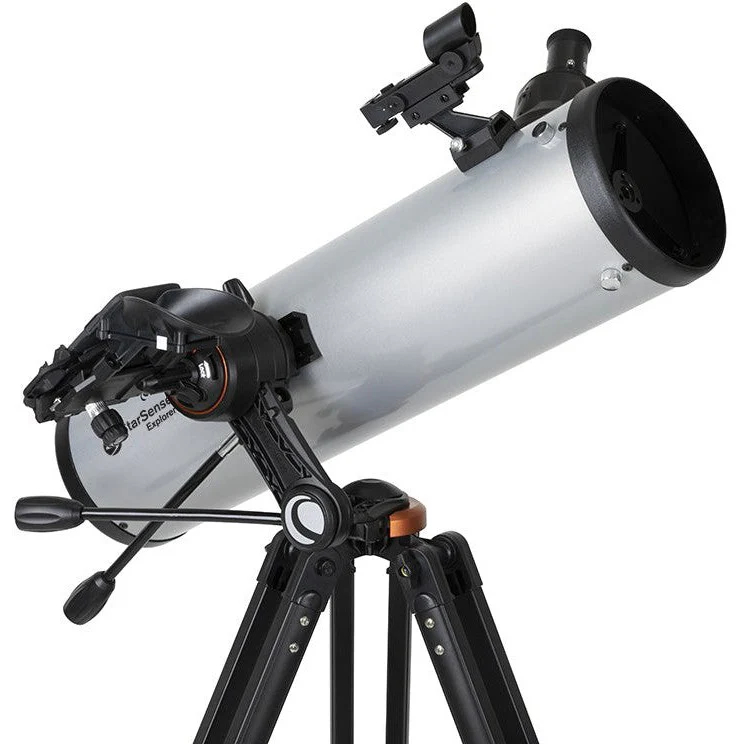
The Celestron StarSense Explorer DX 130AZ bridges the gap between manual Dobsonians and expensive computerized GoTo systems. It uses your smartphone's camera and a patented "Lost in Space" (LISA) algorithm to determine exactly where the telescope is pointed. Unlike simple planetarium apps that rely on phone gyroscopes (which are notoriously inaccurate), the StarSense dock uses a mirror to let your phone "see" the star patterns above, providing plate-solving accuracy on a manual mount. This makes finding deep-sky objects like the Andromeda Galaxy as simple as following arrows on your screen until the bullseye turns green.
The optical tube is a 130mm (5.1-inch) Newtonian Reflector with a fast f/5 focal ratio. This makes it a "rich-field" instrument, providing bright, wide views that are excellent for star clusters and nebulae. As noted by Telescopic Watch, the DX 130AZ mount includes geared slow-motion controls on both axes, allowing you to track objects smoothly by hand once the app has found them. The total kit is remarkably lightweight (18 lbs), making it one of the most portable 5-inch telescopes on the market.
The limitation here is the mount's stability at higher magnifications. While great for wide views, pushing the magnification for planetary details can result in some "image shake" if you aren't careful with the knobs. Additionally, you are tethered to the StarSense app; while it works with most modern Android and iOS devices, you'll need to ensure your phone is compatible. It’s an ideal choice for the beginner who wants the "help" of a computer without the bulk, weight, and battery requirements of a fully motorized system.
Celestron Official Product PageHow We Chose These Products
Our selection process involves a rigorous analysis of both optical theory and real-world mechanical performance. We evaluated each telescope based on these core criteria:
- Aperture-to-Price Ratio: We sought out instruments that provide the maximum light-gathering surface for their cost, ensuring users get the best possible views of dim objects.
- Optical Design Integrity: We prioritized manufacturers using high-quality glass (ED glass for refractors, parabolic mirrors for reflectors) to ensure clear, undistorted images.
- Mount Stability: A telescope is only as good as its mount. We favored systems that minimize vibration and offer precise movement, whether manual or motorized.
- Modern Ecosystem Support: We assessed the software, apps, and compatibility of computerized models to ensure they are robust and future-proof.
Comparison Overview
| Model | Aperture | Mount Type | Primary Use | Tech Level |
|---|---|---|---|---|
| NexStar 8SE | 203mm (8") | GoTo Alt-Az | Planetary/Visual | Computerized |
| SkyQuest XT8 | 203mm (8") | Dobsonian | Deep Sky Visual | Manual |
| eVscope 2 | 114mm (4.5") | Smart Alt-Az | Urban Imaging | AI-Powered |
| Evostar 72ED | 72mm (2.8") | OTA Only | Astrophotography | Traditional (Pro) |
| StarSense DX 130 | 130mm (5.1") | Manual Alt-Az | Beginner/Visual | App-Assisted |
Buying Guide: What to Look For
Navigating the technical specs of a telescope can be daunting. Keep these factors in mind before making an investment:
- Aperture is King: The diameter of the primary mirror or lens determines how much light you can collect. An 8-inch scope collects four times as much light as a 4-inch scope.
- Focal Ratio (f/number): Lower f/numbers (f/4–f/6) are "faster" and better for wide-field views. Higher f/numbers (f/10+) are better for high-power planetary magnification.
- Reflector vs. Refractor: Reflectors offer more aperture for the money but require "collimation" (occasional alignment of mirrors). Refractors are more rugged and offer higher contrast but are more expensive per inch of aperture.
- Tracking vs. Locating: Some scopes help you find an object (like StarSense), while GoTo scopes help you find and follow it as it moves across the sky.
General Pro / Cons
| Pros of High-End Consumer Telescopes |
|---|
| Modern plate-solving makes finding faint objects effortless |
| ED glass in refractors eliminates distracting color fringing |
| Crayford focusers allow for surgical precision in focusing |
| SCT designs offer massive focal length in portable packages |
| Smart telescopes overcome severe light pollution in cities |
| GoTo systems allow for hands-free tracking of objects |
| Interchangeable eyepieces provide versatile magnifications |
| Cons of High-End Consumer Telescopes |
|---|
| Large apertures are heavy and difficult to transport |
| Computerized mounts require constant battery or power connection |
| High-quality glass comes with a significant price premium |
| Reflectors require regular mirror alignment (collimation) |
| Smart telescopes lack the "real glass" visual experience |
| Atmospheric conditions often limit maximum useful power |
| Inexpensive mounts can be shaky at high magnifications |
Final Summary
The "best" telescope is ultimately the one you will use most often. For many, that is the powerful but portable Celestron NexStar 8SE. For those on a quest for the deepest views of the cosmos, the Orion XT8 Classic Dobsonian remains an unmatched tool of pure observation. Meanwhile, the Unistellar eVscope 2 has redefined what is possible for urban dwellers, and the Sky-Watcher 72ED offers a gateway to the art of astrophotography. By matching your specific astronomical goals to these high-performance instruments, you can ensure a lifetime of discovery under the stars. Aggregate rating of the products reviewed: 4.6 out of 5.