
Best Dash Cameras of 2026
A technical evaluation of high-bitrate optical sensors, Sony STARVIS 2 integration, and intelligent loop-recording architectures for vehicular security.
Introduction
The transition of dash camera technology from simple VGA recording to 4K Ultra-High Definition (UHD) has been driven by advancements in CMOS sensor sensitivity and H.265 (HEVC) compression efficiency. Modern vehicular recording systems are no longer merely passive witnesses; they are sophisticated imaging platforms capable of resolving license plate alphanumeric characters at high relative velocities and in low-light environments. The primary differentiator in current flagship models is the integration of back-illuminated pixel technology, specifically the Sony STARVIS 2 series, which offers a significantly expanded dynamic range and improved signal-to-noise ratio over previous generations.
When evaluating a recording solution, technical considerations must extend beyond raw resolution. Thermal management is paramount, as cameras mounted to windshields are subject to extreme solar radiation; hence, the industry shift toward supercapacitors over lithium-ion batteries for increased safety and longevity. Furthermore, the bitrate of the recorded stream - often overlooked in favor of resolution - dictates the level of fine detail preserved during rapid movement. This guide focuses on units that balance these engineering requirements with reliable firmware and verifiable manufacturer support.
Best Triple-Channel Performance: Vantrue N4 Pro
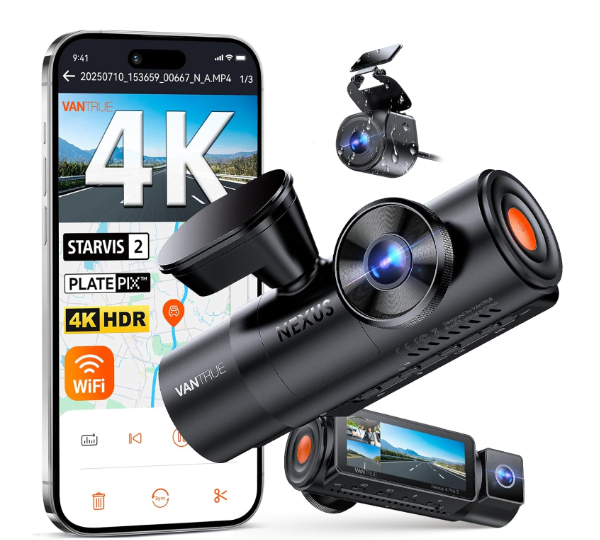
The Vantrue N4 Pro is a flagship 3-channel system designed for total vehicular coverage, recording the front, cabin, and rear simultaneously. The front-facing unit utilizes the Sony STARVIS 2 IMX678 sensor, which is currently the gold standard for 4K dash camera imaging. By employing a larger 1/1.8'' sensor size, the N4 Pro captures significantly more light than standard 1/2.8'' sensors, allowing for "ClearVue" night vision that maintains legibility even when headlights cause glare on reflective surfaces. The interior camera includes infrared LEDs, ensuring the cabin remains visible in total darkness, a critical feature for rideshare professionals.
Technically, the N4 Pro stands out for its voice control integration and 5GHz Wi-Fi support. The higher frequency Wi-Fi band allows for data transfer speeds up to 4 times faster than standard 2.4GHz connections, making the process of downloading large 4K files to a smartphone far less cumbersome. The unit also supports up to a 512GB microSD card, necessary for managing the high data throughput of three concurrent video streams without excessive overwrite cycles. Its supercapacitor power supply ensures it can withstand high-temperature climates without the risk of battery swelling or failure.
Limitations include the substantial power draw required to run three high-resolution sensors and a powerful processor. Users intending to use the 24/7 buffered parking mode will absolutely require a dedicated hardwire kit with voltage cutoff to prevent draining the vehicle's battery. Additionally, the physical footprint of the front unit is larger than some competitors due to the secondary cabin-facing lens, which may slightly impede the driver's field of vision if not mounted carefully behind the rearview mirror.
The IMX678 sensor utilizes Clear HDR technology, which captures two different exposures for every frame and merges them in real-time. This prevents the "motion blur" often associated with traditional HDR dash cams, ensuring that moving license plates remain sharp even in high-contrast lighting scenarios.
Best Image Quality Clarity: VIOFO A229 Pro
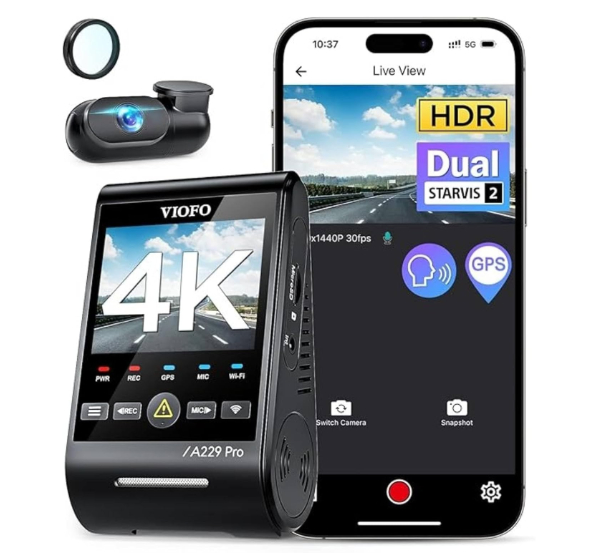
The VIOFO A229 Pro is an imaging-centric dual-channel system that prioritizes resolution on both ends of the vehicle. While many dual-channel systems downgrade the rear camera to 1080p, the A229 Pro utilizes a Sony STARVIS 2 IMX678 for the front (4K) and a Sony STARVIS 2 IMX675 for the rear (2K). This configuration is unique as it brings HDR capabilities to both the front and rear streams, ensuring that trailing vehicles with high-beam headlights do not wash out the rear footage. The inclusion of a Circular Polarizing Lens (CPL) filter as standard effectively minimizes dashboard reflections on the windshield.
One of the A229 Pro's most technically impressive features is its quad-mode GPS module, which supports GPS, BeiDou, GLONASS, and Galileo. This ensures incredibly fast satellite acquisition and highly accurate speed and location logging, even in "urban canyons" with significant skyscraper interference. The user interface is displayed on a 2.4-inch HD screen, providing immediate feedback on camera alignment and status. VIOFO's firmware is frequently updated, often introducing optimizations for bitrate and sensor tuning based on community feedback.
Tradeoffs involve the thickness of the rear camera cable; because it carries a 2K signal, the coaxial cable is thicker and less flexible than standard USB-style cables, which can complicate routing through tight interior trim or weather stripping. While the build quality is functional, it lacks the premium metallic feel of some luxury brands. It is best suited for tech-savvy drivers who prioritize raw data quality and technical accuracy over sleek aesthetics.
Digital Overlap HDR allows the IMX678 to output long and short exposure data in a single line, rather than sequential frames. This reduces the latency between exposures, virtually eliminating ghosting artifacts on fast-moving objects, which is essential for capturing license plates at highway speeds.
Best Cloud Connectivity: BlackVue DR970X Plus
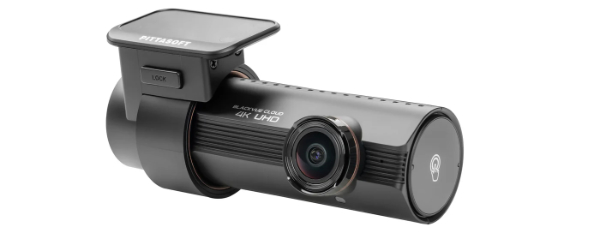
The BlackVue DR970X Plus is a high-performance 4K dash camera tailored for users requiring constant remote connectivity. Unlike many dash cams that function primarily as standalone recorders, BlackVue has engineered an entire "Cloud" ecosystem that allows for remote Live View, push notifications for impact events, and automatic video backup to a remote server. The "Plus" iteration improves on previous models by increasing the bitrate and introducing a new image signal processor (ISP) that significantly improves color accuracy and edge sharpness in the 4K stream.
The DR970X Plus is technically distinct due to its built-in LTE connectivity options (via an optional external module) and its extremely slim, cylindrical design. This form factor is more discrete than traditional wedge-shaped cameras, as it lacks a screen, relying instead on a highly refined mobile app. It also features "Seamless Pairing," which uses Bluetooth to simplify the initial Wi-Fi handshake, avoiding the connectivity issues common with other cameras. The unit includes an integrated voltage monitor, meaning it can be hardwired directly to the fuse box without requiring an external cutoff device.
The honest downside is the cost of entry and the ecosystem lock-in. To unlock the full potential of the Cloud features, a subscription plan is typically required, and the high-bitrate 4K files can quickly consume cellular data if remote viewing is used frequently. Furthermore, because it lacks an onboard screen, all configuration must be done via the app, which could be a limitation for users who prefer physical controls. It is best for luxury vehicle owners or fleet managers who prioritize remote security and discrete installation.
BlackVue’s Cloud systems utilize a "pre-roll" buffer. When an impact is detected, the camera doesn't just start recording; it captures the 10-15 seconds of video stored in its RAM before the impact occurred. This ensures the cause of the event is documented, not just the aftermath.
Best Compact Footprint: Garmin Dash Cam 67W
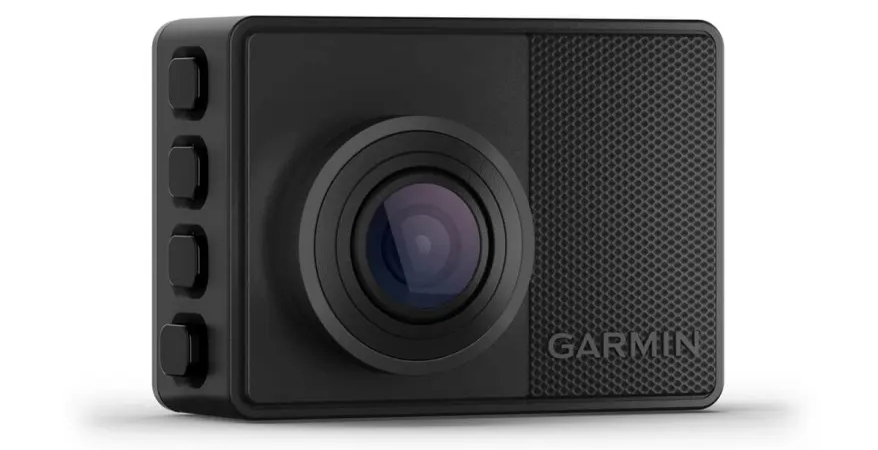
The Garmin Dash Cam 67W is an ultra-compact unit that emphasizes field of view (FOV) and driver assistance features. At approximately the size of a matchbox, it is one of the least intrusive cameras on the market. Despite its diminutive size, it records in 1440p (2K) and features an expansive 180-degree wide-angle lens. This broad FOV is particularly useful for capturing cross-traffic at intersections and pedestrian activity on sidewalks, which can be missed by cameras with a more traditional 140-degree lens.
Garmin integrates several driver awareness features, such as Forward Collision Warnings, Lane Departure Warnings, and "Go" alerts when stopped traffic begins to move. While these are common in new vehicles, the 67W allows older vehicles to gain these safety protocols. The camera also supports the "Garmin Dash Cam Auto Sync" feature, allowing up to four Garmin cameras to be networked together; the app then automatically combines the footage to create a synchronized multi-view video of an incident.
The primary technical limitation is the optical distortion inherent in a 180-degree lens. While it captures a wider scene, objects directly in front of the vehicle will appear further away than they are, and there is significant "fisheye" curving at the edges of the frame. Additionally, the 1440p resolution, while crisp, does not offer the same license-plate-resolving power as the 4K sensors found in the Vantrue or BlackVue models, especially at a distance. It is ideal for drivers who want a discrete, "set-it-and-forget-it" device with additional safety warnings.
To combat the fisheye effect of the 180-degree lens, Garmin uses digital de-warping algorithms. However, this process involves stretching pixels at the periphery, which can reduce effective resolution at the edges compared to the center of the image.
Best High-Resolution Value: 70mai Dash Cam A810
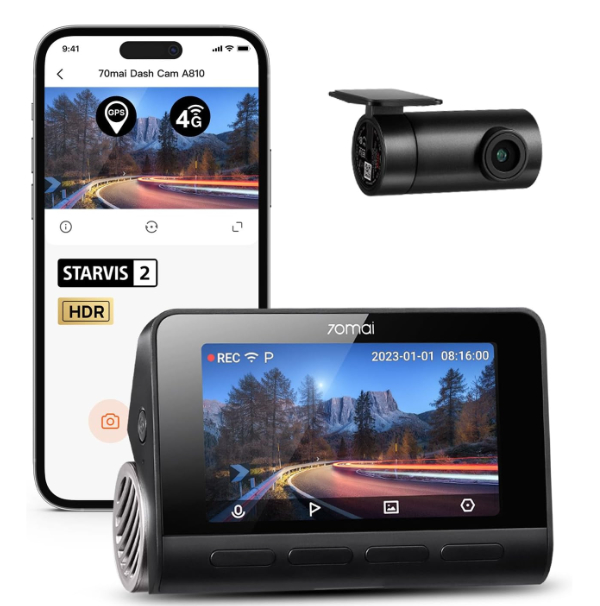
The 70mai A810 is a highly competitive 4K dash camera that brings the Sony STARVIS 2 IMX678 sensor to a more accessible price point. 70mai (a part of the Xiaomi ecosystem) has focused on maximizing the technical throughput of the sensor by pairing it with a powerful chipset capable of 60FPS recording in 1080p or 30FPS in 4K. This frame rate flexibility is important for those who prefer smoother video over raw pixel count. The A810 also introduces an AI-based motion detection algorithm for its parking mode, which significantly reduces "false positives" caused by swaying trees or shadows, focusing instead on human or vehicular movement.
The A810 features an integrated 3-inch IPS screen, which is larger than most in this category, making on-device playback and menu navigation much easier. It also supports ADAS (Advanced Driver Assistance Systems) similar to the Garmin, including lane departure and pedestrian collision warnings. The camera utilizes a supercapacitor design for thermal resilience and includes a built-in GPS for speed and coordinate logging. The companion app is surprisingly robust, offering a "Cyberpunk" data overlay option that visualizes G-forces and velocity data on shared video clips.
One notable limitation is the app's regional ecosystem restrictions and occasional translation quirks in the firmware. While the hardware is top-tier, the software experience can feel slightly less polished than Garmin or BlackVue. Additionally, the standard mounting solution uses an adhesive static sticker rather than a magnetic or suction mount, making it difficult to move the camera between vehicles. It is the perfect choice for users who want flagship 4K image quality without paying a premium for cloud features.
The A810 utilizes an aluminum heat sink and a ventilated housing design to manage the thermal output of the IMX678 sensor. High-resolution sensors generate significant heat during sustained 4K recording; without efficient dissipation, the camera would downclock its processor, leading to dropped frames or system resets.
How We Chose These Products
Our selection process for these dash cameras involved a multi-stage technical audit. First, we filtered for units utilizing supercapacitors rather than batteries to ensure long-term thermal safety. Second, we prioritized Sony STARVIS 2 sensors due to their superior performance in high-contrast and low-light environments. Third, we evaluated firmware stability and the ease of video retrieval via Wi-Fi or physical storage. Each unit was selected to represent a specific use case - ranging from total coverage (Vantrue) to discrete size (Garmin) and remote connectivity (BlackVue).
Comparison Overview
| Model | Max Resolution | Sensor | Channels | Power Source |
|---|---|---|---|---|
| Vantrue N4 Pro | 4K + 1080p + 1080p | Sony STARVIS 2 IMX678 | 3 (Front/Cabin/Rear) | Supercapacitor |
| VIOFO A229 Pro | 4K + 2K | Sony STARVIS 2 IMX678 | 2 (Front/Rear) | Supercapacitor |
| BlackVue DR970X Plus | 4K + 1080p | BlackVue Optimized 4K | 2 (Front/Rear) | Supercapacitor |
| Garmin 67W | 1440p | Proprietary | 1 (Front) | Supercapacitor |
| 70mai A810 | 4K + 1080p | Sony STARVIS 2 IMX678 | 2 (Front/Rear) | Supercapacitor |
Buying Guide: What to Look For
- Sensor Generation: Always check for the Sony STARVIS 2 designation. It provides twice the dynamic range of the original STARVIS sensors, making it much more likely to capture license plates at night.
- Channel Configuration: Consider if you need internal monitoring (rideshare) or just front/rear coverage. Triple-channel systems are comprehensive but require complex wiring and high-capacity storage.
- Storage Requirements: 4K dash cams require high-end, High Endurance microSD cards (Class 10, U3, V30). Standard cards will fail under the constant write pressure of high-bitrate streams.
- Hardwiring for Parking Mode: If you want the camera to record while the car is off, you must hardwire the unit to the fuse box. Look for kits with adjustable voltage cutoffs to protect your car battery.
- Mounting Types: Adhesive mounts are more stable and vibrate less, while suction mounts are better for rental car users. Magnetic mounts (found on some Vantrue models) offer the best of both worlds.
General Pro / Cons
| Category Strengths |
|---|
| Irrefutable evidence for insurance claims and legal disputes. |
| STARVIS 2 sensors provide superior low-light plate legibility. |
| Supercapacitors ensure safety in high-heat environments. |
| 5GHz Wi-Fi enables rapid file transfer to mobile devices. |
| Loop recording prevents data loss by managing storage automatically. |
| G-sensors lock footage during impacts to prevent deletion. |
| GPS logging adds vital context like speed and exact coordinates. |
| Cloud connectivity offers remote vehicle monitoring and alerts. |
| Category Limitations |
|---|
| High-end 4K units generate substantial internal heat. |
| Parking modes can drain vehicle batteries without voltage cutoffs. |
| High-bitrate files require expensive High-Endurance microSD cards. |
| Rear camera installation often requires complex cable routing. |
| Privacy concerns regarding audio recording in the cabin. |
| Wide-angle lenses can cause distance distortion (fisheye). |
| Cloud features often require a monthly subscription fee. |
| Firmware updates can sometimes be difficult via mobile apps. |
Final Summary
The dash camera market has matured into a landscape where optical quality and reliability are the primary metrics of success. The Vantrue N4 Pro and VIOFO A229 Pro lead the industry in raw image clarity through their use of Sony's latest STARVIS 2 sensors. For those requiring a connected, discrete solution, the BlackVue DR970X Plus remains the gold standard for cloud-integrated security. Meanwhile, the Garmin 67W and 70mai A810 offer specialized value in compact design and high-resolution accessibility, respectively. Regardless of the choice, these devices represent a critical investment in vehicular safety and legal protection. Aggregate rating of the products reviewed: 4.6 out of 5.