
Best Dog Training Aids of 2026
A technical analysis of high-performance tools designed to enhance canine communication, refine behavioral responses, and foster a balanced training environment through precision engineering and behavioral science.
Introduction
Modern dog training is an intricate intersection of behavioral psychology and mechanical precision. Selecting the right training aid is not merely about convenience; it is about establishing a clear, consistent dialogue between the handler and the canine. Whether utilizing operant conditioning through positive reinforcement or employing balanced methods for off-leash reliability, the hardware used must offer repeatable performance and durable construction. A high-quality training tool acts as a bridge, reducing the "noise" in communication and allowing for faster acquisition of complex tasks.
Technical considerations for these products range from the tactile response of a marking device to the radio frequency stability of remote trainers. In this analysis, we evaluate tools based on their ergonomic design, signal reliability, and the physiological impact on the dog. According to resources like the Starmark Academy and major veterinary behaviorists, the efficacy of any tool is maximized when its mechanical limitations are understood. For instance, a harness that provides mechanical advantage for pulling management must be balanced with training that addresses the underlying drive. Our selection focuses on products that provide the highest degree of feedback accuracy, ensuring that every interaction is meaningful and every correction or reward is perfectly timed.
The following guide breaks down five essential categories of training aids: remote communication systems, automated reward dispensers, place-training platforms, mechanical control harnesses, and precision acoustic markers. Each product has been vetted for its build quality, manufacturer support, and real-world performance in professional and domestic environments.
Best for Long-Range Communication: Dogtra 1900S Remote Trainer
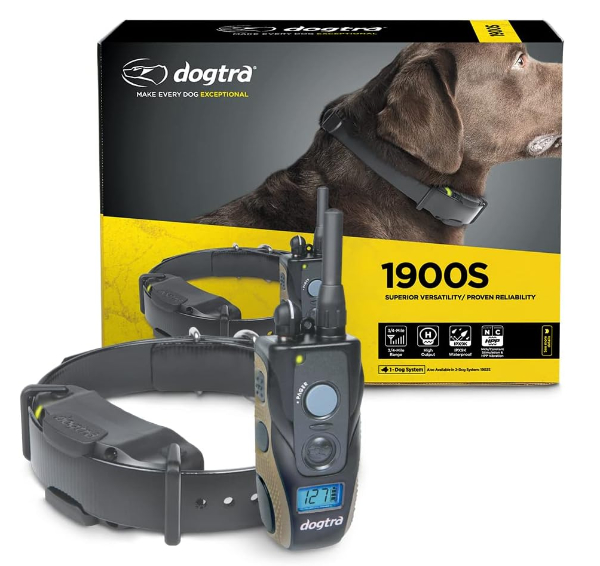
The Dogtra 1900S is widely regarded as the "workhorse" of the professional dog training industry. Designed for dogs 35 pounds and up, it features a slim, ergonomic receiver that curves around the dog's neck, minimizing the bulky profile common in older e-collar designs. This high-output system provides a 3/4-mile range, utilizing advanced RF technology to maintain signal integrity even in dense cover or rolling terrain. The transmitter features a patented Rheostat dial that allows for 127 levels of precise stimulation, ensuring the handler can find the exact "working level" for any individual dog's temperament.
Technically, the 1900S excels in its versatility of feedback modes. It offers "Nick" (a single, split-second pulse), "Constant" (up to 12 seconds of continuous stimulation), and a "High-Performance Pager" (vibration only). The vibration mode is particularly useful for sensitive dogs or as a "pre-warning" signal. As noted by Leerburg training experts, the IPX9K waterproof rating is the highest in the industry, meaning the unit can withstand high-pressure water jets from close range, making it virtually indestructible during water retrieves or in torrential rain. The rapid-charge Lithium Polymer batteries reach full capacity in just two hours, ensuring the tool is ready for multi-day field sessions.
While the 1900S is a formidable tool, its primary limitation is the requirement for handler education. It is a high-output unit capable of significant correction, and without proper understanding of low-level "pressure-on, pressure-off" techniques, it can be misused. Furthermore, the system is designed for a single dog and is not expandable; users needing to manage two dogs simultaneously should look toward the 1902S variant. There are no ongoing subscription fees, making this a one-time investment in hardware that typically lasts for years of rigorous use.
Dogtra Official Product PageBest for Remote Positive Reinforcement: PetSafe Treat & Train Remote Reward Dog Trainer
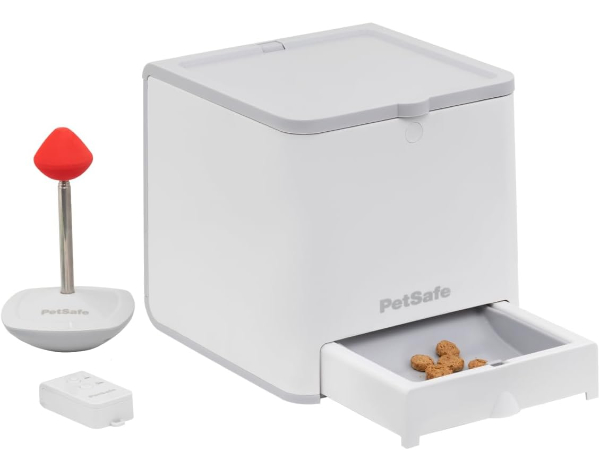
The PetSafe Treat & Train (formerly known as the MannersMinder) is a specialized remote-controlled treat dispenser designed by veterinary behaviorist Dr. Sophia Yin. It is engineered to facilitate positive reinforcement training from a distance, which is critical for solving behaviors like jumping at the door, begging at the table, or separation anxiety. The base unit uses a motorized carousel to dispense kibble or small treats, triggered by a handheld remote that works from up to 100 feet away. This tool allows the handler to reward a dog for "staying" or "settling" even while the human is in another room or moving away, effectively decoupling the reward from the handler's physical presence.
From a technical standpoint, the Treat & Train offers two main operating modes: Remote and Automatic. In automatic mode, the device can be programmed to dispense treats at variable or fixed intervals, which is an essential protocol for "shaping" calm behavior over long durations. The package includes an extendable target wand with a weighted base, allowing for the teaching of complex "go to" commands and agility maneuvers. According to PetSafe's technical documentation, the unit comes with two different-sized treat disks to accommodate various kibble shapes, ensuring reliable dispensing without jams—a common failure point in cheaper competitive models.
Limitations include the unit's reliance on 4 D-cell batteries, which can be a significant recurring cost if the device is used daily for long sessions. The motor emits a distinct mechanical sound; while this often becomes a "secondary reinforcer" (like a clicker), it may initially startle sound-sensitive dogs. Additionally, the unit is fairly bulky, making it better suited for home use than field training. However, for indoor behavior modification and precision "place" training, it remains the most scientifically grounded electronic aid available.
PetSafe Official Product PageBest for Boundary Training: Blue-9 KLIMB Dog Training Platform
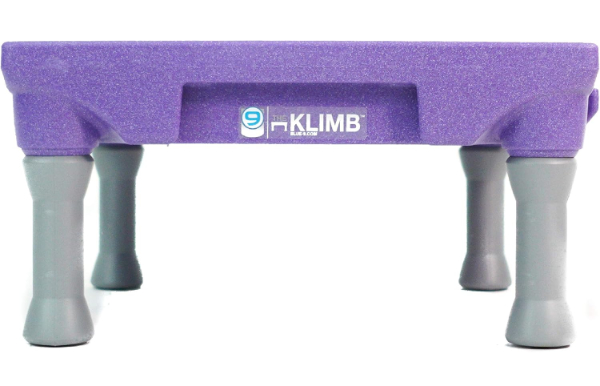
The Blue-9 KLIMB is a professional-grade elevated platform that serves as a dedicated "focus zone" for training. By elevating the dog 12 inches off the ground, the KLIMB utilizes the canine's natural instinct to stay on a defined surface, which significantly improves impulse control and concentration. This tool is the gold standard for "place" training, where a dog is taught to remain in a specific spot regardless of distractions like the doorbell or passing guests. The platform is constructed from a high-density, UV-stabilized molded poly-plastic, designed to support up to 500 pounds, making it suitable for even the largest breeds.
Technically, the KLIMB's standout feature is its proprietary PawGrip surface. This rubberized texture ensures the dog has confident footing even during high-energy "send-outs" or fitness exercises. The legs are removable and screw into the base for easy storage or transport; they also feature non-marring feet to protect hardwood floors. As noted in canine fitness studies, using an elevated platform like the KLIMB enhances a dog's proprioception (awareness of their body in space), making it a dual-purpose tool for both behavioral training and physical conditioning. Multiple units can also be stacked or connected to create larger surfaces or agility courses.
While the KLIMB is essentially a piece of molded plastic, its price reflects its durability and the engineering behind its stability. It does not wobble, which is critical; a wobbly surface will cause a dog to lose confidence and avoid the training aid. The primary downside is its footprint; at 24 by 24 inches, it takes up considerable space in a small apartment. However, for serious trainers looking to establish a clear boundary for their dog, the KLIMB offers a level of permanence and professional utility that a simple dog bed cannot match.
Blue-9 Official Product PageBest for Pulling Management: PetSafe Easy Walk No-Pull Harness
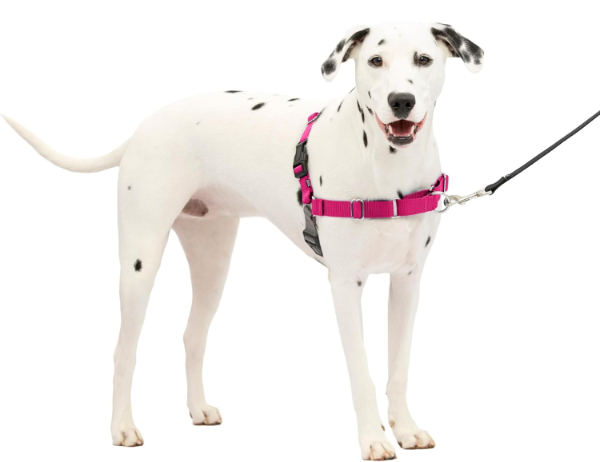
The PetSafe Easy Walk Harness is a mechanical aid designed to stop leash pulling by redirecting the dog's forward momentum. Unlike traditional harnesses that clip on the back—which often triggers the "opposition reflex" and encourages a dog to pull harder—the Easy Walk features a front-chest leash attachment. When the dog pulls, the harness gently steers them toward the handler, effectively neutralizing the pulling behavior without causing the choking or gagging associated with standard collars. This makes it an ideal tool for pet owners who need immediate management of a strong puller while working on long-term loose-leash training.
Technically, the Easy Walk utilizes a patented martingale loop on the chest piece. This loop provides a subtle "squeeze" across the chest when tension is applied, offering a clear physical cue to the dog. The harness features four adjustment points, allowing for a precise fit that doesn't restrict the dog's shoulder movement when sized correctly. According to PetSafe, the belly strap is often a different color from the shoulder straps, which simplifies the process of putting the harness on—a common pain point with complex multi-strap systems. The nylon webbing is durable and has been tested for high-tensile strength across various breed sizes.
However, the Easy Walk is a management tool, not a "cure" for pulling. It does not teach the dog the concept of a loose leash; it simply makes pulling mechanically disadvantageous. If fitted too loosely, the chest strap can sag and trip the dog, or cause chafing behind the front legs. It is also important to note that this harness is not intended for use with a retractable leash or for tie-out. For handlers looking for a humane, effective way to manage a difficult walker, the Easy Walk remains the most widely recommended front-clip harness by veterinary behaviorists.
PetSafe Official Product PageBest for Precision Marking: Starmark Pro-Training Clicker
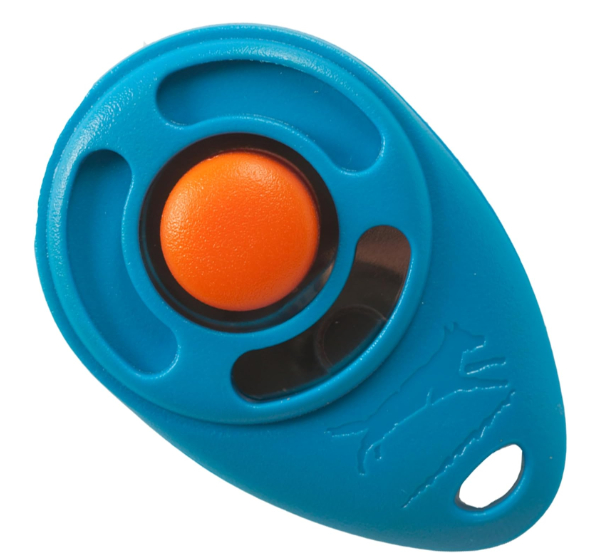
The Starmark Pro-Training Clicker is a precision acoustic marker used in operant conditioning to signal to a dog the exact moment they have performed a desired behavior. While many clickers on the market are flimsy or inconsistent, the Starmark unit is engineered for professional use. It features an ergonomic shape that fits comfortably in the palm and a large, raised button that is easy to trigger even when wearing gloves. This ensures that the handler's "marker" is delivered with the split-second timing necessary for the dog to make the association between the behavior and the coming reward.
Technically, the consistency of the sound is the clicker's most important attribute. The Starmark clicker produces a distinct, sharp "click" that is neither too loud to startle sensitive dogs nor too quiet to be heard in a busy park. The internal metal leaf is made of stainless steel, preventing the rust and fatigue that often affect cheaper models. As noted by the Starmark Academy, the use of a mechanical marker is superior to a verbal "yes" because it is a neutral, non-emotional sound that never varies in pitch or tone, providing the dog with an unambiguous signal of success. The unit also includes a basic training guide that outlines the fundamentals of clicker conditioning.
The obvious limitation of any clicker is that it is a small, handheld object that is easily lost. It also requires the handler to have a hand free, which can be challenging when managing a leash and a treat pouch simultaneously. Furthermore, the clicker itself provides no "correction"; it is strictly a tool for positive reinforcement. Despite its simplicity, the Starmark Pro-Training Clicker is an essential component of any high-precision training toolkit, particularly for shaping complex tricks or service dog tasks.
Starmark Official Product PageHow We Chose These Products
Our selection process focused on three primary pillars: Technical Reliability, Behavioral Science Alignment, and Manufacturer Support. We prioritized products that have stood the test of time in professional training academies and those that provide clear, repeatable feedback to the dog. For electronic items like the Dogtra 1900S and PetSafe Treat & Train, we analyzed signal stability, battery longevity, and waterproof ratings. For mechanical aids like the Easy Walk and KLIMB, we looked at material durability (LDPE plastics, high-tensile nylon) and the ergonomic impact on the canine's physiology. Products with a history of failure or those from fly-by-night brands were excluded in favor of manufacturers like PetSafe, Dogtra, and Starmark, who provide extensive educational resources and verifiable warranties.
Comparison Overview
| Product | Primary Training Function | Key Technical Spec | Best Use Case |
|---|---|---|---|
| Dogtra 1900S | Remote Communication | IPX9K Waterproof / 3/4-Mile Range | Off-leash reliability & K9 work |
| PetSafe Treat & Train | Automated Reward | Remote-triggered treat carousel | Separation anxiety & settle training |
| Blue-9 KLIMB | Boundary/Fitness | 500lb capacity / PawGrip surface | Place training & impulse control |
| Easy Walk Harness | Mechanical Management | Front-clip martingale loop | Loose-leash walking management |
| Starmark Clicker | Precision Marking | Stainless steel leaf / Ergonomic button | Shaping complex behaviors |
Buying Guide: What to Look For
- Consistency of Signal: Whether it’s an electronic pulse or an acoustic click, the signal must be identical every time to avoid confusing the dog.
- Durability and Environmental Rating: Training often happens outdoors. Look for IPX ratings for electronics and UV-stabilized materials for platforms.
- Ergonomics (Handler and Dog): A training aid that is difficult for a human to trigger or uncomfortable for a dog to wear will lead to inconsistent training sessions.
- Scale and Power: Ensure the tool is appropriate for your dog’s size. High-output remote trainers are necessary for large, driven breeds but may be overkill for toy breeds.
- Educational Ecosystem: Prefer brands that offer instructional videos or manuals, as the tool is only as effective as the handler's technique.
General Pros / Cons
| General Category Strengths |
|---|
| Speeds up communication between handler and dog |
| Reduces physical strain on the handler during walks |
| Allows for training at a distance (off-leash) |
| Provides objective, non-emotional feedback |
| Enhances focus by creating defined training zones |
| Facilitates behavior modification for anxiety and reactivity |
| Durable enough for years of repeated daily use |
| General Category Weaknesses |
|---|
| Requires significant handler education to avoid misuse |
| Initial investment for pro-grade gear can be high |
| Mechanical aids may only manage symptoms, not root causes |
| Electronic aids require battery management and charging |
| Some tools (platforms, dispensers) have large storage footprints |
| Can cause dependency if "fading the tool" is not practiced |
| Improper fit can cause physical discomfort or chafing |
Final Summary
Successful dog training is built on a foundation of clear communication and reliable equipment. The Dogtra 1900S and PetSafe Treat & Train represent the pinnacle of electronic aids, offering precision in both correction and reward at a distance. For physical management and boundary setting, the Blue-9 KLIMB and PetSafe Easy Walk provide the mechanical advantages necessary to keep training sessions productive and safe. Finally, the Starmark Clicker remains a low-cost, high-impact essential for any trainer focusing on operant conditioning. By selecting tools based on technical merit and behavioral science, owners can ensure a more harmonious and effective training journey.
Aggregate rating of the products reviewed: 4.74 out of 5.