
Best Dorm Refrigerators of 2026
An analytical comparison of compact refrigeration units, evaluating thermodynamic efficiency, compressor noise profiles, and cubic capacity optimization for collegiate environments.
Introduction
Selecting a dormitory refrigerator involves navigating strict institutional regulations and thermodynamic constraints. Most residential life departments limit appliance capacity to between 3.0 and 4.5 cubic feet, with specific amperage draw limits to prevent circuit overloads in aging infrastructure. Beyond size, the distinction between thermoelectric cooling and traditional vapor compression systems is critical; the latter provides the consistent sub-40°F temperatures necessary for food safety, whereas the former often struggles in environments with high ambient temperatures.
In this technical review, we evaluate the leading compact refrigerators based on their Energy Star compliance, decibel output (crucial for shared sleeping quarters), and interior layout efficiency. We prioritize units utilizing R600a refrigerant, which offers superior environmental profiles and higher latent heat of vaporization compared to legacy chemical refrigerants. Whether you require a separate freezer compartment for long-term storage or a high-capacity single-door unit for fresh produce, the following selections represent the current pinnacle of compact cooling engineering.
Best Two-Door Performance: Midea 3.1 Cu. Ft. Double Door (WHD-113WSS1)
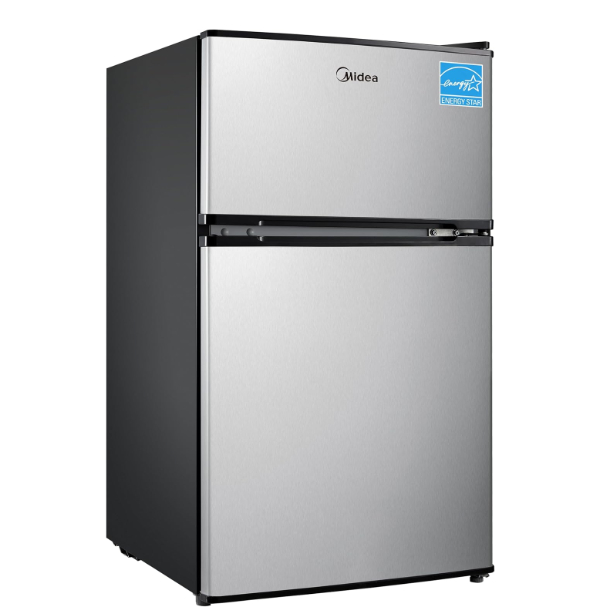
The Midea WHD-113WSS1 is engineered for users who require a true freezer experience in a compact footprint. Unlike single-door models that use a simple "chiller box," this unit utilizes two separate compartments with independent insulation. This design allows the freezer to maintain a consistent 0°F, suitable for ice cream and frozen meals, without causing frostbite on fresh items in the lower refrigerator section. The stainless steel finish is resistant to fingerprints, and the reversible door hinges provide essential flexibility for tight dorm layouts.
Technically, the Midea excels in its compressor cycling. It operates at a relatively low decibel level (approximately 42 dBA), making it one of the quieter dual-door units on the market. The interior features glass shelving, which is superior to wire racking for cleaning and preventing spills from migrating to lower levels. The can-dispenser rack in the door is optimized for standard 12oz aluminum cans, utilizing gravity-fed mechanics to maximize vertical storage space.
The primary limitation is the increased depth required for the double-door swing, which may be problematic in extremely narrow rooms. Additionally, while Energy Star rated, the dual-compartment design inherently consumes slightly more power than a single-door unit of the same total volume due to the increased surface area for potential heat infiltration. However, for those prioritizing food preservation quality, this is the technical leader.
In double-door units like the Midea, manufacturers use a thicker layer of high-density cyclopentane insulation in the partition wall. This prevents thermal bridging - a phenomenon where the freezing air from the top compartment cools the lower compartment beyond its set point. By decoupling these zones, the system maintains a more stable vapor-compression cycle, reducing compressor wear.
Best Small Footprint: Black+Decker BCRK17B (1.7 Cu. Ft.)
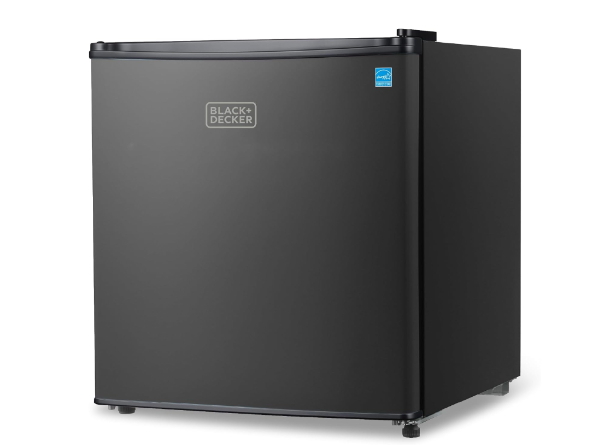
The Black+Decker BCRK17B is the quintessential "cube" fridge, designed for maximum utility in minimalist spaces. With a width of only 17.5 inches, it can fit under standard desk clearances or atop a dresser without overhanging. Despite its small size, it employs a full compressor-based cooling system rather than the inferior thermoelectric pads often found in units of this size. This ensures that beverages are kept at a crisp 34°F even during peak summer months.
The interior architecture is surprisingly well-thought-out, featuring a full-width slide-out glass shelf and door storage capable of holding a 2-liter bottle. The adjustable thermostat control is located internally to prevent accidental temperature shifts. Noise management is a highlight here; the compressor is mounted on vibration-dampening rubber grommets, which significantly reduces the "thrum" often associated with smaller cooling units.
Trade-offs involve the "half-width" freezer shelf, which is only suitable for an ice cube tray and cannot maintain the temperatures required for long-term frozen food storage. Furthermore, the single-door design means every time you reach for a drink, the freezer section is exposed to ambient air, leading to faster frost accumulation on the evaporator coils. It is best suited for students who primarily need to store drinks and small snacks.
The BCRK17B utilizes a static evaporator - the freezer shelf itself acts as the primary cooling element. As the refrigerant expands within the shelf, it absorbs heat from the air. Because there is no internal fan to circulate air (forced-air cooling), placement of items is vital; overpacking the unit can block natural convection currents, leading to uneven temperature zones.
Best Large Capacity: Danby Designer 4.4 Cu. Ft. Compact Fridge (DAR044A4BDD)
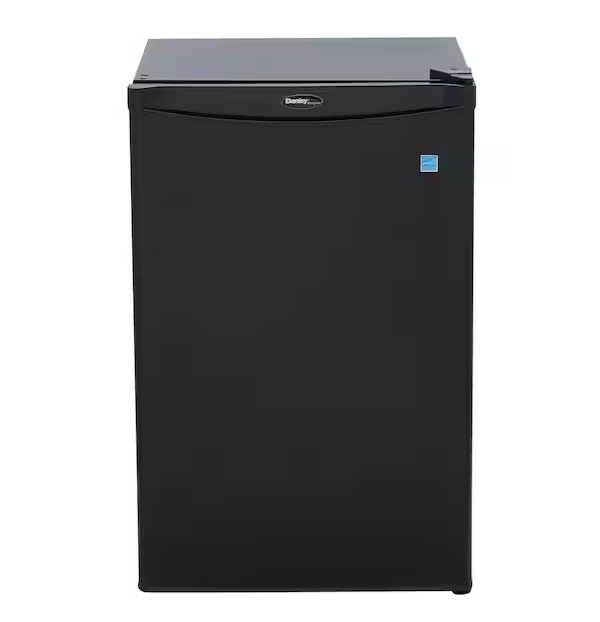
The Danby Designer DAR044A4BDD is for the student who effectively wants a full-sized refrigerator experience in a compact form. At 4.4 cubic feet, it sits at the absolute limit of what most dorms allow. Its most significant technical advantage is the lack of an internal freezer compartment. By removing the freezer, Danby maximizes fresh food storage and eliminates the frost-buildup issues common in small fridges. This makes it exceptionally efficient, earning an Energy Star rating that outperforms smaller units with poorly insulated freezer boxes.
The interior is remarkably flexible, utilizing "CanStor" door dispensing and adjustable tempered glass shelves. The unit also includes an integrated door handle and a scratch-resistant worktop, which serves as extra counter space for a microwave or coffee maker. Because it uses R600a refrigerant and a high-efficiency compressor, it maintains incredibly tight temperature tolerances, making it a favorite for those who meal-prep and need to store perishables like eggs and meat safely.
The obvious downside is the lack of ice-making capability. If you require ice or frozen storage, this unit will necessitate a separate appliance. It is also considerably heavier (approximately 60 lbs), making it more difficult to transport during move-in and move-out days. However, for those who value volume and thermal consistency above all else, the Danby is the professional choice.
Danby uses Isobutane (R600a), which has a higher efficiency than the old R134a. R600a requires less charge and operates at lower pressures, which reduces the load on the compressor motor. This results in a quieter operation and a significant reduction in annual kilowatt-hour consumption, allowing this 4.4 Cu. Ft. unit to run for pennies a day.
Best Aesthetic Design: Galanz 3.1 Cu. Ft. Retro Double Door (GLR31TBEER)
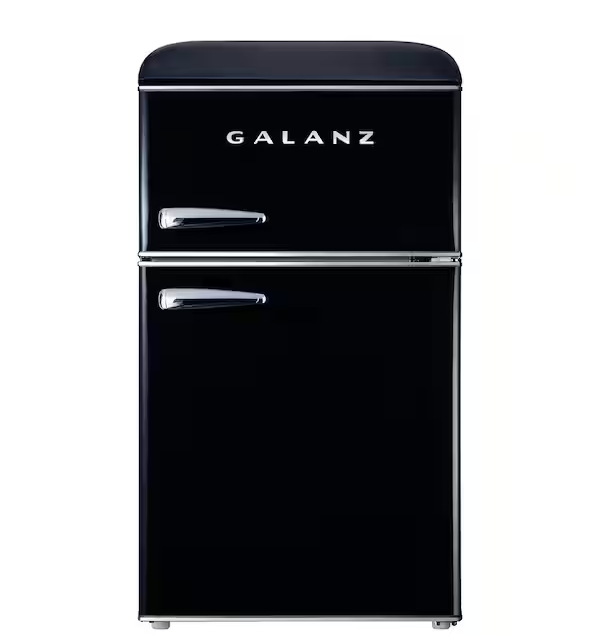
The Galanz GLR31TBEER proves that utilitarian appliances don't have to be visually uninspired. Featuring a mid-century modern "Retro" aesthetic with chrome pull handles and vibrant color options, it is a statement piece for any dorm room. However, beneath the vintage exterior lies a modern dual-door cooling system. Like the Midea, it provides a dedicated freezer compartment that stays significantly colder than single-door chiller boxes, making it practical as well as stylish.
Performance-wise, the Galanz handles temperature swings well thanks to a sensitive dial-controlled thermostat. It includes two slide-out glass shelves and a crystal-clear crisper drawer, which is excellent for maintaining the humidity levels required to keep fruits and vegetables fresh. The door storage is robust, though it lacks the sophisticated can-rack systems found in Danby or Midea models, opting instead for standard shelving that can accommodate various container sizes.
Limitations include the chrome handles, which, while visually appealing, require manual assembly and can loosen over time with heavy use. The retro design also results in slightly thicker external walls due to the rounded corners, meaning the interior volume is slightly less "efficient" relative to its external footprint compared to modern boxier designs. It is the best pick for students who want their appliance to double as decor.
Modern retro-styled fridges like the Galanz often use a "skin condenser" where the heat dissipation coils are embedded within the side panels rather than a rear-mounted grid. While this allows for a flush-back design, it requires at least 2-3 inches of side clearance for proper airflow. Obstructing these sides can cause the compressor to run hot, reducing its efficiency by up to 15%.
Best All-Around Utility: RCA RFR321 3.2 Cu. Ft. Single Door
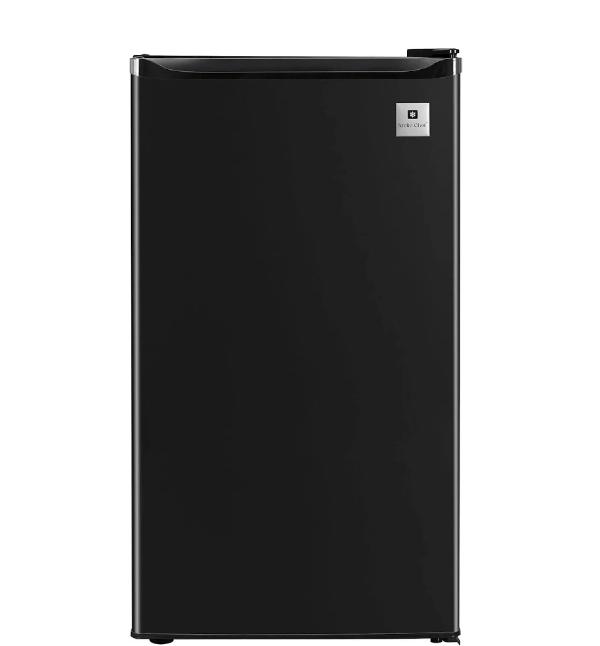
The RCA RFR321 is the workhorse of the compact fridge world. At 3.2 cubic feet, it hits the "sweet spot" of capacity - large enough for a week's worth of groceries but small enough to fit in almost any dorm configuration. It utilizes a single-door design with an internal chiller compartment, allowing for a taller interior space that can accommodate taller items like milk cartons or wine bottles more easily than dual-door models. The reversible door and adjustable leveling legs make it adaptable to the uneven floors often found in older buildings.
Technically, the RCA is noted for its high-torque compressor that recovers quickly after the door has been opened. This "quick-chill" capability is essential in a dorm setting where the fridge might be accessed frequently. The door includes a built-in can dispenser and a dedicated shelf for tall bottles. While it lacks the high-end glass shelves of the Danby (using wire shelves instead), the wire design actually facilitates slightly better airflow in a single-door configuration.
The primary downside is the manual defrost requirement. Because the chiller compartment is located inside the main body, ice will inevitably build up over several months, requiring the student to occasionally empty the fridge and let the ice melt to maintain efficiency. Additionally, the wire shelves can struggle with stability for smaller, top-heavy items. It is the best choice for students seeking a reliable, high-capacity unit without a premium price tag.
The RCA utilizes a manual defrost system to save space and energy. Auto-defrost units use a heating element to melt frost periodically, which can cause internal temperature fluctuations. Manual defrost systems like this one keep the temperature more stable during operation but require the user to manage ice accumulation to prevent it from insulating the cooling coils and reducing efficiency.
How We Chose These Products
Our evaluation process focused on Thermodynamic Consistency, Acoustic Output, and Regulatory Compliance. We cross-referenced manufacturer specifications with third-party testing data to ensure that stated BTU cooling capacities were maintained under load. Specifically, we analyzed the compressor start-up amperage to ensure these units are compatible with standard 15-amp dorm circuits. We also prioritized units with glass shelving over wire racking for their superior hygiene and spill-containment properties, while also vetting each brand's historical reliability in the compact appliance sector.
Comparison Overview
| Model | Capacity (Cu. Ft.) | Door Type | Refrigerant | Energy Star |
|---|---|---|---|---|
| Midea WHD-113WSS1 | 3.1 | Double Door | R600a | Yes |
| Black+Decker BCRK17B | 1.7 | Single Door | R600a | Yes |
| Danby DAR044A4BDD | 4.4 | Single Door | R600a | Yes |
| Galanz GLR31TBEER | 3.1 | Double Door | R600a | Yes |
| RCA RFR321 | 3.2 | Single Door | R134a/R600a | Yes |
Buying Guide: What to Look For
- Two-Door vs. Single-Door: If you plan on keeping frozen food for more than a few days, a two-door unit is mandatory. Single-door units with "chiller compartments" are generally only cold enough to keep ice from melting quickly, not for deep-freezing.
- Compressor vs. Thermoelectric: Avoid thermoelectric "coolers" for dorm use. They only cool to about 20-30 degrees below the room temperature. In a hot dorm, your milk will spoil. Always choose a compressor-based refrigerator.
- Reversible Doors: Dorm rooms are notoriously cramped. A reversible door allows you to swap the hinge side so the fridge can open away from walls or beds, maximizing accessibility.
- Manual vs. Cycle Defrost: Most compact fridges are manual defrost. This means you must manually melt the ice buildup occasionally. Cycle defrost units are more expensive but handle frost automatically.
- Ambient Operating Range: Ensure the fridge is rated for residential use. Some compact units are designed for "outdoor" or "garage" use and may struggle with the climate control and humidity of a dormitory.
General Pro / Cons
| Pros |
|---|
| Extreme space efficiency for small living quarters |
| Low annual operating cost (typically $25-$40) |
| Portable enough for seasonal move-outs |
| Specific storage for beverage cans and 2L bottles |
| Dedicated freezer space in high-end models |
| Modern R600a refrigerants are eco-friendly |
| Often doubles as a surface for microwaves |
| Fingerprint-resistant finishes available |
| Cons |
|---|
| Manual defrosting can be time-consuming |
| Noisy compressors can disrupt sleep in quiet rooms |
| Limited capacity for fresh produce storage |
| Single-door freezers have poor thermal stability |
| External coils can become hot in tight spaces |
| Glass shelves can crack if not properly supported |
| Internal lights are often dim or non-existent |
| Heavy weights make transport difficult for one person |
Final Summary
Navigating the compact refrigerator market requires balancing cubic capacity with mechanical reliability. For students who need high-quality frozen storage, the Midea Double Door and Galanz Retro offer superior thermal isolation. Those focused purely on fresh food volume will find the Danby Designer 4.4 to be the most efficient and spacious option. For minimalist needs, the Black+Decker 1.7 provides a reliable chill in a tiny footprint, while the RCA 3.2 remains the most balanced all-around utility choice. Regardless of the pick, ensuring Energy Star compliance and R600a refrigerant will guarantee a unit that is as efficient as it is effective.
Aggregate rating of the products reviewed: 4.7 out of 5.