
Best Educational Toys for Young Children of 2026
An analytical exploration of high-performance developmental tools designed to foster cognitive growth, fine motor precision, and foundational STEM literacy in early childhood.
Introduction
The landscape of early childhood education has shifted significantly toward "purposeful play," a methodology where toys serve as the primary interface for neurological development. Scientific research from the National Association for the Education of Young Children (NAEYC) suggests that children under age seven absorb foundational concepts of physics, logic, and social-emotional intelligence most effectively when engaged in tactile, open-ended activities. The market is saturated with "edutainment" that often prioritizes flashy lights over cognitive substance; therefore, discerning the difference between a simple distraction and a technical developmental tool is essential for effective early learning environments.
In this analysis, we evaluate products based on their "play value"—a metric that combines the duration of engagement with the depth of skills addressed. We prioritize toys that offer modularity, allowing the child’s interaction to evolve in complexity as they age. Whether it is through the gravitational mechanics of a stacking toy or the computational logic of a screen-free coding robot, these selections represent the pinnacle of current educational toy engineering, verified for safety, durability, and pedagogical alignment.
Best for Spatial Reasoning: Magna-Tiles Clear Colors 32-Piece Set
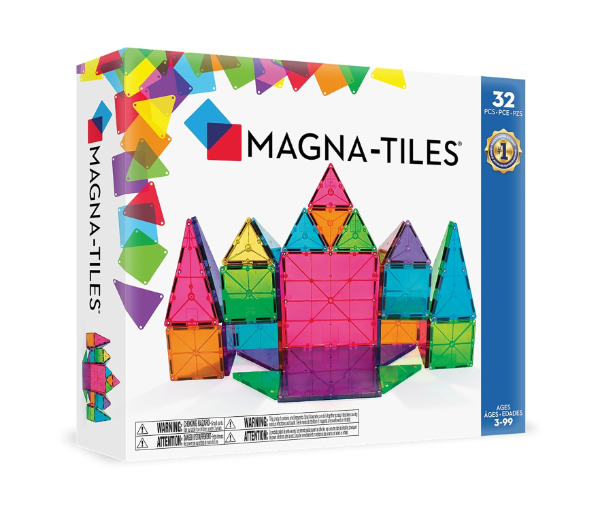
Magna-Tiles have established the industry standard for magnetic construction through a patented design that utilizes sonic welding to secure neodymium magnets within food-grade ABS plastic. The structural integrity is paramount; each tile contains specialized ceramic magnets located at the apex of every edge, allowing for instantaneous 3D construction that defies the limitations of standard gravity-based blocks. This set is a technical powerhouse for teaching geometry, as it forces the user to visualize the relationship between 2D planes and 3D volumes—a core competency in early spatial reasoning.
The "Clear Colors" variant is particularly effective for light-play and color-mixing experiments. From a performance perspective, the tiles are engineered with a "lattice" interior structure that prevents cracking under reasonable pressure. Unlike inferior magnetic blocks that use weak iron-based magnets, the high-coercivity magnets in Magna-Tiles ensure that structures remain stable even when built to significant heights. This fosters a trial-and-error environment where children learn structural engineering principles such as load-bearing and center of mass through hands-on failure and success.
While the product is exceptionally durable, the 32-piece set can be restrictive for complex architectural projects, often leading to the "ecosystem lock-in" where additional sets are required to expand the play experience. Additionally, because the magnets are encased in plastic, the tiles can scratch over years of heavy friction on abrasive surfaces. However, for a foundational introduction to mathematics and physical science, their performance remains unparalleled.
Magna-Tiles Official Product PageBest for Digital-Physical Integration: Osmo Genius Starter Kit
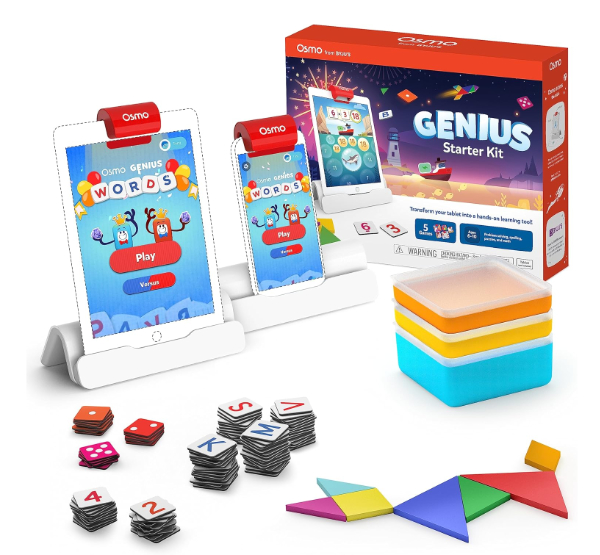
The Osmo Genius Starter Kit utilizes "Reflective AI" technology to bridge the gap between tangible manipulation and digital feedback. By placing a specialized mirror over the tablet's camera, the Osmo software scans the area in front of the device, translating physical movements into the digital game world. This kit includes five distinct applications—Tangram, Newton, Words, Masterpiece, and Numbers—that address visual-spatial intelligence, physics, and literacy. As noted by technical reviewers, the computer vision algorithm is remarkably robust, capable of recognizing shapes and letters in various lighting conditions.
The technical brilliance of Osmo lies in its ability to turn screen time into an active, kinesthetic experience. In the "Newton" game, for example, users place real-world objects (like a pen or their hand) on the table to redirect falling digital balls, teaching basic momentum and collision physics. This creates a feedback loop that requires fine motor control and rapid problem-solving. It is an ideal tool for children who are naturally drawn to tablets but require more physical engagement than traditional apps provide.
Users must be aware of the hardware requirements; Osmo is not a standalone toy and requires a compatible iPad or Fire Tablet. The dependency on a software ecosystem means that system updates are necessary, and the product is tied to the longevity of the tablet's OS. There is also a learning curve for the initial calibration of the reflector, and younger children may require adult assistance to ensure the "play zone" is correctly oriented within the camera's field of view.
Osmo Official Product PageBest for Fine Motor Dexterity: Melissa & Doug Latches Board
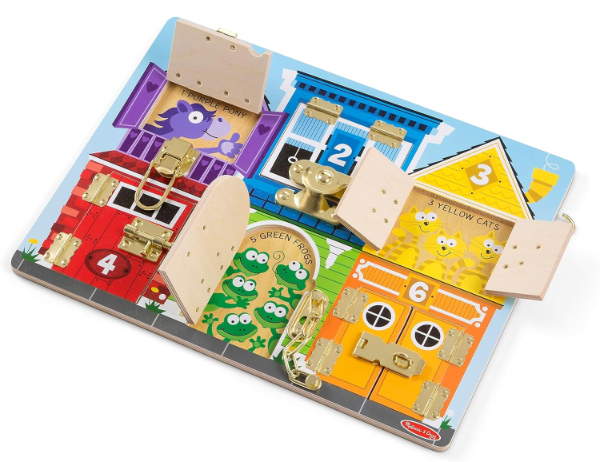
The Melissa & Doug Latches Board is a sophisticated analog tool designed to refine "pincer grasp" and hand-eye coordination. Constructed from high-density engineered wood, the board features six unique metal latches, including sliding bolts, hook-and-eye closures, and snap locks. Each latch reveals a hidden illustration, providing a narrative reward for successfully navigating the mechanical hardware. This focuses on the proprioceptive input required for everyday tasks, such as dressing or using door handles.
From a developmental standpoint, this board is an application of the Montessori "practical life" curriculum. It stands out because of the varying resistance and complexity of the hardware; some latches require a simple horizontal slide, while others demand a multi-step press and lift. This variety prevents the task from becoming repetitive and forces the child to adjust their finger pressure and grip angle. The use of real metal hardware rather than plastic mimics the tactile feedback of real-world objects, which is essential for building authentic dexterity.
The board's primary limitation is its lack of "open-endedness" once the six latches are mastered. While it is an excellent tool for a specific developmental window (typically ages 3 to 5), it does not offer the infinite replayability of building blocks. Furthermore, the board is relatively heavy, which can be a safety concern if dropped on a foot, and the hinges require occasional monitoring to ensure they remain tightened through thousands of cycles.
Melissa & Doug Official Product PageBest for Early Logic and Coding: Learning Resources Code & Go Robot Mouse
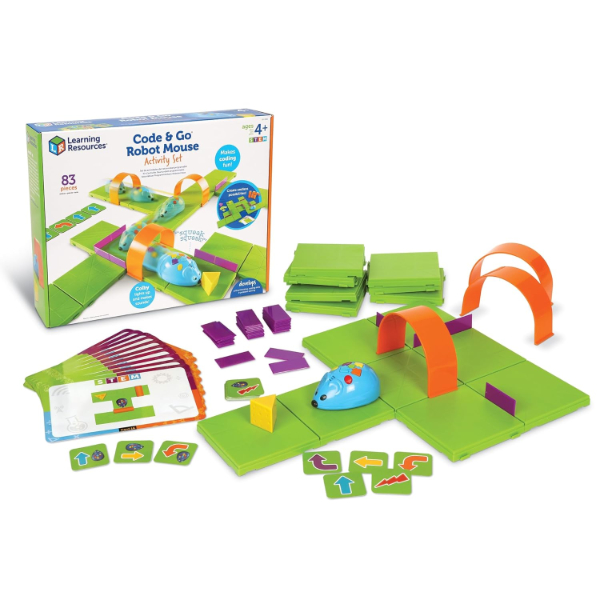
The Code & Go Robot Mouse Activity Set (featuring Colby the Mouse) is an essential introductory tool for computational thinking without the requirement of a screen. The system functions through a simple "input-output" model: the user programs a sequence of commands via directional buttons on the mouse's back to navigate a customizable maze. This introduces "if-then" logic and sequential processing, which are the cornerstones of software engineering. By deconstructing a goal into a series of discrete movements, children learn the fundamentals of algorithm design.
The technical merit of this toy is its "tactile debugging" process. If Colby hits a wall, the child must re-evaluate their code, identify the erroneous command, and reprogram the sequence. This builds resilience and logical troubleshooting skills. The kit includes 30 double-sided coding cards that allow children to "map out" their code before entering it into the hardware, reinforcing the transition from abstract thought to physical execution. The maze pieces are modular, offering high replayability as the configurations can be made increasingly complex.
Power consumption is a consideration, as Colby requires 3 AAA batteries (not included) and can drain them quickly during heavy use on high-friction surfaces like carpet. The mouse operates best on hard, flat surfaces to ensure the encoders in the wheels maintain accurate distance tracking. Over time, the internal gears can accumulate hair or dust, necessitating periodic cleaning to maintain the precision of the 90-degree turns.
Learning Resources Official Product PageBest for Sensory Engineering: Fat Brain Toys SpinAgain
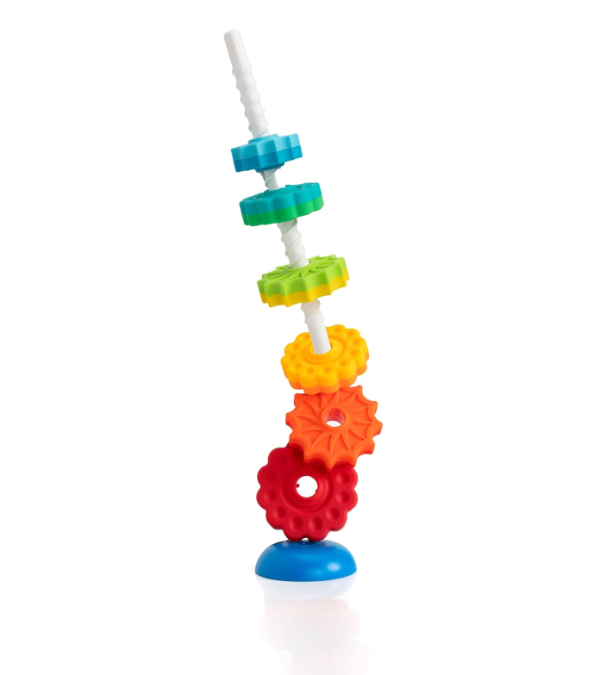
The SpinAgain by Fat Brain Toys re-imagines the classic stacking toy through the lens of kinetic physics. Unlike standard stacking rings that simply sit on a peg, the SpinAgain utilizes a threaded "corkscrew" pole. Each aerodynamic disc is designed with a specific weight-to-drag ratio that allows it to spin rapidly down the pole until it reaches the base. This provides profound sensory feedback and demonstrates the relationship between rotational force and gravity. The discs are double-sided with varied textures, providing tactile stimulation that aids in sensory processing.
Constructed from high-grade ABS plastic that is BPA-free and rigorously safety-tested, the SpinAgain is designed for longevity. The technical appeal is the "cause-and-effect" realization it prompts; the speed of the spin varies based on how the disc is dropped and the angle of the pole. Furthermore, the base is reversible—one side is flat for stability, and the other is wobbled for a "dynamic" challenge. This encourages the child to experiment with balance and stability, shifting the toy from a passive object to an active experiment in equilibrium.
The only significant limitation is its simplicity; it is primarily aimed at the toddler demographic (ages 1 to 4). While it is visually and kinetically captivating, it lacks the multi-faceted complexity of coding toys or magnetic builders. However, as an introductory engineering toy, it is unmatched in its ability to captivate a young child's attention while teaching fundamental physical concepts.
Fat Brain Toys Official Product PageHow We Chose These Products
Our evaluation process for the best educational toys centers on three technical pillars: Durability, Cognitive Complexity, and Safety Compliance. We analyzed manufacturer specifications to ensure all plastics are non-toxic (BPA/Phthalate-free) and that all electronic components meet international safety standards. Furthermore, we assessed "open-endedness"—the ability for a toy to be used in multiple ways—which prevents the "one-and-done" syndrome often found in low-quality educational products. These picks were cross-referenced with educational milestones established by developmental psychologists to ensure they provide age-appropriate challenges.
Comparison Overview
| Model | Primary Skill | Power Source | Key Material | Age Range |
|---|---|---|---|---|
| Magna-Tiles 32-Pc | Spatial Geometry | Manual | ABS Plastic/Neodymium | 3+ Years |
| Osmo Genius Kit | Digital Literacy | Tablet-Powered | Plastic/Reflective Glass | 6-10 Years |
| Latches Board | Fine Motor Skills | Manual | Engineered Wood/Metal | 3+ Years |
| Robot Mouse | Logic/Coding | 3 AAA Batteries | Plastic/Metal Encoders | 4+ Years |
| SpinAgain | Kinetic Physics | Manual | ABS Plastic | 1+ Years |
Buying Guide: What to Look For
- Sensory Feedback: High-quality educational toys should provide clear tactile, auditory, or visual feedback. For example, the "click" of a magnetic block or the "spin" of a gear confirms to the child that their action was successful.
- Open-Ended Play: Avoid toys that only have one "correct" way to be played with. Building blocks and coding kits are superior because they allow the child to set their own goals, fostering creativity and problem-solving.
- Material Safety: Ensure toys are made from food-grade plastics or sustainably sourced wood with non-toxic finishes, as young children frequently use their mouths to explore textures.
- Cognitive Ceiling: Choose toys that offer different levels of difficulty. A toy that is too easy will be abandoned, while one that is too hard will cause frustration. Modular sets (like Magna-Tiles or Osmo) allow you to increase the challenge as the child grows.
- Analog vs. Digital Balance: While digital tools like Osmo are highly effective, they should complement, not replace, analog toys that build physical grip strength and proprioception.
General Pro / Cons
| Developmental Advantages | Practical Limitations |
|---|---|
| Fosters independent problem-solving and logic | Many high-quality STEM toys require recurring battery costs |
| Builds foundational spatial and mathematical literacy | Digital-physical hybrids are dependent on external tablet hardware |
| Improves hand-eye coordination and fine motor strength | Premium educational toys carry a higher initial price point |
| Encourages trial-and-error and scientific inquiry | Small parts in construction sets require careful organization |
| Reduces passive screen time through active engagement | Analog boards have a fixed lifespan of engagement |
| Promotes narrative play and social collaboration | Software-based toys require periodic updates and connectivity |
Final Summary
Investing in high-quality educational toys is an investment in a child’s neurological infrastructure. By selecting tools that emphasize physical manipulation, logical sequencing, and spatial reasoning, parents can provide a "scaffolded" learning environment that supports a wide range of developmental milestones. The Magna-Tiles Clear Colors 32-Piece Set remains the most versatile construction tool, while the Osmo Genius Starter Kit represents the cutting edge of educational technology. Regardless of the choice, prioritizing durability and open-ended play ensures that these toys remain valuable assets in a child’s development for years to come. Aggregate rating of the products reviewed: 4.76 out of 5.