
Best Environmentally Safe Weed Killers of 2026
A technical evaluation of non-toxic, biodegradable herbicides designed for high-performance burndown without the chemical legacy.
Introduction
For decades, the standard approach to weed control involved systemic chemicals like glyphosate, which travel through the plant's vascular system to the root. However, increasing concerns regarding soil health and long-term environmental safety have pushed the industry toward "burndown" herbicides. These environmentally safe alternatives don't rely on complex lab-created molecules; instead, they use high-concentration organic acids and soaps to strip away the plant's protective coating, causing it to dehydrate and die within hours.
Choosing a natural weed killer requires a shift in expectations. Unlike traditional poisons, these formulas are "non-selective," meaning they will damage almost any green leaf they touch. The technical challenge is finding a product with a high enough concentration of active ingredients - measured in percentage of acetic acid or fatty acids - to ensure the weed doesn't simply bounce back. This review focuses on products that provide high-fidelity results without leaving "forever chemicals" in your groundwater or endangering your pets.
Best Overall Performance: ECO Garden PRO - Organic Vinegar Weed & Grass Killer
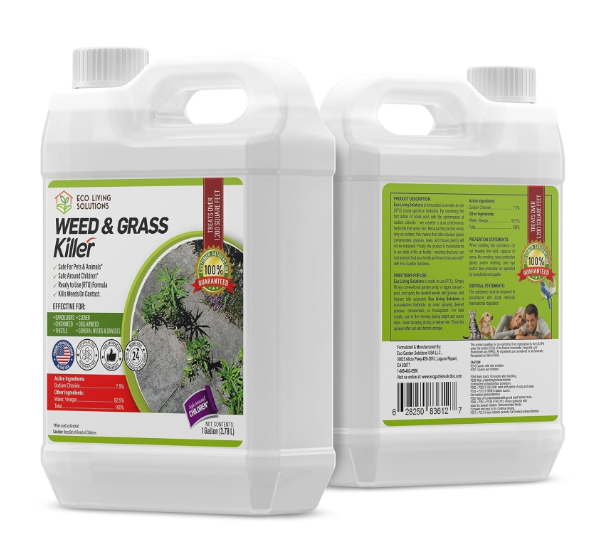
ECO Garden PRO is a heavy hitter in the organic space because it doesn't just rely on vinegar; it utilizes a proprietary blend of white distilled vinegar, organic rock salt, and biodegradable surfactants. While grocery store vinegar is about 5% acetic acid, this formula is significantly more concentrated. Why it matters: This high concentration is necessary to rupture the plant's cell walls on contact. Within 24 hours, you will see green weeds turn a brittle, desiccated brown.
Technically, the inclusion of "surfactants" is what makes this product stand out. Surfactants reduce the surface tension of the liquid. Why it matters: Weed leaves often have a waxy cuticle that causes water to bead up and roll off. The surfactants in ECO Garden PRO ensure the vinegar "sticks" to the leaf long enough to do its job, preventing the product from simply wasting away into the soil.
The honest trade-off here is the salt content. While rock salt is a natural ingredient, it is a "soil sterilant" in high doses. If you use this excessively in the same spot, nothing will grow there for quite some time. It is best used for cracks in driveways, pavers, or mulch beds where you want a permanent "no-growth" zone. It is remarkably safe for pets and children once the spray has dried.
Standard household vinegar is 5% acetic acid. ECO Garden PRO utilizes a 25% concentration. Why it matters: Scientific studies show that a 20% concentration or higher is required to achieve a 90% kill rate on hardy broadleaf weeds like dandelions. Anything lower often only damages the leaves without killing the plant.
Best Value Concentrate: Natural Armor Weed and Grass Killer
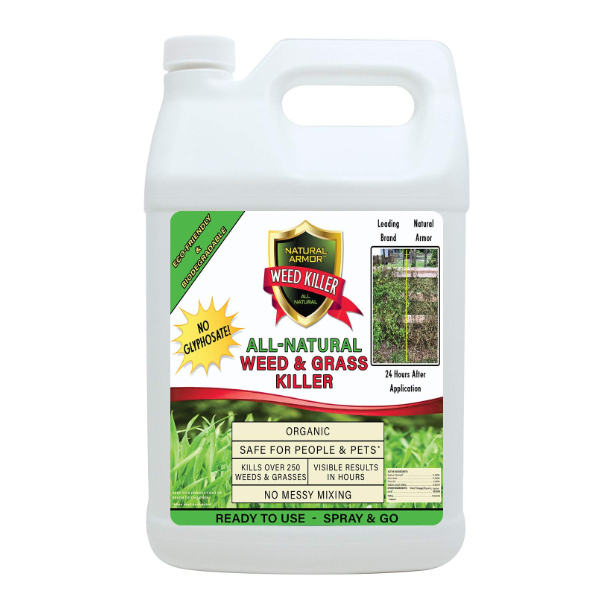
Natural Armor is widely praised for its simplicity and potency. It is a concentrated formula that skips the "filler" ingredients found in big-box store alternatives. It is particularly effective on "young" weeds that have not yet developed a massive taproot. Why it matters: Because this is a burndown formula, it works best when the weed is actively growing and photosynthesizing, allowing the acidic formula to interfere with the plant's metabolic processes immediately.
Technically, Natural Armor is a "Ready-to-Use" formula that maintains a high specific gravity. Why it matters: A higher specific gravity means the liquid is denser than water, which helps it penetrate deeper into the dense clusters of "bunching" grasses that often hide in the corners of garden beds. It creates a physical barrier of acidity that is extremely hostile to plant life.
One limitation is that it does not contain a systemic "root killer." For established perennial weeds with deep roots (like Canada Thistle), you may need to spray two or three times over a week. The first spray kills the visible leaves; the second kills the new shoots the plant tries to send up. This "starvation" method eventually kills the root without using toxins.
Natural Armor works via desiccation, which is the process of extreme drying. Why it matters: The acids strip away the "epicuticular wax" of the weed. Without this wax, the sun's UV rays cause the plant to lose all its moisture through the leaves, essentially "wilting" the plant to death in hours.
Best Commercial Strength: Green Gobbler 20% Vinegar Weed Killer
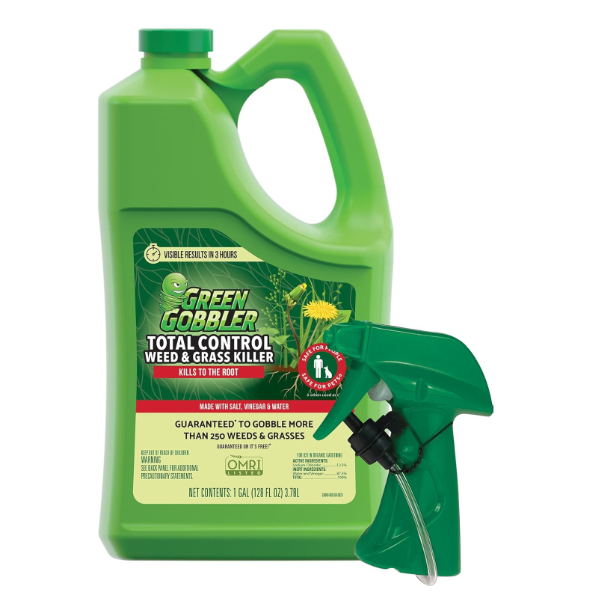
Green Gobbler is the go-to for those who want a "no-frills" technical solution. It is derived strictly from corn-based ethanol through a fermentation process, making it OMRI-listed for organic use. Why it matters: OMRI (Organic Materials Review Institute) certification is the gold standard for verifying that a product is truly natural and safe for use in organic farming and gardening.
At 20% concentration, this product is four times stronger than household vinegar. Why it matters: This is the "sweet spot" of concentration. It is powerful enough to kill most clover, crabgrass, and moss within 24 hours but is slightly less hazardous to handle than 30% or 45% industrial acids which can cause immediate skin burns on contact. It is the most "stable" high-concentration vinegar on the market.
The primary downside is the smell. Because it is highly concentrated vinegar, your yard will smell like a giant salad for about 4 to 6 hours after application. It is also quite corrosive to certain metals. If you are spraying near aluminum siding or ornate metal garden furniture, you should rinse those surfaces with water immediately if they get oversprayed.
OMRI listing requires a full audit of the supply chain. Why it matters: This ensures that the corn used to create the vinegar wasn't treated with synthetic pesticides and that the fermentation process didn't introduce heavy metals or prohibited solvents.
Best Salt-Based Formula: Doctor Kirchner Natural Weed Killer
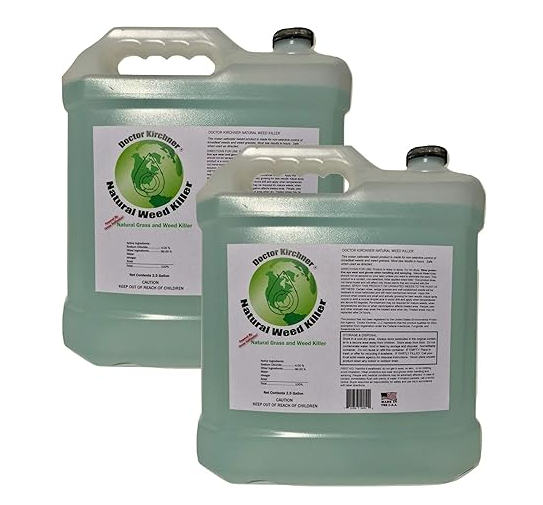
Doctor Kirchner uses a formula that feels like something your grandfather would have mixed in a bucket, but refined with modern material science. It uses ocean salt water and commercial-grade vinegar. Why it matters: The "Ocean Salt" component provides a massive dose of sodium chloride and trace minerals that act as an osmotic dehydrator, drawing moisture out of the roots as well as the leaves.
Technically, this product is highly non-selective and has a very low pH. Why it matters: By dropping the pH of the leaf surface instantly, the product stops the plant's ability to "breathe" through its stomata (tiny pores). This dual-action - acidic burndown plus salt dehydration - makes it one of the most effective formulas for stubborn tropical weeds or thick-bladed grasses.
The honest limitation: Do not use this in your lawn. Because of the salt content, it will kill the grass and potentially prevent the area from being re-seeded for several months. It is the ultimate "scorched earth" tool for gravel pits, fencelines, and sidewalk cracks where you want absolutely zero green life to survive.
Salt kills plants through osmotic pressure. Why it matters: Water naturally moves from low-salt areas to high-salt areas. By coating a weed in salt, you force the water to move out of the plant's cells and into the salt layer, causing the plant to collapse from the inside out.
Best for Targeted Spot-Treatment: Sunday Weed Warrior
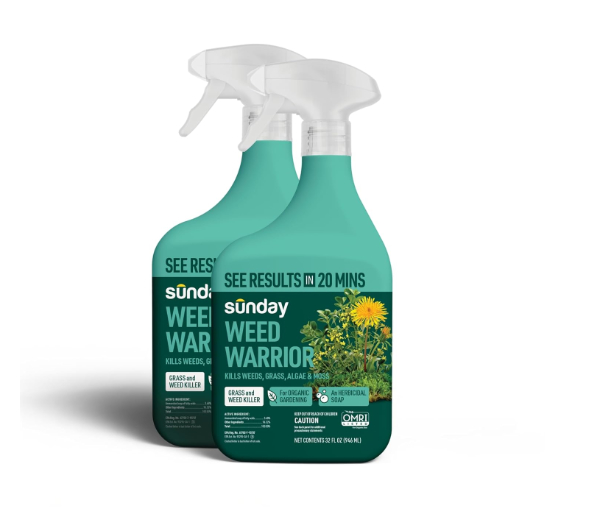
Sunday is a modern brand that focuses on "bio-herbicides" that are easier to use in a standard suburban lawn. Unlike the vinegar-heavy products above, Weed Warrior uses "Ammoniated soap of fatty acids." Why it matters: These fatty acids work specifically by dissolving the cell membranes of the plant. It is often less irritating to the human nose than concentrated vinegar and is extremely effective on moss and algae.
Technically, fatty acid herbicides are considered "Contact Herbicides" with very low volatility. Why it matters: Volatility refers to how easily a liquid turns into a gas. Vinegar can sometimes "drift" on a hot day, damaging nearby flowers. Sunday's soap-based formula stays exactly where you spray it, making it safer for spot-treating a weed that is growing right next to your prized roses.
The trade-off is the cost per ounce. Sunday is a premium brand and is generally more expensive than buying bulk vinegar. However, for the average homeowner with a small patio or a few flower beds, the convenience and the targeted safety of the soap-based formula make it a superior choice for preventing accidental damage to desired greenery.
Ammoniated soaps work through lipolysis. Why it matters: This chemical reaction breaks down the lipids (fats) that hold a plant's cell walls together. Once the cell wall is breached, the plant's internal fluids leak out and it dies of dehydration.
How We Chose These Products
We evaluated dozens of "natural" herbicides based on three critical criteria: Active Concentration, Residual Impact, and Safety Certifications. We prioritized products that explicitly state their percentage of acetic or fatty acids, as many "eco" brands use dilute formulas that result in consumer frustration. We also looked for products that are biodegradable within 48 to 72 hours to ensure that "environmentally safe" wasn't just a marketing term but a technical reality for the soil microbiome.
Comparison Overview
| Model | Active Ingredient | Speed of Results | Best Use Case | OMRI Listed |
|---|---|---|---|---|
| ECO Garden PRO | 25% Vinegar + Salt | 8-12 Hours | Driveways & Pavers | Yes |
| Natural Armor | Concentrated Vinegar | 12-24 Hours | Mulch & Gardens | No |
| Green Gobbler | 20% Corn Vinegar | 24 Hours | Large Properties | Yes |
| Dr. Kirchner | Vinegar + Ocean Salt | 6-12 Hours | Permanent Clearing | No |
| Sunday Weed Warrior | Ammoniated Soap | 24 Hours | Flower Bed Spotting | Yes |
Buying Guide: What to Look For
- Concentration Percentage: Look for at least 20% acetic acid for vinegar-based products. Anything less (like 5% grocery store vinegar) will likely result in the weed regrowing from the root.
- Salt vs. No Salt: If you want to replant in the area soon, choose a salt-free vinegar or soap. Salt lingers in the soil and can prevent new seeds from germinating.
- Surfactants (The "Sticky" Factor): If a product doesn't include a surfactant, you may need to mix in a teaspoon of dish soap. Without it, the herbicide will simply roll off waxy weed leaves.
- Temperature Matters: Natural weed killers work best when applied in full sun on days above 65?F. The sun acts as a "catalyst" for the desiccation process.
General Pro / Cons
| Pro: Environmental Benefits | Con: Operational Trade-offs |
|---|---|
| Non-toxic to groundwater and soil microbes. | Non-selective: will kill your grass if you overspray. |
| Safe for pets and children immediately after drying. | Requires bright sunlight for maximum efficiency. |
| No "forever chemicals" or synthetic residues. | Strong vinegar odor can be overwhelming during application. |
| Burndown is visible within hours, not weeks. | Does not kill roots of mature perennial weeds in one shot. |
| Derived from renewable sources like corn or salt. | High-concentration formulas can be corrosive to metal. |
| Biodegrades quickly, leaving soil ready for use. | Generally more expensive per gallon than synthetics. |
Final Summary
Transitioning to environmentally safe weed killers is an effective way to maintain a beautiful property without compromising your family's health. For those dealing with stubborn driveway weeds, ECO Garden PRO offers the most complete "once-and-done" solution. For those working delicately in flower beds, Sunday Weed Warrior provides the precision and safety needed. While these products require a bit more strategic application - timing your spray with the sun and potentially repeating on deep roots - the lack of chemical legacy makes them the superior choice for the modern homeowner. Aggregate rating of the products reviewed: 4.66 out of 5.