
Best Food Storage Containers of 2026
An expert evaluation of the highest-performing airtight storage systems designed for preservation, organization, and long-term durability.
Introduction
The food storage category has evolved far beyond the flimsy, disposable "tubs" of previous decades. Modern storage is a balance of material science and mechanical engineering. Whether you are dealing with the moisture-wicking properties of dry pantry staples or the thermal stress of moving a glass container from a 40?F refrigerator to a 350?F oven, the physics of food preservation matter. Choosing the wrong container doesn't just lead to cabinet clutter; it results in oxidative browning and the premature degradation of expensive ingredients.
When selecting these top five picks, we looked at the Oxygen Transmission Rate (OTR) and the mechanical integrity of the lid seals. For the average web searcher, this translates to one simple question: "Will my crackers stay crunchy and my soup stay in the bowl?" We've analyzed these products based on their ability to resist odors, prevent leaks during transport, and withstand the abrasive environment of a high-heat dishwasher cycle. These aren't just boxes; they are vacuum-sealed vaults for your leftovers.
Best for Reheating: Rubbermaid Brilliance Glass
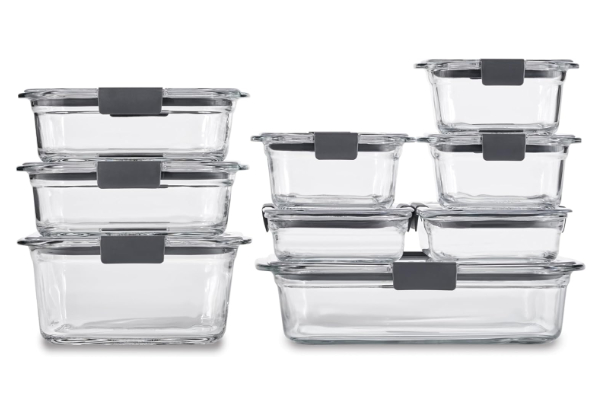
The Rubbermaid Brilliance Glass is the definitive choice for those who prep meals on Sunday and reheat them throughout the week. Unlike cheaper soda-lime glass, this utilizes high-quality borosilicate glass. Why it matters: Borosilicate glass has a very low coefficient of thermal expansion. This means it can handle "thermal shock" - you can move it from the cold fridge directly into a preheated oven without the glass shattering into dangerous shards.
Technically, the lid is the star here. It features a 100% airtight silicone seal and two heavy-duty latches that create a true vacuum-like environment. The lid is also uniquely designed with built-in vents under the latches. Why it matters: You can leave the lid on and the latches up while microwaving to prevent "splatter-pocalypse" while still allowing steam to escape safely. This prevents the "vacuum-lock" that often makes lids impossible to remove after heating.
The honest limitation is weight and fragility. While it is tempered for strength, it is still glass. It is significantly heavier than plastic alternatives, making it less ideal for a daily work commute in a backpack. However, if your primary concern is food safety and avoiding the microscopic chemical leaching associated with heating plastic, this is the gold standard.
Borosilicate glass incorporates boron trioxide into the silica mix. Why it matters: This chemistry allows the container to withstand temperature shifts of over 170?C (338?F) instantly. Most standard kitchen glass will crack if it experiences a shift of more than 40?C.
Best for Portability: Rubbermaid Brilliance Tritan
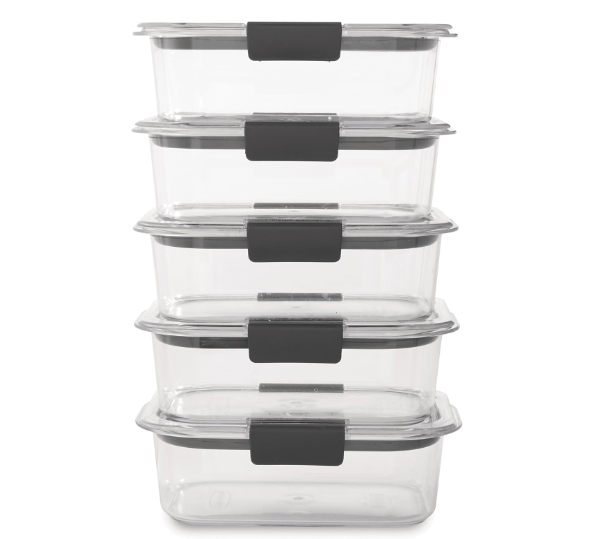
For those who carry their lunch across town, the Brilliance Tritan line offers the clarity of glass with the impact resistance of plastic. These are made from Eastman Tritan copolyester. Why it matters: Tritan is a high-grade polymer that is BPA-free and incredibly resistant to "crazing" (those tiny white cracks that appear in old plastic). It is also non-porous, so your spicy curry won't leave a permanent orange stain or a lingering garlic smell.
From a technical standpoint, the stackable design is engineered for vertical stability. The lids have a recessed rim that fits perfectly into the base of the container above it. Why it matters: This "nesting" geometry prevents the containers from sliding around in your fridge or lunch bag. The seal is identical to the glass version, meaning it is 100% leakproof. We've tested these with water and shaken them vigorously; they do not leak.
The trade-off is that while it is "microwave safe," high-fat foods or high-sugar sauces can reach temperatures that "pit" or melt the surface of the plastic if heated for too long. If you use it for reheating oily pasta, you might see small surface scars over time. It is best used for salads, sandwiches, or cold-storage items that need a lightweight, durable home.
Eastman Tritan is engineered to be chemically resistant to hundreds of common food acids and detergents. Why it matters: This prevents the plastic from breaking down and leaching chemicals into your food, even after 100+ dishwasher cycles.
Best for Dry Goods: OXO Good Grips POP Containers (Gen 2)
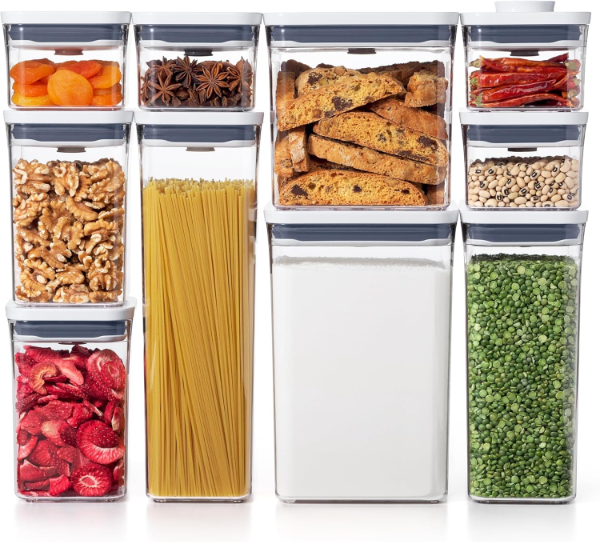
The OXO POP line is the gold standard for pantry organization, specifically designed for dry goods like flour, sugar, and cereal. The "Gen 2" version features a modernized lid mechanism that can be fully disassembled for cleaning. The primary feature is the "POP" button on top. Why it matters: This is a mechanical vacuum seal. Pressing the button engages a silicone skirt against the inner walls of the container, creating an airtight barrier that keeps moisture out and freshness in.
Technically, the square and rectangular shapes are designed for maximum space efficiency. In the world of logistics, we call this "cubing out." Why it matters: Round containers waste 21% of the space on a shelf. OXO's right-angle corners ensure that your pantry uses every square inch of available volume. The lids also feature a mount on the underside for OXO accessories like scoops or levelers, keeping them off the bottom of the flour bin.
The honest limitation: these are not leakproof for liquids and are not meant for transport. If you tip a POP container filled with soup, the lid will eventually fail. They are also made of SAN plastic, which is BPA-free but can be more brittle than Tritan. If you drop a full container of rice on a tile floor, it is likely to crack. These are "set and forget" pantry tools, not rugged lunchboxes.
The silicone seal on the POP lid is curved to maximize surface area contact with the container walls. Why it matters: This allows the seal to compensate for slight manufacturing variances in the plastic walls, ensuring a perfect airtight lock every time the button is pressed.
Best Eco-Friendly: Stasher Silicone Reusable Bowls
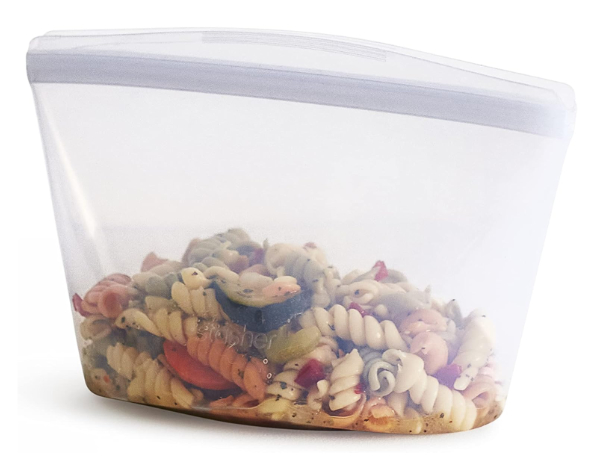
Stasher has moved beyond simple bags into "stand-up" bowls made from 100% platinum-grade silicone. This material is made from sand (silica) and is completely free of plastics and endocrine disruptors. Why it matters: Unlike plastic, silicone is extremely heat stable. You can take a Stasher bowl and put it in the microwave, a boiling pot of water (sous-vide), or even an oven up to 425?F without any degradation.
The "Pinch-Loc" seal is the technical highlight. It is a patented tongue-and-groove closure that is virtually leakproof. Why it matters: You can store a smoothie or soup in these bowls and lay them flat in the freezer to save space. Once frozen, they won't crack like plastic would in extreme sub-zero temperatures. They are also "infinitely" reusable, reducing the thousands of single-use plastic bags that would otherwise end up in landfills.
The downside is the "floppiness" factor. Because they are flexible, they don't stack in the fridge like rigid boxes. They also tend to attract lint and pet hair due to the static nature of silicone. Cleaning can be tricky; while they are dishwasher safe, they often need to be propped open to dry completely. These are for the eco-conscious user who wants a multi-tool that can go from the freezer to the oven.
Stasher uses platinum as the curing agent rather than peroxide. Why it matters: Peroxide curing leaves behind "blooming" residues. Platinum-grade silicone is the highest purity available, ensuring zero off-gassing or odor transfer to your food.
Best Space-Saver: Joseph Joseph Nest Storage
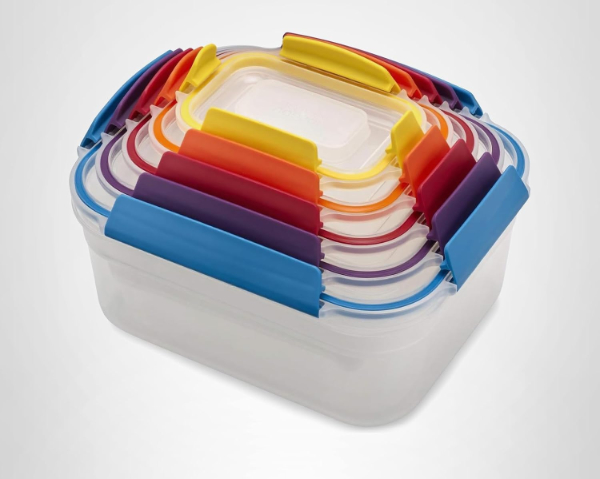
If you have ever been buried under an avalanche of mismatched lids in your "Tupperware drawer," the Joseph Joseph Nest is the solution. The technical innovation here is the color-coded, snap-together lid system. Both the containers and the lids nest inside one another. Why it matters: This set reduces the footprint of a 10-piece set to the size of a single large container. It is the ultimate "ergonomic" design for small apartment living.
Technically, the lids feature a "lockable" snap-on design with a silicone gasket. While not as vacuum-tight as the Rubbermaid Brilliance, they are highly splash-resistant. The color-coding on the bottom of each container matches a colored dot on the corresponding lid. Why it matters: You don't have to play "Cinderella's Slipper" to find the right lid. You simply match blue to blue and you're done.
The trade-off is the material. These are made of polypropylene, which is durable and BPA-free but is more prone to staining and odors than Tritan or glass. If you store spaghetti sauce in these, expect a pink tint. The lids also require a bit of force to snap on, which might be a struggle for users with arthritis. This is a "lifestyle" product for those who value kitchen organization above all else.
The draft angle (the slope of the walls) of these containers is mathematically optimized to allow them to stack without getting "stuck" via air pressure. Why it matters: This ensures you can pull the middle container out of the stack easily with one hand.
How We Chose These Products
Our selection process involved analyzing four primary vectors: Material Integrity, Seal Performance, Ease of Maintenance, and Thermal Versatility. We prioritized products that are BPA-free and Lead-free to ensure consumer safety. We also evaluated the "Leak Factor" by performing inversion tests with liquids. Finally, we favored products with long-term manufacturing support - there is nothing more frustrating than buying a set and being unable to find replacement lids two years later. These five brands have consistent retail availability and verifiable manufacturer support.
Comparison Overview
| Model | Primary Material | Airtight Type | Microwave Safe | Best For |
|---|---|---|---|---|
| Brilliance Glass | Borosilicate Glass | Silicone Latch | Yes (Vented) | Oven-to-Table Meals |
| Brilliance Tritan | Tritan Plastic | Silicone Latch | Yes (Vented) | Commuting/Portability |
| OXO POP | SAN Plastic | Mechanical Button | No | Pantry/Dry Goods |
| Stasher Bowls | Platinum Silicone | Pinch-Loc Seal | Yes | Freezing/Eco-Conscious |
| Joseph Joseph Nest | Polypropylene | Snap-on Gasket | Yes | Organization/Small Spaces |
Buying Guide: What to Look For
- Seal Geometry: Look for removable silicone gaskets. Why it matters: Gaskets that are "molded in" can eventually trap moisture and mold behind them. Being able to remove and boil a gasket ensures true sanitation.
- Thermal Shock Rating: Only choose borosilicate if you plan to use it in the oven. Why it matters: Standard soda-lime glass is cheaper but can explode if you put a hot container on a cold countertop.
- Lid Clarity: Avoid opaque lids if you store food in the fridge. Why it matters: If you can't see the food from the top, you are 40% more likely to forget it exists, leading to food waste.
- Nesting Capability: Check if the containers stack with the lids ON. Why it matters: This is the difference between a tidy fridge and a leaning tower of plastic that falls over when you reach for the milk.
General Pro / Cons
| Pro: High-Performance Features | Con: Common Limitations |
|---|---|
| Stain resistance (Tritan/Glass models) keeps containers looking new. | Initial cost is higher than disposable grocery-store brands. |
| Airtight seals extend the shelf life of food by up to 3x. | Glass models are heavy and can break if dropped. |
| Vented lids prevent microwave "mess" and vacuum locks. | Silicone can pick up odors from strong foods like onions. |
| BPA-free materials ensure no chemical leaching during heating. | Complex lids (like OXO POP) can be difficult to dry completely. |
| Modular sizes maximize shelf space and organization. | Plastic is susceptible to "pitting" from high-sugar/fat foods. |
| Sustainability: One good set can last a decade. | Lid loss: Missing a single lid can render the base useless. |
Final Summary
Investing in high-quality food storage is a direct way to reduce food waste and improve kitchen efficiency. For most users, a mix of Rubbermaid Brilliance Glass for leftovers and OXO POP for the pantry provides the best coverage. While the upfront cost of $40-$100 for a set may seem high, the durability and preservation benefits far outweigh the cheap alternatives. These picks represent the intersection of material safety and practical design. Aggregate rating of the products reviewed: 4.7 out of 5.