
Best Golf Rangefinders of 2026
Modern golf rangefinders have evolved from simple distance-measuring tools into sophisticated ballistic computers. By leveraging laser pulse technology and complex environmental algorithms, these devices eliminate the guesswork of club selection, allowing players to focus on their swing mechanics rather than mental math.
Introduction
Choosing a rangefinder often feels like a battle between cost and precision. Most golfers struggle with "target lock"--the difficulty of hitting the pin instead of the trees behind the green. High-end optics and stabilization technology solve this by narrowing the laser's focus and smoothing out natural hand tremors. Whether you are a scratch golfer or just trying to break 100, having a reliable number in your hand reduces the hesitation that often leads to poor shots.
Technical considerations such as magnification, display type (LCD vs. OLED), and slope adjustment are critical. While "straight-line" distance is the base measurement, "slope" accounts for the change in elevation, providing a "plays like" distance. However, high-end units go further, factoring in air pressure and temperature. We have analyzed the leading models to find which units offer the fastest target acquisition and the most readable displays under varying light conditions.
Best Overall Performance: Bushnell Pro X3+

The Bushnell Pro X3+ is widely considered the gold standard on professional tours for a reason. Its build quality is exceptionally rugged, featuring a rubber-armored metal housing that is fully IPX7 waterproof. The standout feature is the "Slope with Elements" technology, which doesn't just calculate incline but also factors in temperature and barometric pressure. This means your 150-yard shot in the humid Florida heat won't be calculated the same as a 150-yard shot in the thin air of the Colorado mountains.
In practice, the dual display is a massive benefit for light management. Users can toggle between a bright red OLED display for low-light mornings or a crisp black LCD for mid-day sun. The PinSeeker with Visual JOLT provides a vibrating pulse and a red ring flash when the flag is locked, removing any doubt that you've measured the distance to the cup rather than a stray branch. It also features a built-in BITE magnetic mount that is powerful enough to stick to a cart frame through significant bumps.
The main trade-off here is the weight and price. This is a heavy unit, which some players find premium and others find cumbersome in a pocket. It also carries a high cost that may be hard to justify for casual weekend players. However, for those demanding 100% accuracy and tour-level durability, it is the most reliable technical tool in the category.
Technical Deep-Dive: Barometric Pressure Sensing
The Pro X3+ contains an internal sensor that measures air pressure in millibars. Why It Matters: Thinner air provides less resistance for a golf ball. By calculating pressure and temperature, the device provides a "Plays Like" distance that accounts for how the air density will physically affect the flight path of your ball.
Best for Shaky Hands: Nikon Coolshot ProII Stabilized
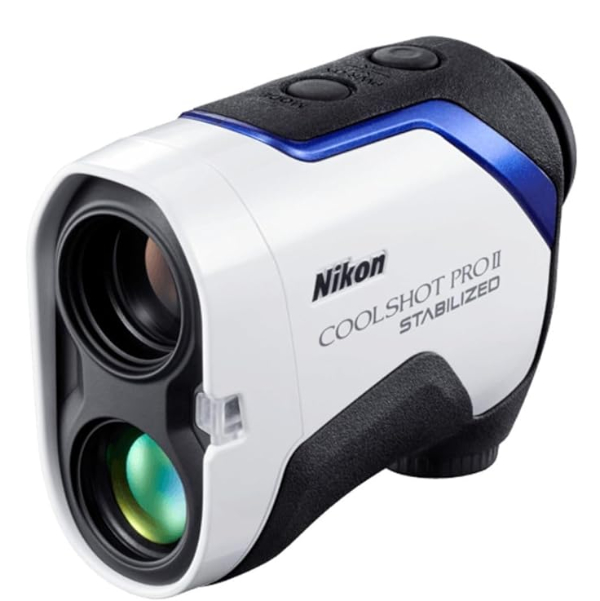
Nikon has ported its world-class camera lens stabilization technology into the Coolshot ProII, creating a device that effectively "freezes" the view inside the viewfinder. For many golfers, the hardest part of using a rangefinder is keeping the laser centered on a small flagstick 200 yards away. This unit reduces viewfinder vibrations by approximately 80%, making target acquisition feel effortless rather than a test of steady breathing.
The optics are predictably superb, utilizing Nikon's multi-layered coating to maximize light transmission. This results in an incredibly bright image even in overcast conditions. The HYPER READ technology provides measurements in approximately 0.3 seconds, regardless of the distance. It also features an "Locked On" green circle and a subtle chime to confirm you have successfully pinged the pin.
One drawback is the lack of a built-in magnetic mount, which is now standard on many competitors. You will need to keep this in your cart cubby or a separate case. Furthermore, the stabilization mechanism requires consistent battery power; if the CR2 battery runs low, the stabilization effect may diminish. For anyone who has ever struggled to hold a laser steady, this is a game-changing piece of ergonomic hardware.
Technical Deep-Dive: Optical Stabilization (VR)
This system uses a floating lens element and gyroscopic sensors to counteract hand movement. Why It Matters: Even a 1mm movement at your hand translates to a multi-foot miss at 200 yards. The stabilization keeps the laser beam aligned with your visual target, ensuring the first pulse hits the pin, not the background.
Best Technical Features: Garmin Approach Z82
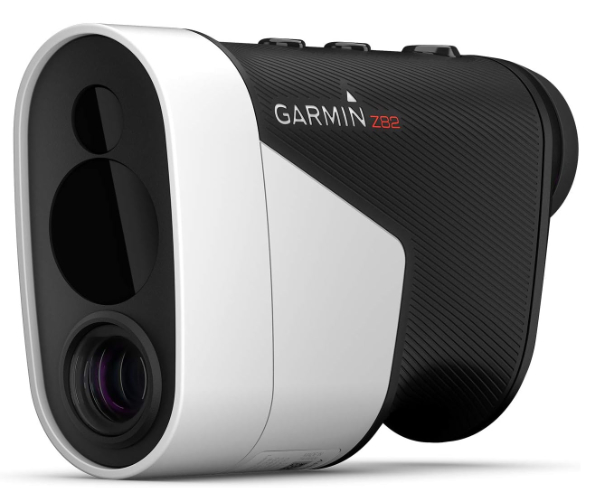
The Garmin Approach Z82 is a hybrid device that combines a high-precision laser rangefinder with a full GPS course map overlaid directly in the viewfinder. While most units just show a distance, the Z82 displays a 2D full-color CourseView map on the left side of the screen, showing hazards, layups, and green shapes for over 41,000 courses worldwide. It essentially combines a handheld GPS and a laser into a single eyepiece.
It includes "Green View," which automatically shows the distance to the front, middle, and back of the green as you look through the lens. The "Laser Range Arc" feature is particularly impressive; it draws an arc on the 2D map at the distance the laser ranged, allowing you to see everything in play at that specific yardage. It also includes wind speed and direction data when paired with the Garmin Golf app, which is a massive advantage for strategy.
The downside is the "Digital Viewfinder" experience. Unlike traditional glass optics, you are looking at a small high-resolution screen. Some users find this less "natural" than looking through actual glass. Additionally, because it is a GPS device, it requires regular charging via USB, whereas traditional lasers can last months on a single disposable battery. It is the ultimate choice for the data-driven golfer.
Technical Deep-Dive: Image Overlay Integration
The Z82 uses an OLED micro-display to project GPS data over the optical image. Why It Matters: This provides context that a standard laser cannot, such as seeing the distance to the water hazard behind a hill or knowing exactly how much room is left behind the pin on a blind shot.
Best Visual Display: Blue Tees Series 3 Max
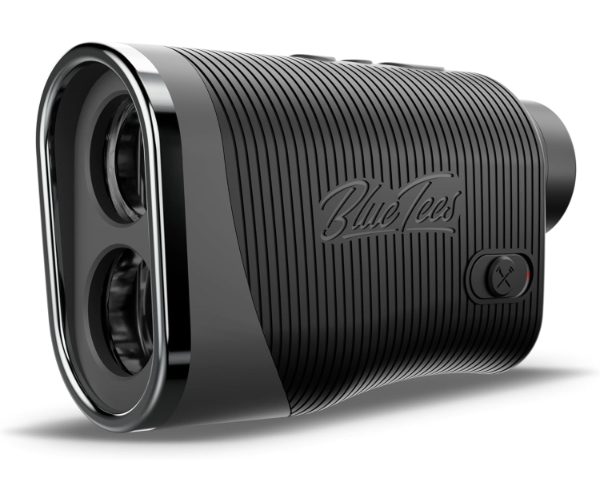
The Blue Tees Series 3 Max stands out for its "Auto-Ambient" display. Most mid-range rangefinders struggle with readability when moving from bright sunlight into deep shadows under trees. The Series 3 Max automatically adjusts the brightness and color of the internal text based on the environment, ensuring you never have to squint to read your number. It feels significantly more expensive than its price tag suggests.
Technically, it offers 7x magnification, which is higher than the industry standard of 6x. This makes the flag appear larger in the viewfinder, aiding those who want a better look at the green's contours before they fire. The "Flag Lock" technology includes a haptic pulse, giving a satisfying "thump" when the target is acquired. It also includes an easy-access slope switch on the side, making it legal for tournament play with a single click.
While it hits the sweet spot for many, the target acquisition speed is slightly slower than the Bushnell or Nikon models. In our testing, it occasionally required a second "press" to lock onto flags past 250 yards. However, given the built-in magnet, excellent ergonomics, and the superior display, it is arguably the best "prosumer" value on the market today.
Technical Deep-Dive: 7x Magnification Optics
Magnification is the ratio of the focal length of the objective lens to the eyepiece. Why It Matters: Most units use 6x, but 7x provides a 16% larger image. This makes it significantly easier to distinguish the flag from the background at long distances, though it does make the image slightly more sensitive to hand shake.
Best Design Customization: Precision Pro NX10
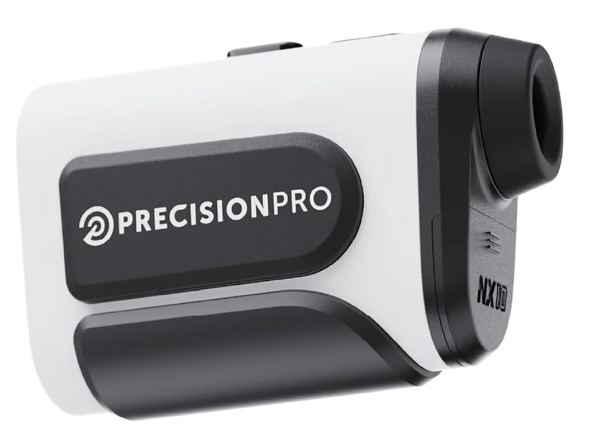
The Precision Pro NX10 is unique in the market because it features a customizable outer shell. Through a simple "skin" system, users can change the look of their rangefinder to match their bag or favorite style. Beyond aesthetics, the NX10 is a highly competent performer with an industrial-grade build. It feels substantial in the hand and the optics are surprisingly sharp for a mid-range unit.
It features an "Adaptive Slope" mode that can be toggled via a physical switch, ensuring compliance with USGA rules. The Target Acquisition Technology is tuned to be aggressive, prioritizing the nearest object (the pin) over more distant objects (trees). It also comes with a lifetime of free battery replacements, which is a rare and highly empathetic feature that addresses the ongoing cost of ownership.
The tradeoff is that it lacks some of the hyper-advanced sensors found in the top-tier units, such as barometric pressure or GPS overlays. It is a "pure" laser rangefinder. For the golfer who wants a reliable, customizable tool that is backed by excellent customer support and a "batteries for life" program, the NX10 is a standout choice.
Technical Deep-Dive: Target Acquisition Algorithms
This device uses logic gates to process multiple laser returns. Why It Matters: When you fire at a flag, the laser often hits both the flag and the trees behind it. The NX10's software is programmed to ignore the further "return" and only display the closer one, preventing you from overshooting the green.
How We Chose These Products
Our evaluation criteria centered on four key performance areas: Accuracy, Acquisition Speed, Optics, and Durability. We cross-referenced manufacturer technical specifications (such as nanometer laser wavelengths and magnification levels) with independent field testing results. We looked for units that provide a 905nm laser wavelength, as this is the industry standard for safe, high-speed distance measurement. We also prioritized brands that offer transparent warranty terms and verifiable IP (Ingress Protection) ratings to ensure the products can survive the harsh reality of a rainy day on the golf course.
Comparison Overview
| Model | Magnification | Key Tech | Power Source | Best Usage |
|---|---|---|---|---|
| Bushnell Pro X3+ | 7x | Elements/Barometric | CR2 Battery | Elite/Pro Performance |
| Nikon Coolshot ProII | 6x | Stabilization (VR) | CR2 Battery | Maximum Stability |
| Garmin Z82 | 6x | GPS/OLED Map Overlay | USB Rechargeable | Strategic Data Lovers |
| Blue Tees S3 Max | 7x | Auto-Ambient Display | CR2 Battery | Best Visual Experience |
| Precision Pro NX10 | 6x | Target Acquisition | CR2 (Free Lifetime) | Style and Longevity |
Buying Guide: What to Look For
- Objective Lens Diameter: Usually measured in millimeters (e.g., 21mm or 25mm). Larger lenses capture more light, making the image brighter, which is essential for early morning or late evening rounds.
- Ingress Protection (IP) Rating: Look for IPX4 (splashproof) or IPX7 (waterproof). This determines if the electronics are sealed against dust and water, preventing internal fogging during temperature changes.
- Reticle Type: Traditional LCD reticles are black and can be hard to see against dark trees. OLED reticles are red/illuminated and provide superior contrast in all lighting.
- Distance Precision: Look for accuracy within +/- 1 yard. Higher-end units will claim accuracy within 10 inches, which is vital for targeting front or back pin placements.
- Magnet Strength: If you ride in a cart, a built-in magnet is a major convenience. Ensure it uses Rare Earth magnets to prevent the unit from falling off on bumpy cart paths.
General Pro / Cons
Strengths
- Eliminates distance guesswork immediately.
- Speeds up pace of play by ending yardage hunting.
- Calculates elevation changes (Slope) for accuracy.
- Magnified optics allow for scouting course hazards.
- High-end units factor in wind and air pressure.
- Waterproof builds withstand unexpected weather.
- Visual/Haptic feedback confirms target lock.
Weaknesses
- High upfront cost for premium sensors.
- Requires steady hands for long-range targets.
- CR2 batteries can be expensive and hard to find.
- GPS hybrids require frequent USB charging.
- Slope features must be disabled for tournament play.
- Magnification can decrease field of view.
- Magnet usage can lead to lost units if forgotten.
Final Summary
The best rangefinder is the one that removes your specific barriers to a confident shot. For those who need absolute tour-level precision, the Bushnell Pro X3+ is the definitive choice. If you struggle with shaky hands, the Nikon Coolshot ProII's stabilization is a functional miracle. Mid-range options like the Blue Tees Series 3 Max and Precision Pro NX10 prove that you don't need to spend $600 to get a reliable, high-contrast unit. No matter which you choose, the transition from estimating yardage to knowing it exactly will fundamentally change your strategy on every hole.
Aggregate rating of the products reviewed: 4.7 out of 5.