
Best Home Fire Extinguishers of 2026
An authoritative guide to selecting the right UL-rated suppression tools to protect your family and property from common residential fire hazards.
Introduction
Buying a fire extinguisher is a task most people put off because the technical jargon - ratings like "1-A:10-B:C" - feels like a math test you didn't study for. However, having the wrong unit, or one with a faulty plastic valve, can be the difference between a minor kitchen mishap and a total loss. In this guide, we strip away the marketing fluff to look at the material science and mechanical reliability of the units currently available for your home.
Most residential fires fall into three categories: Class A (wood, paper, cloth), Class B (flammable liquids like grease or gasoline), and Class C (electrical equipment). A "multipurpose" extinguisher is designed to handle all three using a chemical called monoammonium phosphate. While these chemicals are effective, the physical build of the extinguisher - specifically whether the valve and handle are metal or plastic - dictates whether the unit will actually hold its pressure over five to ten years of sitting in your pantry.
Best Overall & Professional Choice: Amerex B402 (5lb ABC)
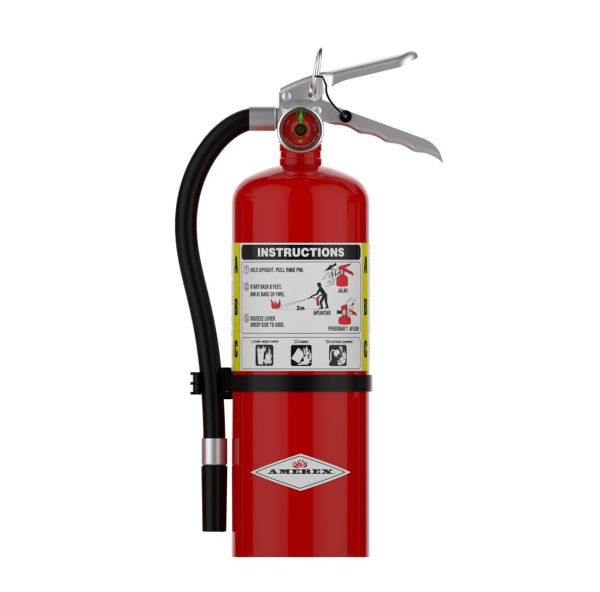
The Amerex B402 is widely considered the "Gold Standard" by fire safety professionals. Unlike the cheaper units found in big-box stores, the B402 features an all-metal valve construction and a drawn-steel cylinder. Why it matters: Plastic valves are prone to "creep," where the material slowly deforms over time under the 195 PSI (pounds per square inch) of internal pressure. This often leads to gradual leaks that leave the unit useless when you actually pull the pin. The metal assembly ensures a hermetic seal that lasts for years.
Technically, this unit carries a 2-A:10-B:C rating. The "2-A" designation means it has the equivalent extinguishing power of 2.5 gallons of water on wood or paper fires. Why it matters: This is twice the capacity of standard "entry-level" home units, giving you a critical extra 14 seconds of discharge time to suppress a growing flame before it becomes unmanageable. It is also fully rechargeable, meaning if you use it once, a local fire service shop can refill it rather than you having to throw the whole unit in the trash.
The trade-off is the price and weight. At nearly 10 lbs fully loaded, it can be heavy for some users to maneuver, and it costs significantly more than budget alternatives. However, when you factor in that this unit can be serviced and maintained for 20+ years, the total cost of ownership is actually lower than buying "disposable" plastic units every six years. This is the best choice for your main floor or hallway.
Amerex uses anodized aluminum for their valve bodies. Anodizing is an electrochemical process that converts the metal surface into a decorative, durable, corrosion-resistant, anodic oxide finish. Why it matters: This prevents the "pitting" and corrosion that can occur in humid environments like laundry rooms or garages, ensuring the internal spring mechanism never seizes up.
Best for General Home Use: First Alert Home1 (FE1A10GR)
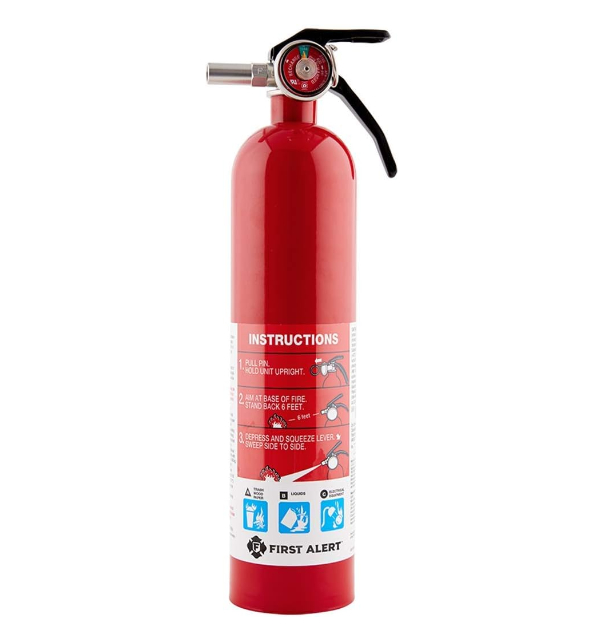
The First Alert Home1 is the most common "defensive" unit for a reason: it strikes a balance between portability and utility. It features a 1-A:10-B:C rating, which is the minimum recommended for a residential living space. Why it matters: While it has less "A" capacity than the Amerex, it is much lighter (around 5 lbs), making it easy to grab from under a sink or inside a closet during a panic.
One of the standout features is the oversized, easy-to-read pressure gauge. Why it matters: Fire extinguishers are "set it and forget it" devices. Having a gauge that clearly shows a green "charged" zone allows you to perform a 5-second visual inspection once a month to ensure the nitrogen propellant hasn't leaked out. If the needle drops into the red, you know immediately that the unit needs replacement.
The primary limitation is the plastic handle and valve assembly. These units are generally considered "disposable." Once the seal is broken (even by a tiny test spray), the unit will lose pressure and cannot be reliably recharged at a cost lower than buying a new one. It is an excellent, budget-friendly "layer" of protection for every bedroom, but shouldn't be your only line of defense.
This unit uses monoammonium phosphate as its extinguishing agent. Why it matters: This chemical melts at low temperatures ($190^\circ C$) to form a "molten" layer that coats the fuel and cuts off oxygen. It is highly effective but also acidic; it can damage electronics if not cleaned up quickly after use.
Best for Garage & Workshop: Kidde Pro 210 (2-A:10-B:C)
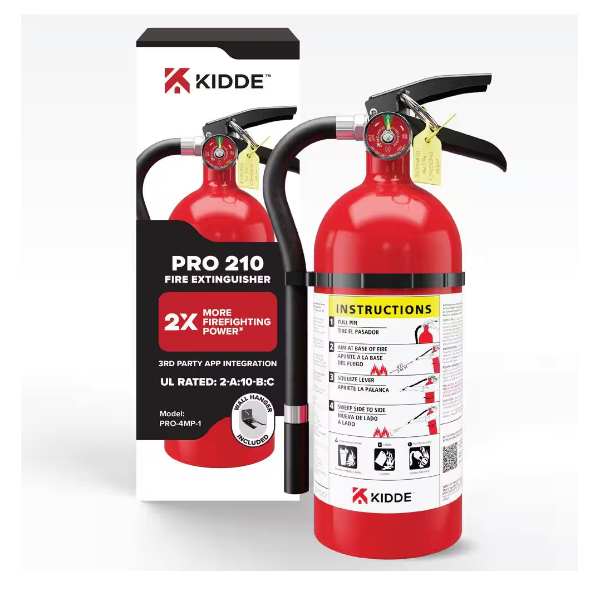
The Kidde Pro 210 is a "prosumer" unit that bridges the gap between disposable home units and industrial gear. It offers a 2-A:10-B:C rating in a package that is slightly more compact than the Amerex. Why it matters: In a garage or workshop, you are more likely to encounter Class B (oil/gas) and Class C (power tool) fires. The 4 lbs of dry chemical agent in this unit provides enough volume to suppress a liquid spill fire that a smaller unit might struggle with.
Unlike the cheaper Kidde "Home" models, the Pro series uses a chrome-plated brass valve. Why it matters: Brass is an alloy of copper and zinc that is naturally resistant to sparking and extremely durable. This is critical in a workshop environment where the unit might get bumped by lumber or tools. The metal valve also allows the unit to be recharged by professionals.
One downside is the mounting bracket. The included plastic bracket is functional but can be flimsy for a 7 lb total weight unit. For a workshop, we recommend upgrading to a steel "marine" bracket to ensure the unit stays secure during vibrations or accidental impacts. It is a reliable, high-capacity tool for high-risk areas.
The Pro 210 has an effective discharge range of 10 to 15 feet. Why it matters: In a garage fire involving flammable liquids, you do not want to stand directly over the flames. This range allows you to maintain a safe distance while using the "PASS" method (Pull, Aim, Squeeze, Sweep).
Best for Kitchen & Accessibility: First Alert EZ Fire Spray
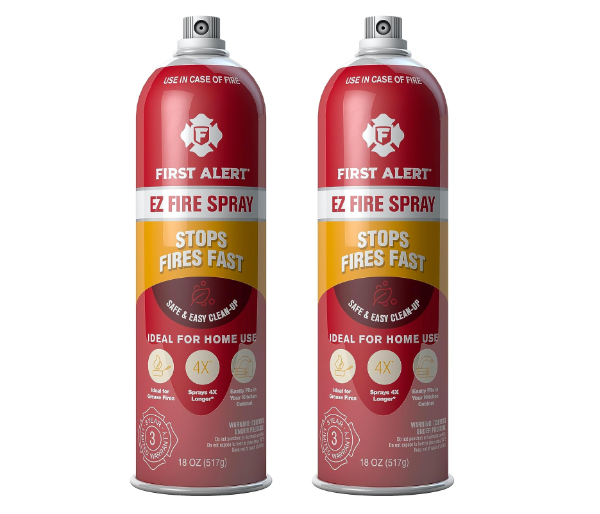
The EZ Fire Spray is not a traditional extinguisher; it's an aerosol-based suppression tool. It does not carry a standard UL "Alpha-Numeric" rating, but it is tested to suppress common small fires. Why it matters: Traditional extinguishers require you to pull a pin and use a heavy lever. For the elderly, children, or those with limited grip strength, the spray-can form factor is much more intuitive - you just point and press a button.
Technically, it uses a specialized biodegradable formula that is much easier to clean up than ABC powder. Why it matters: Standard ABC powder is incredibly messy and can ruin your oven or stovetop even if the fire was small. The EZ Fire Spray uses a liquid agent that can be wiped away with a damp cloth, saving you thousands in kitchen cleanup costs.
The trade-off is capacity and range. This unit only sprays for about 20-30 seconds and has a very short reach (about 3-5 feet). It is designed for "stage one" fires - a pan of grease or a toaster flare-up. It is not a substitute for a primary 5lb extinguisher, but it is the perfect "first response" tool to keep right next to the stove.
Unlike nitrogen-pressurized cylinders, this uses an internal pouch-on-valve system. Why it matters: This allows the spray to work at any angle, even upside down. In a kitchen fire where you might be reaching over a counter, this flexibility ensures the agent actually reaches the base of the fire.
Best Compact Metal Valve Option: Buckeye 2.5 lb ABC
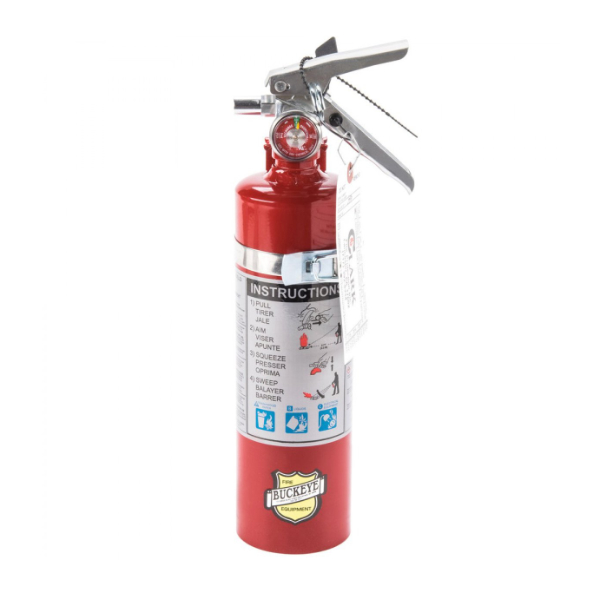
Buckeye is an American manufacturer that focuses on industrial-grade equipment. Their 2.5 lb unit is the best choice if you need a high-reliability unit that fits in a small space, like a laundry room cabinet or a vehicle mount. Why it matters: Most 2.5 lb units at the hardware store use plastic valves to save weight. Buckeye uses anodized aluminum valves even on their smallest units, ensuring the unit won't leak over time.
It carries a 1-A:10-B:C rating despite its small size. Why it matters: It has the same fire-fighting "rating" as the larger First Alert Home1 but in a much more durable, metal-bodied package. This makes it ideal for mounting in "utility" environments where it might be subject to temperature swings or physical jostling.
The limitation here is strictly the volume of agent. With only 2.5 lbs of powder, you have a very limited "mistake window." You must aim accurately at the base of the fire on the first try, as the unit will empty in roughly 9-10 seconds. It is a precision tool for the prosumer who wants the highest quality materials in the smallest possible footprint.
Buckeye coats their cylinders in a polyester epoxy powder finish. Why it matters: This coating is UV-resistant and salt-spray tested for 240 hours. This means the cylinder itself won't rust or weaken if stored in damp basements or near coastal salt air.
How We Chose These Products
Our evaluation criteria were based on the standards set by the National Fire Protection Association (NFPA) and Underwriters Laboratories (UL). We prioritized units that provide ABC coverage, as most home fires involve a mix of materials. Crucially, we analyzed the valve material science - preferring metal (brass or aluminum) over plastic (acetal or nylon) for any unit intended to serve as a primary safety device. We also looked for units with clear, visual pressure gauges and "rechargeability" as a marker of industrial build quality.
Comparison Overview
| Model | UL Rating | Valve Material | Weight (Agent) | Rechargeable? |
|---|---|---|---|---|
| Amerex B402 | 2-A:10-B:C | Anodized Aluminum | 5.0 lbs | Yes |
| First Alert Home1 | 1-A:10-B:C | Plastic | 2.5 lbs | No |
| Kidde Pro 210 | 2-A:10-B:C | Chrome-Plated Brass | 4.0 lbs | Yes |
| First Alert EZ Spray | N/A (Aerosol) | Pouch-on-Valve | 14 oz | No |
| Buckeye 2.5 lb | 1-A:10-B:C | Anodized Aluminum | 2.5 lbs | Yes |
Buying Guide: What to Look For
- UL Rating Decoding: The number before 'A' tells you how much water-equivalent it has (1 = 1.25 gal). The number before 'B' tells you the square footage of liquid fire it can handle (10 = 10 sq ft). Look for at least 1-A:10-B:C.
- Valve Construction: Avoid plastic valves for your primary hallway extinguisher. They are more likely to leak over 5-10 years. Brass or aluminum is worth the extra $20.
- Agent Weight vs. Total Weight: An extinguisher listed as "5 lbs" refers to the powder inside. The actual unit will weigh nearly 10 lbs. Ensure all family members can lift it.
- Serviceability: If the unit has a metal valve, it can be refilled. If it has a plastic valve, it is a one-time use item. Check for a "rechargeable" label on the neck.
General Pro / Cons
| Pro: Why You Need One | Con: The Realities of Ownership |
|---|---|
| Can stop a small fire before it causes catastrophic damage. | ABC powder is corrosive and creates a massive cleanup job. |
| Provides peace of mind and potentially lowers insurance rates. | Requires regular inspection; they are not "install and forget." |
| Inexpensive relative to the value of a home ($40-$100). | Plastic-valved units can leak silently over several years. |
| Essential for kitchens where grease fires cannot be hit with water. | Using the wrong class (e.g., water on grease) can spread the fire. |
| Modern units are much lighter and easier to use than old steel units. | The chemical agent can settle/compact if not "fluffed" annually. |
| Standardized "PASS" method is easy to learn and remember. | Most home units only provide 10-15 seconds of spray time. |
Final Summary
Fire safety is about layers of protection. While a budget unit like the First Alert Home1 is perfect for tucking away in every bedroom, your main defensive line should be an all-metal unit like the Amerex B402. It offers twice the fire-fighting capacity and a valve assembly that won't fail when you need it most. For specific high-risk zones like the kitchen, a clean-agent spray like the First Alert EZ Fire Spray provides an accessible, low-mess option. Remember to check your gauges monthly and replace any unit that shows signs of corrosion or pressure loss. Aggregate rating of the products reviewed: 4.48 out of 5.