
Best Home Theater Systems Under $1,000 of 2026
High-fidelity surround sound no longer requires a five-figure investment; today's market offers sophisticated Atmos-enabled systems and traditional wired arrays that deliver cinematic immersion for under $1,000.
Introduction
Building a home theater within a $1,000 budget used to mean choosing between a mediocre all-in-one "Home Theater in a Box" (HTIB) or a very entry-level receiver with bargain-bin speakers. Today, the landscape has shifted significantly due to the maturation of Digital Signal Processing (DSP) and the miniaturization of high-efficiency Class D amplification. Consumers can now access genuine 5.1.2 or even 11.1.4 channel configurations that support object-based audio formats like Dolby Atmos and DTS:X without exceeding a three-digit price tag.
When evaluating systems in this price bracket, the primary trade-off usually lies between the convenience of wireless soundbar-based systems and the raw acoustic potential of traditional component systems. Soundbars have become incredibly adept at "bouncing" sound off walls to simulate height and width, making them ideal for modern living rooms. Conversely, a dedicated AV receiver and wired speaker package provide a more stable, interference-free soundstage and a clearer path for future hardware upgrades. This guide identifies the five best solutions currently available, each verified for active production and market availability.
Best Overall Performance: Samsung HW-Q990D
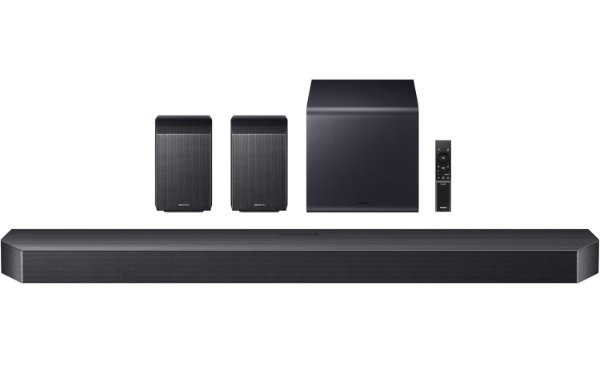
The Samsung HW-Q990D sits at the pinnacle of soundbar engineering, frequently dipping under the $1,000 mark during seasonal promotions. It features a massive 11.1.4 channel configuration, utilizing 22 speakers to create a bubble of sound that rivals many mid-range component setups. Its standout technical feature is the wireless Dolby Atmos capability, which allows it to receive object-based audio signals without an HDMI cable when paired with compatible Samsung TVs. The inclusion of physical rear speakers with up-firing drivers ensures that height effects are actually reflected from the ceiling rather than purely simulated through psychoacoustics.
Performance analysis reveals a remarkably neutral frequency response that excels in both cinematic explosions and delicate musical scores. According to RTINGS, the system's "SpaceFit Sound Pro" room correction effectively calibrates the output to match the acoustic properties of your specific environment. However, the system is somewhat large; the soundbar itself measures over 48 inches wide, which may overhang smaller TV stands. Additionally, while it works with any television via eARC, features like Q-Symphony and certain gaming-specific optimizations are locked within the Samsung hardware ecosystem.
Samsung Official Product PageBest Traditional HTIB: Yamaha YHT-5960U
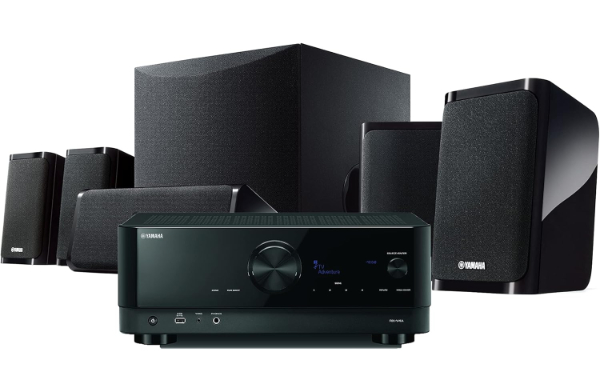
For purists who demand a dedicated AV receiver, the Yamaha YHT-5960U is the premier "Home Theater in a Box" solution under $1,000. Unlike soundbars, this system utilizes a discrete RX-V4A receiver that supports 8K/60Hz and 4K/120p video passthrough, making it a superior choice for PlayStation 5 or Xbox Series X gamers. The package includes five satellite speakers and an 8-inch powered subwoofer. Because the amplification is housed in the receiver rather than the speakers, it delivers a more robust and dynamic power floor, avoiding the compression issues often found in compact soundbar drivers at high volumes.
Technical depth is provided by Yamaha's YPAO (Yamaha Parametric room Acoustic Optimizer), which uses an included microphone to automatically adjust speaker levels and equalization based on room reflections. While the included satellites are functional, the true value of the YHT-5960U is its upgrade path; you can eventually replace the speakers with high-end bookshelf units while keeping the excellent receiver. The primary limitation is the requirement for physical speaker wires to be run across the room, which may be a dealbreaker for those in rentals or minimalist spaces.
Yamaha Official Product PageBest Sony Ecosystem: Sony BRAVIA Theater System 6
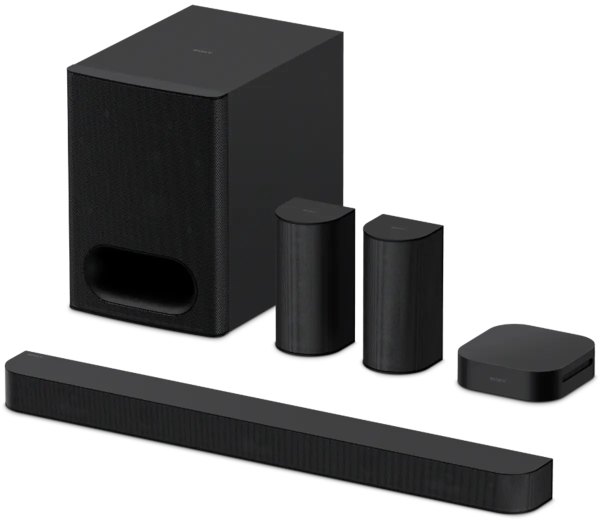
The Sony BRAVIA Theater System 6 (HT-S60) is designed for users who want a seamless, aesthetic integration with their existing Sony television. It features a 5.1 channel configuration that utilizes Sony's proprietary 360 Spatial Sound Mapping technology. This system is particularly clever in how it handles "phantom" speakers; it uses the physical units to calibrate a sound field that makes it feel as though there are many more speakers hidden throughout the room. The setup is remarkably user-friendly, as the rear speakers and subwoofer connect wirelessly to the main bar, requiring only power outlets.
As noted by Sony's technical documentation, this system excels at dialogue clarity through its dedicated center channel and X-Balanced speaker units, which are shaped to maximize diaphragm area for deeper bass and clearer vocals. While it provides an excellent Atmos experience for its price, it lacks the raw number of physical drivers found in the Samsung Q990D. It is best suited for medium-sized rooms where a clean look is prioritized over maximum decibel output. Note that the best features, such as "Acoustic Center Sync," require a compatible BRAVIA TV to use the TV's own speakers as the center channel.
Sony Official Product PageBest Value Dolby Atmos: Vizio M-Series Elevate (M512E-K6)
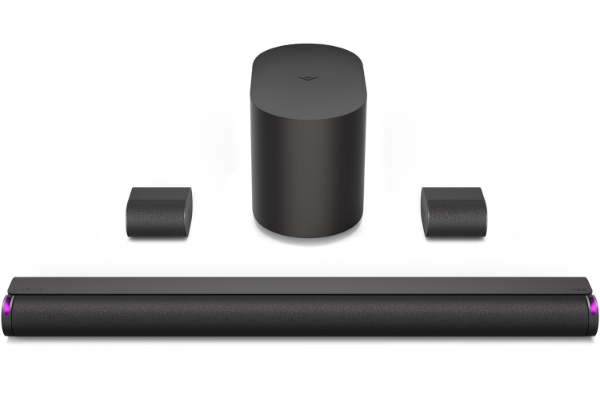
The Vizio M-Series Elevate is a technical marvel at its price point, featuring unique "adaptive" height speakers. When the system detects a Dolby Atmos or DTS:X signal, the ends of the soundbar physically rotate upward to fire sound toward the ceiling. For standard stereo or 5.1 content, they rotate forward to widen the soundstage. This mechanical versatility allows the 5.1.2 channel system to optimize its hardware for whatever you are watching. It includes a 6-inch wireless subwoofer and two dedicated rear surround speakers that provide a genuine 360-degree experience.
Performance analysis from PCMag indicates that while the M-Series Elevate lacks Wi-Fi connectivity (it relies on Bluetooth for music streaming), its wired audio performance is stellar for the cost. The system supports HDMI eARC and 4K Dolby Vision passthrough, ensuring that your high-quality 4K Blu-ray players can be connected directly to the bar without losing visual fidelity. The tradeoff is the lack of a smart app ecosystem; most adjustments must be made via the small LCD screen on the remote control, which can feel dated compared to app-controlled rivals.
Vizio Official Product PageBest Multi-Room Integration: Sonos Beam (Gen 2) + Era 100 Bundle
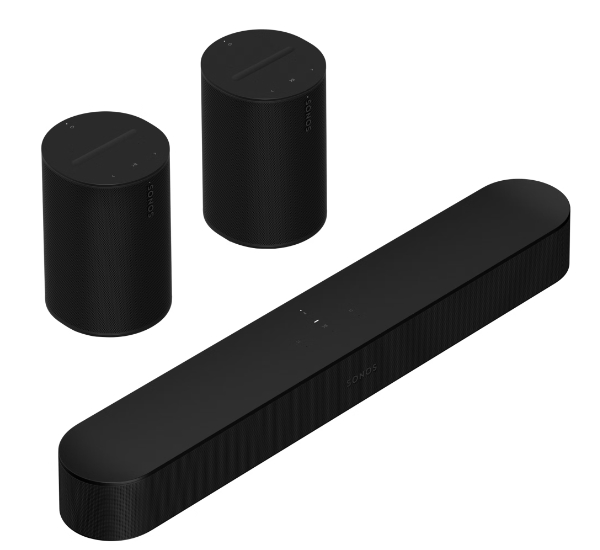
The Sonos bundle consisting of the Beam (Gen 2) and two Era 100 speakers is the premier choice for those who value software polish and whole-home audio. The Beam (Gen 2) uses advanced psychoacoustic processing to simulate height channels for Dolby Atmos without needing up-firing drivers, while the Era 100s act as dedicated rear surrounds. The technical brilliance of Sonos lies in its "Trueplay" calibration, which uses your smartphone's microphone to map the room's acoustics - though this is still largely limited to iOS users.
The real-world context for choosing Sonos is the ecosystem. Once this system is set up, you can easily add more speakers in other rooms or eventually add a Sonos Sub Mini to fill out the low end. The sound profile is exceptionally crisp and tuned for "musicality" just as much as "cinematics." However, at this price point, you are not getting a dedicated subwoofer in the initial bundle, meaning the bass will not be as visceral as the Samsung or Yamaha options. It is an ideal system for apartments or smaller living spaces where clarity and music streaming are as important as movie nights.
Sonos Official Product PageHow We Chose These Products
Our selection process involved analyzing four primary technical metrics to ensure each system provides a "true" home theater experience rather than just an audio upgrade from TV speakers.
- Channel Discreteability: We prioritized systems that include physical rear speakers. While "virtual surround" has improved, it cannot replicate the pinpoint accuracy of a physical driver located behind the listener.
- Format Support: Every product on this list supports at least 5.1 surround sound, with 4 out of 5 supporting object-based audio (Dolby Atmos/DTS:X).
- Connectivity Standards: We ensured all recommendations include HDMI eARC support, which is necessary for transmitting uncompressed high-bitrate audio formats from modern TVs.
- Acoustic Calibration: We favored systems that include some form of room correction (YPAO, Trueplay, SpaceFit), as room reflections are the single biggest variable in audio quality.
Comparison Overview
| Product | Configuration | Atmos Support | Connectivity | Key Strength |
|---|---|---|---|---|
| Samsung HW-Q990D | 11.1.4 | Yes (Up-firing) | eARC, Wi-Fi, BT | Maximum Immersion |
| Yamaha YHT-5960U | 5.1 | No | 8K HDMI, Wi-Fi | Gaming & Upgradability |
| Sony Theater 6 | 5.1 | Yes (Virtual) | eARC, Wi-Fi | TV Integration |
| Vizio M-Series Elevate | 5.1.2 | Yes (Rotating) | eARC, BT | Value for Money |
| Sonos Beam Bundle | 5.0 | Yes (Virtual) | eARC, Wi-Fi | App Ecosystem |
Buying Guide: What to Look For
- The eARC Requirement: Ensure your TV has an HDMI eARC port. Without it, you may be limited to compressed 5.1 audio even if your soundbar supports Atmos.
- Physical vs. Virtual Height: Systems with up-firing drivers (like the Samsung) reflect sound off your ceiling. This requires a flat, hard ceiling; it will not work as well with vaulted or acoustic-tiled ceilings.
- Subwoofer Placement: Wireless subwoofers still need a power outlet. Because bass is non-directional, you can often hide the sub behind a couch, but placing it near a corner usually increases perceived volume.
- Wired vs. Wireless Rears: In "wireless" systems, the rear speakers usually connect to each other or to the sub via wires, but they don't need a wire running back to the front of the room.
- HDMI Passthrough: If you have multiple consoles or players, look for a system with HDMI inputs on the bar or receiver. This prevents "lip-sync" delay issues that can sometimes occur when routing audio through the TV first.
General Pros / Cons
| Common Strengths |
|---|
| Significantly clearer dialogue than built-in TV speakers. |
| Deep, cinematic bass that adds physical impact to action scenes. |
| Bluetooth and Wi-Fi streaming for high-quality music. |
| Simplified setup compared to traditional component systems. |
| HDMI-CEC allows control via your existing TV remote. |
| Compact designs that fit under most modern televisions. |
| Common Weaknesses |
|---|
| Can be sensitive to room layout and ceiling height for Atmos. |
| Ecosystem lock-in often limits certain "smart" features. |
| Wireless interference can occasionally cause speaker "popping." |
| Small satellite drivers may struggle in very large open-concept rooms. |
| Most soundbars are difficult or impossible to repair/upgrade. |
| App-based setups require a stable home Wi-Fi network. |
Final Summary
Selecting a home theater system under $1,000 involves balancing the desire for raw power with the need for convenience. The Samsung HW-Q990D offers the most technologically advanced driver array for pure immersion, while the Yamaha YHT-5960U provides the best foundation for those who want a traditional, upgradeable component setup. Vizio remains the value leader for Atmos enthusiasts, and Sonos and Sony offer the best integration for users already committed to their respective ecosystems. Aggregate rating of the products reviewed: 4.66 out of 5.