
Best Leaf Blowers of 2026
An expert evaluation of high-performance leaf blowers designed to clear lawn debris with precision and ergonomic efficiency.
Introduction
The transition from gas-powered leaf blowers to high-voltage electric systems has reached a tipping point where performance no longer requires a trade-off. For most homeowners, the primary "friction points" are runtime anxiety - the fear that a battery will die halfway through the yard - and the physical strain of carrying a heavy unit. Modern lithium-ion density has finally caught up to two-stroke engines, providing the "Newton force" (actual pushing power) needed to move matted, wet leaves without the maintenance headaches of spark plugs or fuel mixing.
When evaluating these tools, we look beyond the marketing numbers. While Miles Per Hour (MPH) tells you how fast the air moves, Cubic Feet per Minute (CFM) tells you how much volume is being pushed. Why it matters: A high-MPH blower with low CFM is like a narrow pressure washer - great for a single spot, but useless for moving a massive pile. These recommendations focus on balanced air dynamics and motor efficiency, ensuring the tool actually finishes the job rather than just moving dust around.
Best Overall Performance: EGO Power+ 765 CFM
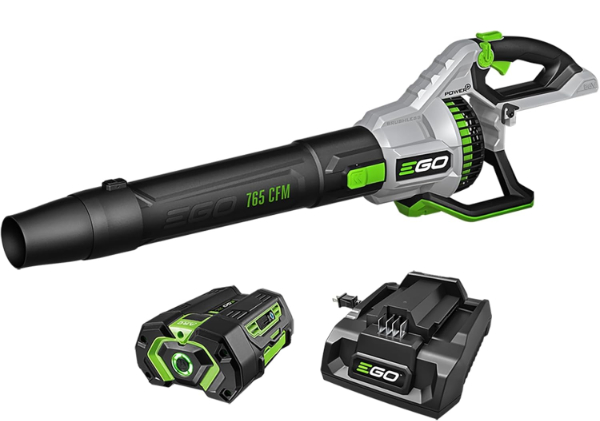
The EGO Power+ 765 CFM currently sits at the top of the cordless hierarchy, delivering a massive 26 Newtons (N) of blowing force. This is the "honest trade-off" model: it provides professional-grade power that can move heavy, rain-soaked oak leaves, but it demands a disciplined finger on the trigger. If you run it exclusively in "Turbo" mode, you will drain even a high-capacity 5.0Ah battery in under 15 minutes. However, its efficiency at lower speeds is high enough that "Turbo" is rarely needed for standard yard maintenance.
Technically, the unit stands out due to its axial fan design, which pulls air in a straight line through the motor. Why it matters: This reduces internal turbulence, meaning more of the battery's energy goes into moving air rather than generating heat. It is best for property owners with large deciduous trees who need to move significant volume quickly without the vibration and deafening noise of a gas engine.
The primary downside is the weight of the ecosystem. EGO's 56V batteries are bulky, and when paired with this high-output motor, the unit can feel "nose-heavy" during long sessions. It includes a tapered nozzle and a spread nozzle to adjust the air pattern, but for most, the standard round tip provides the best balance of speed and volume. It remains the most capable alternative to a gas backpack blower currently available in a handheld form factor.
Unlike traditional blowers that use a centrifugal (squirrel cage) fan to push air at a 90-degree angle, the EGO uses an Axial Fan similar to a jet engine. Why It Matters: By keeping the airflow straight, the motor loses less energy to "drag," resulting in a higher CFM-to-Watt ratio. This is how it achieves 765 CFM without doubling the battery weight.
Best Technology and Value: Ryobi 40V HP Brushless 730 CFM
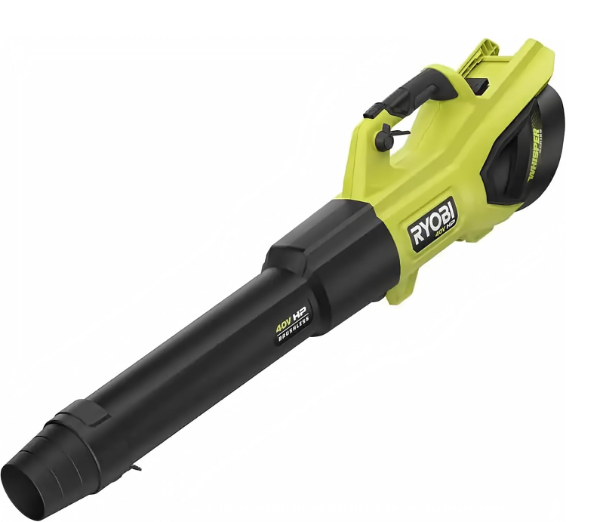
Ryobi’s 40V HP (High Performance) line is designed for the homeowner who prioritizes neighbor-friendly noise levels without sacrificing the ability to clear a driveway. This model is part of their "Whisper Series," which uses internal dampening and specifically tuned fan blades to reduce high-pitched frequencies. Why it matters: You can clear your patio early on a Sunday morning without the sound carrying three blocks away. It delivers a solid 730 CFM, which is more than enough for mixed debris and grass clippings.
The technical standout here is the "Crossforce" fan design. By pulling air from both sides of the unit, it creates a more stable air stream that resists "surging" - that annoying pulse of power you sometimes feel in cheaper blowers. It feels more controlled in the hand, making it easier to "sweep" leaves into a precise pile rather than scattering them in every direction. It is the ideal choice for those already invested in Ryobi’s 40V battery platform.
The honest limitation is the physical size. It is a long tool, and for shorter users, the nozzle can occasionally scrape the ground if not held at a steep angle. Additionally, while it is marketed as a 730 CFM unit, that peak is only achieved using the "Turbo" trigger, which puts a significant strain on the 40V lithium cells. It is a sophisticated, quiet tool that excels in suburban environments.
The Ryobi HP uses a Brushless Motor with a dedicated microprocessor. Why It Matters: Unlike older motors that use carbon brushes (which create friction and heat), this motor uses magnets and electronic sensors. This results in 30% more runtime per charge and a motor that won't "burn out" under heavy resistance.
Best Heavy-Duty Power: Milwaukee M18 FUEL Dual Battery Blower
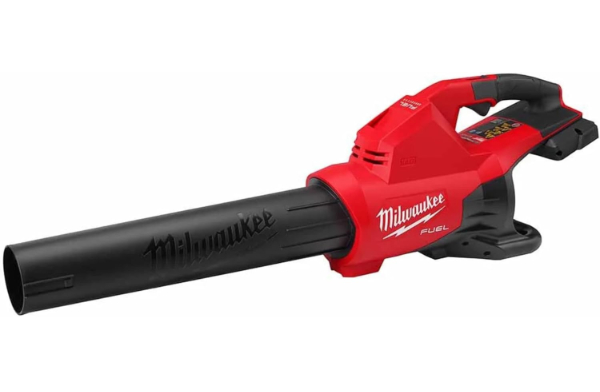
The Milwaukee M18 FUEL Dual Battery blower is engineered for those who demand "constant power." Most single-battery blowers suffer from "voltage sag" - as the battery gets low, the blowing force weakens. By using two 18V batteries in series, this tool maintains a massive 17.7 Newtons of force until the very end of the charge. It is built with professional-grade materials, including a reinforced nozzle that can handle being bumped against pavement or dropped into a truck bed.
Practically, this is the tool for people with "hard" debris - pine needles, wet mud, or wood chips. While it clocks in at 600 CFM, its 145 MPH airspeed is highly concentrated. Why it matters: This high-speed air acts like a chisel, prying stuck debris off the ground that high-volume/low-speed blowers would just roll over. It reaches full throttle in under one second, providing instant feedback that helps you clear corners and edges with surgical precision.
The friction point here is the cost of entry. To get the most out of this tool, you need two high-output batteries (8.0Ah or 12.0Ah), which adds significant weight and expense. It is a heavy unit, designed for the "prosumer" who already has a garage full of M18 tools. If you are starting from scratch, the cost of the batteries and dual-charger can be a barrier.
The Redlink Plus circuitry provides full-system communication between the tool, battery, and charger. Why It Matters: It monitors heat at a microscopic level to prevent the batteries from "thermal throttling." This means you get 100% power even when the batteries are nearly empty, which is a major advantage over competitors.
Best Corded Reliability: Worx WG520 Turbine 600
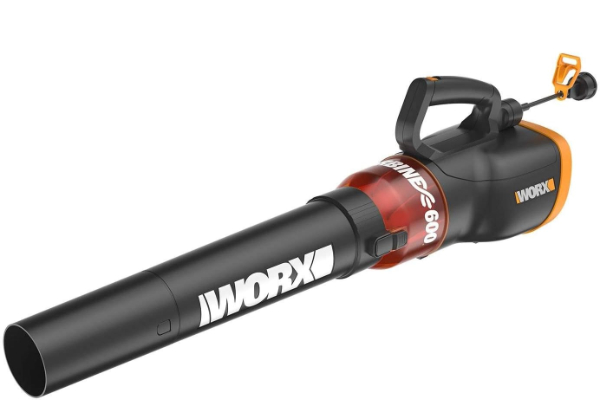
In a world obsessed with batteries, the Worx WG520 remains a top choice because it eliminates the biggest friction point of all: runtime. For homeowners with a standard suburban lot and access to a high-quality extension cord, this blower provides 600 CFM of continuous power that never fades. It is incredibly lightweight (only 6.4 lbs) because it doesn't have a massive battery hanging off the back. Why it matters: You can blow out a 4-car driveway and a large back deck without your wrist feeling like it's going to snap.
The "Turbine" technology in the name refers to the hyper-stream nozzle design that accelerates air through a tapered internal cone. This creates a very concentrated beam of air that is perfect for "sweeping" garage floors or clearing light leaf cover. Because it runs on standard 120V power, you get the same performance at minute one as you do at minute sixty. It’s the ultimate "low-friction" tool - no charging, no fuel, just plug and go.
The honest trade-off is the cord. Navigating around bushes and trees with 100 feet of extension cord can be frustrating and limits your range. It also lacks a "Turbo" mode, as it is designed to run at its peak 12-Amp draw consistently. For those who don't want to worry about battery health or expensive replacements, this is the most logical and cost-effective pick.
The Worx uses Dynamic Induction, which pulls air through a larger rear intake and forces it through a smaller front opening. Why It Matters: This creates a "Venturi effect" that increases air velocity without requiring a massive, heavy motor, keeping the tool light enough for one-handed operation by almost anyone.
Best Ergonomic Weight: Makita XBU03Z 18V LXT Brushless Blower
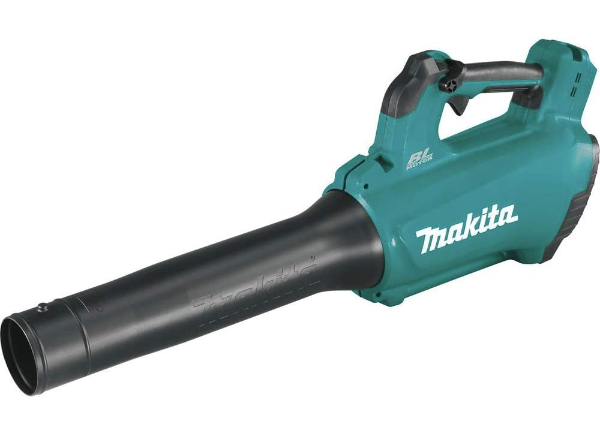
Makita has mastered the "human-tool interface" with the XBU03Z. While it doesn't boast the staggering 700+ CFM of the EGO or Ryobi, its 459 CFM is delivered with a balance that makes the tool feel weightless. Most blowers "kick back" when you hit the trigger, requiring wrist strength to keep the nozzle down. The Makita is balanced in a way that the airflow actually helps stabilize the tool. Why it matters: This is the best choice for users with arthritis or anyone who finds heavy-duty blowers too cumbersome to maneuver.
The technical advantage here is the 18V LXT battery system. Makita has the fastest charge times in the industry - a 5.0Ah battery is back to full in just 45 minutes. This addresses the "waiting around" friction point. If the battery dies, you take a short break, and it’s ready again. It is surprisingly powerful for a single-battery 18V unit, capable of 116 MPH airspeeds that easily handle dry leaves and grass.
The honest limitation is that this is not a "demolition" blower. It will struggle with deep, wet leaf piles or clearing large gravel driveways. It is a "maintenance" tool, designed for keeping the garage clean, blowing off the deck after a storm, or managing a manicured lawn. It is a precision instrument, not a sledgehammer.
Makita's LXT Technology involves a "Smart-Box" inside the battery that communicates with the tool. Why It Matters: The tool can tell the battery exactly how much amperage it needs, preventing "over-discharge" which is the #1 killer of lithium batteries. This is why Makita batteries often last years longer than cheaper alternatives.
How We Chose These Products
Our evaluation process involves three critical metrics: Effective Newton Force, Thermal Management, and Weight Distribution. We prioritize products that maintain their performance as the battery depletes, avoiding units that "stutter" or lose 50% of their power after 5 minutes. We also looked for "Brushless" motors across the board (except for the corded budget pick), as they offer significantly better longevity and less mechanical vibration, which directly impacts user comfort.
Comparison Overview
| Product | CFM (Volume) | MPH (Speed) | Power Source | Weight (Tool Only) |
|---|---|---|---|---|
| EGO Power+ 765 | 765 CFM | 200 MPH | 56V Battery | 4.6 lbs |
| Ryobi 40V HP | 730 CFM | 190 MPH | 40V Battery | 9.1 lbs |
| Milwaukee M18 Fuel | 600 CFM | 145 MPH | Dual 18V Battery | 6.0 lbs |
| Worx Turbine 600 | 600 CFM | 110 MPH | Corded (120V) | 6.4 lbs |
| Makita XBU03Z | 459 CFM | 116 MPH | 18V Battery | 5.1 lbs |
Buying Guide: What to Look For
- Newton Force (N): This is the most accurate measurement of a blower's power. It combines CFM and MPH. Look for 15N or higher if you have wet leaves or large piles.
- CFM vs. MPH: If you are moving a large volume of dry leaves, prioritize CFM. If you are unsticking wet leaves from the pavement, prioritize MPH.
- Noise Levels: Electric blowers are quieter than gas, but "Whisper" models (like Ryobi) are significantly quieter than standard electric ones. Check the decibel (dB) rating if you have close neighbors.
- Ecosystem Lock-in: Batteries are expensive. If you already have power tools (drills, saws) from a specific brand, it is usually 50% cheaper to buy a "Tool Only" version of their blower.
- Cruise Control: Look for a lever that locks the trigger in place. Holding a trigger for 20 minutes can cause significant hand cramping.
General Pro / Cons
| Strengths | Weaknesses |
|---|---|
| Instant start without fuel or pull-cords. | High-capacity batteries are expensive to replace. |
| Zero localized emissions (no exhaust fumes). | Turbo modes drain batteries in 10-15 minutes. |
| Minimal maintenance (no spark plugs or air filters). | Cordless models can be heavy due to battery weight. |
| Significantly quieter than 2-stroke gas engines. | Corded models are limited by extension cord length. |
| Variable speed allows for delicate work around mulch. | Battery performance can drop in freezing temperatures. |
| Brushless motors provide longer tool lifespans. | Ecosystem lock-in makes switching brands costly. |
| Lightweight options available for smaller tasks. | Can struggle with large-scale professional cleanup. |
| No vibration fatigue compared to internal combustion. | Plastic nozzles can crack if used to scrape debris. |
Final Summary
The modern leaf blower landscape is dominated by the battle between raw power and user comfort. The EGO Power+ 765 CFM provides a clear path for those needing to replace a gas unit, while the Makita XBU03Z offers a more ergonomic, maintenance-focused experience. For the average homeowner, the Ryobi 40V HP provides the most "empathetic" experience with its quiet operation and massive air volume. Regardless of the choice, moving away from gas means less maintenance and a much more pleasant Sunday afternoon on the lawn.
Aggregate rating of the products reviewed: 4.7 out of 5.