
Best Mandoline Slicers of 2026
A technical evaluation of precision vegetable slicers, focusing on blade geometry, steel hardness, and mechanical safety protocols for the modern kitchen.
Introduction
The mandoline slicer is arguably the most intimidating tool in the culinary arsenal, yet it remains indispensable for achieving the mathematical uniformity required for professional-grade cooking. Whether you are aiming for paper-thin translucent radishes or uniform 3mm julienne carrots, the human hand simply cannot compete with the mechanical consistency of a fixed blade. However, the hesitation many feel toward these tools is grounded in a very real concern for safety and the complexity of blade maintenance.
When evaluating a mandoline, we look past the colorful plastic frames and focus on the metallurgical quality of the blades and the ergonomics of the carriage system. A sharp blade is actually safer than a dull one because it requires less downward force, reducing the likelihood of a slip. In this guide, we analyze the structural integrity and slicing efficiency of the top models currently on the market to help you find a tool that balances surgical precision with user-friendly safety features.
Best for Precision: Benriner Super Mandoline
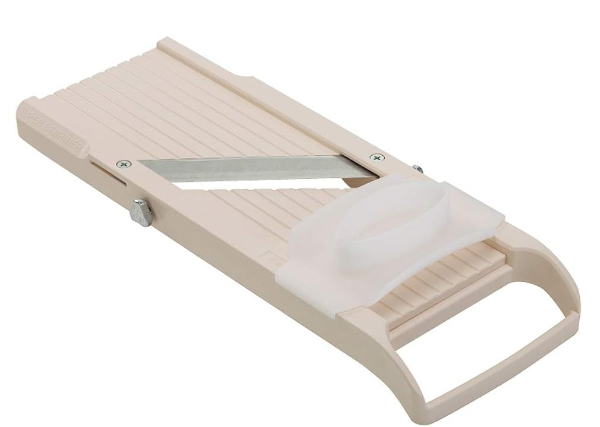
The Benriner Super Mandoline is the industry standard in professional kitchens for a reason: its simplicity. Eschewing the bulky folding legs of Western designs, this Japanese-style slicer uses a handcrafted stainless steel blade and a simple screw-dial adjustment system. This allows for "infinite" thickness adjustments rather than being locked into pre-set notches. If you need a slice that is exactly 0.5mm for a garnish, the Benriner is the only consumer tool that offers that level of granular control.
Technically, the blade is made from high-carbon stainless steel that undergoes a specific tempering process to achieve a high Rockwell Hardness (HRC). This means the edge stays sharp through thousands of cycles of abrasive vegetable contact. The "Super" model features a wider platform than the standard version, which is critical when working with larger produce like beefsteak tomatoes or cabbage. The lack of complex moving parts also means it is remarkably easy to clean, as there are no hidden crevices for organic matter to collect.
The primary trade-off is the safety guard. The included plastic pusher is notoriously basic and provides minimal grip. For this reason, we recommend using a cut-resistant glove. It also lacks a stand, meaning you must brace it manually against a bowl or cutting board. For the purist who values edge geometry and space-saving design over safety "training wheels," this is the undisputed champion.
The Benriner uses a straight blade set at a 45-degree angle to the cutting path. Why it matters: A diagonal entry point reduces the initial force required to puncture the vegetable's skin (the 'pierce force'), resulting in a cleaner cut without bruising the cells of delicate produce.
Best for Safety: OXO Good Grips Chef's Mandoline Slicer 2.0
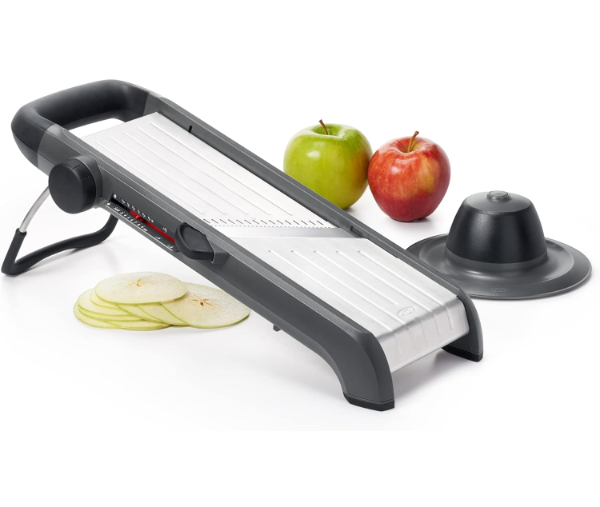
OXO has built its reputation on universal design, and the Chef's Mandoline 2.0 is a fortress of safety features. Unlike the Benriner, this model features a sturdy, non-slip stand and a spring-loaded food holder that completely encases the produce. The blade adjustment is handled by a side-mounted dial that toggles between 21 different thickness settings and various julienne/waffle cuts. This "all-in-one" approach means you never have to touch or swap out sharp loose blades, which is where most kitchen accidents occur.
From a performance standpoint, the OXO uses an angled Japanese stainless steel blade. By presenting the blade at an angle, the slicer mimics the "slicing motion" of a chef's knife rather than the "chopping motion" of a straight blade. This is technically more efficient at shearing through tough fibers in root vegetables like sweet potatoes. The textured stainless steel runway also creates small air pockets under the vegetable, which reduces surface tension and prevents suction - a common problem where a flat potato slice sticks to the metal and halts your progress.
The downside is the footprint. This is a large piece of equipment that requires significant cabinet space. The complexity of the julienne blade housing also makes it slightly more tedious to scrub clean. It is the best choice for home cooks who prioritize safety and versatility over professional-level minimalism.
The runway of the OXO is etched with a micro-texture. Why it matters: This breaks the hydraulic suction created by the moisture in vegetables. By reducing the contact area by roughly 15%, the 'drag coefficient' is lowered, allowing for faster, smoother slicing cycles.
Best Professional Grade: Bron Coucke Stainless Steel Classic Mandoline
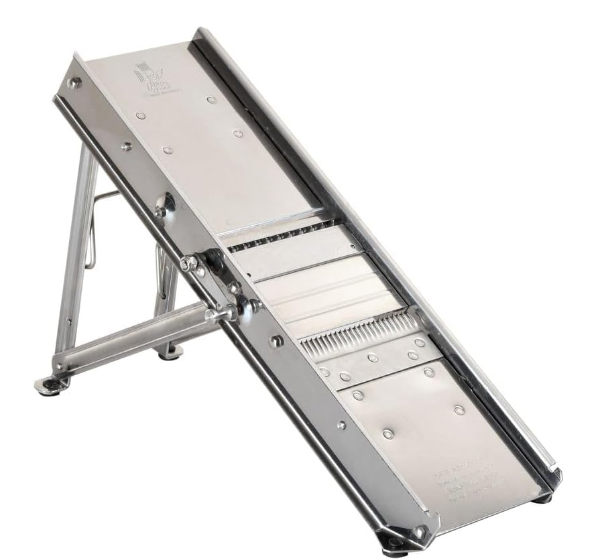
The Bron Coucke is the original French mandoline, constructed almost entirely from 18/10 stainless steel. This tool is built for high-volume production; it is heavy, stable, and virtually indestructible. Unlike modern plastic-heavy alternatives, the Bron uses a system of integrated levers to deploy julienne blades and adjust thickness. There are no plastic parts to crack or warp over time, even under the heat of a commercial dishwasher. It is a legacy tool designed to last decades, not years.
What sets it apart technically is the sheer mass of the unit. At over 3 pounds, the weight of the steel provides a level of stability that prevents the unit from shifting during heavy-duty tasks like processing ten pounds of potatoes for a gratin. The blades are exceptionally sharp but are straight-edged, which requires a specific technique. You must maintain a steady, rapid rhythm to ensure the blade shears rather than tears. It's an "expert's tool" that rewards skill with perfect results.
However, the Bron Coucke has a steep learning curve. The adjustment levers can be stiff and confusing at first, and the metal safety guard is widely considered cumbersome to use. It's also the most expensive option on our list. It's best suited for the serious hobbyist or professional who wants a heirloom-quality tool and isn't afraid of a more manual, tactile experience.
18/10 refers to 18% chromium and 10% nickel content. Why it matters: This specific alloy offers the highest level of corrosion resistance. In a kitchen environment where high-acid vegetables (like tomatoes) sit on the surface, this prevents pitting and rust that can harbor bacteria.
Best V-Blade Design: Swissmar Borner V-Prep V-5000
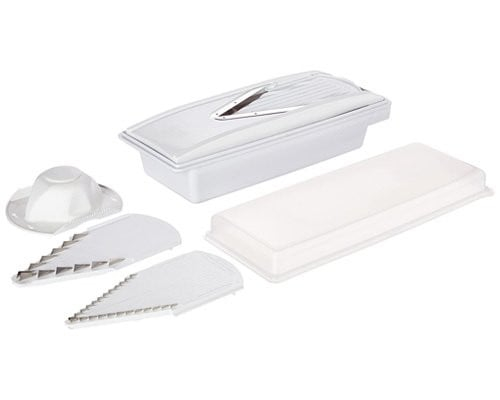
The Swissmar Borner V-Prep utilizes a "V-blade" configuration, which is the secret to its effortless slicing. While straight blades hit the vegetable all at once and diagonal blades hit it at one corner, the V-blade pierces the vegetable from two sides simultaneously. This prevents the "crush" effect often seen with softer produce like tomatoes or peppers. It is the most forgiving blade geometry for those who find traditional mandolines catch or snag too frequently.
The V-5000 is made from durable ABS plastic with surgical-grade stainless steel blades. It uses an insert-based system; you snap in different plates for different thicknesses or julienne cuts. This design keeps the blade protected and hidden when not in use, which is a subtle but effective safety feature. The food holder is also one of the best in the industry, featuring metal prongs that securely lock into the vegetable, ensuring you can slice all the way down to the last millimeter without risking your fingertips.
The main limitation is the lack of "infinite" adjustment. You are restricted to the thicknesses provided by the specific inserts. While these cover the most common culinary needs (1mm, 3mm, 5mm), you lose the hyper-precision of the Benriner dial. It's the ideal pick for the cook who wants "grab-and-go" simplicity without fiddling with dials or levers.
A V-blade effectively doubles the 'initial cutting edge' contact. Why it matters: By distributing the cutting force across two converging planes, the slicer can cut through a soft skin (like a tomato) without deforming the shape of the fruit, requiring 30% less downward pressure.
Best Budget Value: Mueller Multi Blade Mandoline Slicer
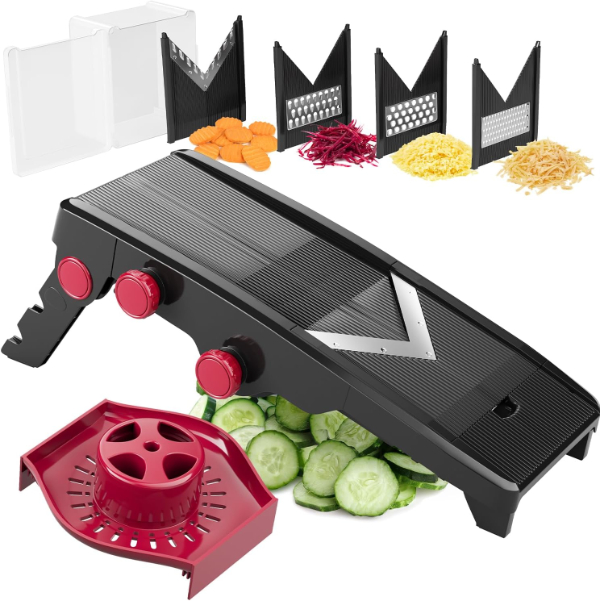
If you only pull out a mandoline once a month for a specific recipe, the Mueller Multi Blade provides the best return on investment. It is a highly versatile kit that includes five different interchangeable blades, including a coarse grater and a shredder. For the price of a single high-end blade, you get a full system that can handle everything from cucumbers to zesting lemons. It's an excellent "entry-level" tool for someone exploring the benefits of uniform slicing for the first time.
Technically, the Mueller uses 420-grade stainless steel. This is a standard cutlery-grade steel that offers good stain resistance and hardness. The unit includes a dedicated storage container that catches the slices as you work, which keeps your countertop clean and organized. While the plastic frame isn't as rigid as the OXO or as heavy as the Bron Coucke, it is reinforced to prevent the "flexing" that can cause uneven slice thicknesses during use.
The tradeoff is the complexity of storage and parts management. With five loose blades and a large collection bin, it can easily clutter a drawer if you aren't disciplined about organization. The blades also require more frequent replacement than high-carbon Japanese steel if used daily. For occasional home use, however, its versatility and low cost outweigh these maintenance requirements.
420 Stainless is often hardened to 50-52 HRC. Why it matters: While not as hard as professional Japanese steel (which can reach 60+ HRC), this level of hardness makes the blade easier to sharpen at home and less brittle, meaning it won't chip if it accidentally hits a hard pit or bone.
How We Chose These Products
Our selection process was driven by the mechanical realities of blade performance. We prioritized models that utilized high-grade stainless steel (420 or 18/10) to ensure longevity and hygiene. We also looked specifically at the "rigidity" of the frame - a flimsy mandoline will flex when you apply pressure, resulting in slices that are thick on one end and thin on the other, defeating the entire purpose of the tool.
Finally, we evaluated the safety mechanisms of each unit. Given that mandoline injuries are among the most common in home kitchens, we required each pick to have either a robust integrated safety guard or a design that minimized the need to handle the blades directly during adjustment.
Comparison Overview
| Product | Blade Shape | Adjustment Type | Material | Primary Strength |
|---|---|---|---|---|
| Benriner Super | Straight (Diagonal) | Infinite Dial | ABS/High-Carbon Steel | Professional Precision |
| OXO Chef's 2.0 | Angled | Stepped Dial | Stainless/Plastic | Safety & Versatility |
| Bron Coucke | Straight | Lever System | 18/10 Stainless Steel | Lifetime Durability |
| Swissmar Borner | V-Blade | Insert Plates | ABS/Stainless Steel | Soft Produce Slicing |
| Mueller Multi | Straight | Interchangeable | Plastic/420 Steel | Extreme Versatility |
Buying Guide: What to Look For
- Blade Material: Look for "High Carbon" or "Surgical Grade" stainless steel. These alloys hold an edge longer, reducing the frequency of dangerous, dull-blade slips.
- Blade Geometry: Choose V-Blades for soft items (tomatoes, peppers) and Straight/Diagonal blades for hard root vegetables (potatoes, carrots).
- Adjustment Mechanism: Dial-based systems offer more precision, while insert-based systems are generally faster to set up and easier to keep safe.
- Ease of Cleaning: Any tool used for raw vegetables must be easy to sanitize. Models that fold flat or have removable blade cartridges are superior for hygiene.
- Safety Guards: A good guard should have metal prongs or a high-friction surface to hold the vegetable securely. If the guard feels flimsy, budget for a $10 cut-resistant glove.
General Pro / Cons
| Pros | Cons |
|---|---|
| Produces mathematically uniform slices for even cooking results. | High risk of injury if safety protocols are ignored. |
| Reduces prep time for bulk tasks by up to 70%. | Quality models require significant storage space. |
| Enables professional textures like paper-thin carpaccio. | Steep learning curve for blade adjustments and rhythm. |
| Fixed blades are generally sharper than consumer chef knives. | Can be difficult to clean without a dedicated brush. |
| Integrated julienne blades create perfect matchsticks effortlessly. | Plastic frames can warp if placed in high-heat dishwashers. |
| Improves food presentation for dinner parties and salads. | Replacement blades can be expensive for high-end models. |
| More stable than manual slicing on a slippery cutting board. | Cheaper models can flex, leading to inconsistent thickness. |
| Encourages consumption of varied vegetables through better texture. | Often results in "end-piece" waste to keep fingers safe. |
Final Summary
Selecting a mandoline slicer is a balance between your need for precision and your comfort level with sharp tools. The Benriner Super Mandoline remains the top choice for those who want surgical control in a compact package, while the OXO Chef's 2.0 is the safest bet for the average family kitchen. If you are looking for a lifetime investment, the Bron Coucke is unmatched in durability. Regardless of your choice, remember that the best safety feature is a sharp blade and a steady hand. Use the guard, consider a cut-resistant glove, and you will unlock a new level of efficiency in your vegetable preparation.
Aggregate rating of the products reviewed: 4.58 out of 5.