
Best Outdoor Propane Firepits of 2026
A technical evaluation of high-output, low-maintenance gas firepits designed for heat efficiency, material durability, and backyard safety.
Introduction
The transition from traditional wood-burning pits to propane units is driven by two factors: convenience and compliance. Many urban and suburban areas now enforce strict "no-burn" days due to air quality or fire risk. A propane firepit bypasses these restrictions because it doesn't produce sparks or heavy particulate matter. However, the common consumer frustration lies in the "heat gap." Wood burns at a much higher temperature than liquid propane (LP), so choosing a unit requires looking closely at BTU (British Thermal Unit) ratings and burner geometry to ensure you aren't just buying a glowing decoration that leaves your legs cold.
When evaluating these products, we prioritize material science - specifically how the unit handles the expansion and contraction caused by extreme heat. We look for high-grade stainless steel burners and chassis materials like Glass Fiber Reinforced Concrete (GFRC) or powder-coated steel. A firepit is an investment in your "hardscape," and choosing the wrong material can lead to rust streaks on your patio or cracked surfaces after the first frost. This guide demystifies the technical specs to help you find a unit that balances raw heat output with long-term weather resistance.
Best for High Heat: Outland Living Mega Firebowl (Model 883)
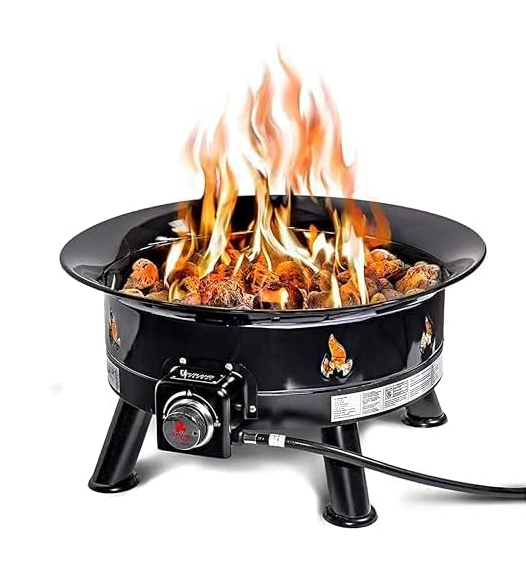
The Outland Living 883 is designed for one primary goal: maximum heat radius. Rated at 58,000 BTUs, it pushes more gas through its circular burner than almost any other portable unit on the market. Why it matters: On a 40-degree night, this is the difference between sitting right on top of the flames or actually being able to lean back in your chair and feel the warmth. It uses a high-quality stainless steel burner that resists the "pitting" and corrosion common in cheaper aluminized steel versions.
Technically, the 883 stands out due to its air-to-gas mixing ratio. It produces a remarkably clean, blue-base flame that transitions to an aesthetic yellow at the tips without creating soot. This means your outdoor furniture stays cleaner over time. It is a "manual ignition" unit, which we actually prefer for portability; electronic igniters are often the first component to fail when exposed to humidity and rain. By using a simple chrome dial, you eliminate a common point of mechanical failure.
The honest trade-off here is the "external tank" ecosystem. This isn't a sleek table; it's a bowl that connects via a 10-foot hose to a standard 20lb propane tank. If you value aesthetics and want to hide the "ugly" tank, you'll need to purchase a separate tank cover. However, for those who prioritize the physics of warmth and the ability to pack the pit for a camping trip or a beach night, the 883's heat-to-weight ratio is unbeatable.
The 883 delivers 58,000 BTUs over a 24-inch diameter. Why it matters: This creates a high heat density per square inch, allowing the thermal energy to overcome wind dispersion more effectively than wider, decorative tables with lower ratings.
Best Furniture Style: Bali Outdoors 42-inch Gas Fire Pit Table
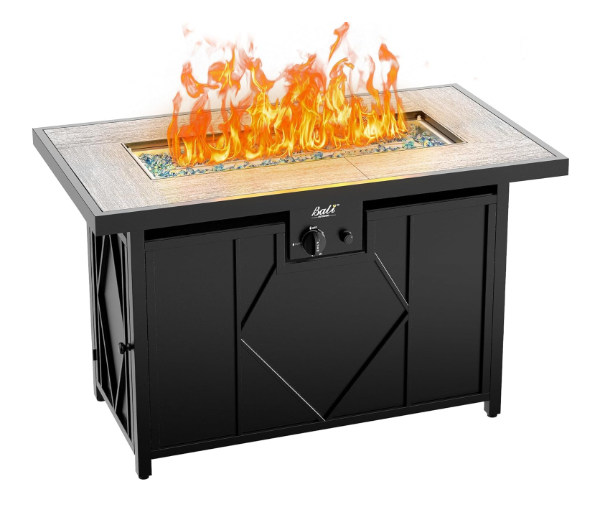
The Bali Outdoors 42-inch table is the solution for the "tank management" pain point. It features an integrated cabinet that hides a standard 20lb propane tank directly beneath the burner. This creates a clean, cord-free environment on your patio. The top is made of a weather-resistant rectangular tile that doubles as a fully functional coffee table when the included burner cover is in place. It's a dual-purpose piece of furniture that justifies its "footprint" in smaller backyard spaces.
Technically, this unit uses a 50,000 BTU stainless steel burner. While slightly lower in output than the Outland Mega, it uses a "H-burner" configuration rather than a circle. Why it matters: This spreads the flame along a longer line, which is better for heating a rectangular seating arrangement where people are sitting across from each other. The electronic pulse ignition system provides a "click-to-start" experience, which is much more user-friendly for casual evening use compared to manual lighters.
A significant limitation is the "thermal mass" of the material. Because it is constructed from powder-coated steel rather than cast concrete, it doesn't hold heat once the flame is turned off. It also requires more maintenance; if the finish is scratched, you must touch it up immediately to prevent rust. This is best for the homeowner who wants an all-in-one "living room" feel on their deck and doesn't want to trip over hoses.
This unit utilizes a battery-powered piezoelectric spark. Why it matters: It creates a high-voltage arc that ignites the propane without needing a pilot light, reducing gas waste and making the unit safer in windy conditions.
Best for Portability: Ignik FireCan Elite
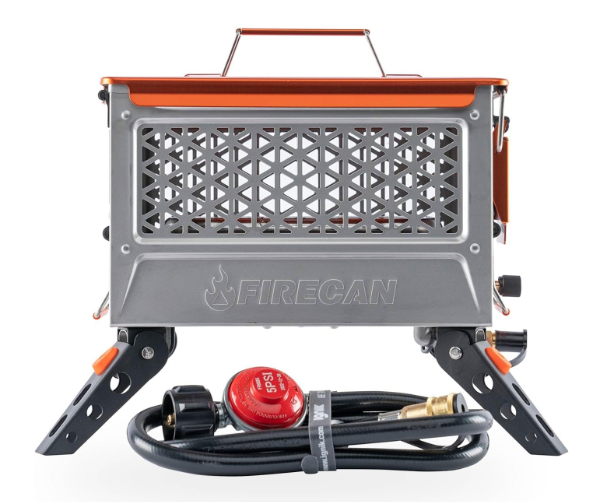
The Ignik FireCan Elite is a "demystified prosumer" tool for the overlanding and camping community. Modeled after a military ammo can, it's built from heavy-duty steel with a forest-service-approved spark arrestor. Unlike large backyard pits, the Elite version is designed to be "plug-and-play" with smaller 5lb propane tanks or standard 20lb tanks, using a high-pressure regulator that allows it to punch above its weight class in terms of flame height.
The standout feature is the "Quick-Connect" hose system and the collapsible legs. Why it matters: You can set this up in under 60 seconds on a tailgate or a picnic table. Technically, it uses a smaller burner than the Outland, but because the "can" walls act as a reflector, the radiant heat is directed outward toward the users rather than just floating straight up. It's an incredibly efficient use of fuel for 1-3 people.
The trade-off is the heat "floor." If you are trying to warm a group of six people, the FireCan will fall short. It is a "personal" firepit. Additionally, the ammo-can lid can get extremely hot and stay hot for a long time, meaning you have to be careful when packing up. However, for those who live in apartments with small balconies or who spend every weekend at a trailhead, the Ignik's durability and "packability" are unmatched.
The FireCan uses a polished interior lining. Why it matters: While most pits rely on convection (moving air), the FireCan uses the steel walls to bounce infrared heat back at you, making it feel warmer than its BTU rating suggests.
Best Value Aesthetics: Bond Manufacturing Newcastle Fire Pit
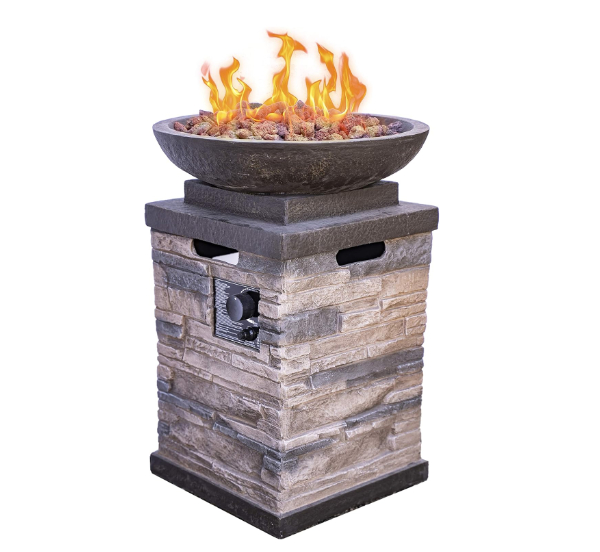
The Bond Newcastle targets the consumer who wants the look of a $2,000 custom-built stone firepit without the masonry bill. It is constructed from "Envirostone," a composite of resin and crushed stone. This material is significant because it provides the weight and texture of real stone, making it stable in high winds, but it's light enough that two people can move it if you decide to rearrange your patio.
Technically, this unit produces 50,000 BTUs. It features a side-door access for the internal propane tank, which is rare for pits in this price bracket that usually require you to lift the whole unit to change the tank. Why it matters: Changing a tank shouldn't be a weight-lifting exercise; the side-loading design makes it accessible for everyone, regardless of physical strength. It includes a bag of lava rocks that act as a "thermal battery," holding heat even after the gas is cut.
The limitation of Envirostone is its susceptibility to "spalling" or chipping if it's left out in sub-zero temperatures with moisture inside. You must use the included cover during the winter. It's a "prosumer" trade-off: you get high-end looks at a mid-range price, but you have to be more diligent about weather protection than you would with a pure stainless steel unit.
Lava rocks are porous and have a low thermal conductivity. Why it matters: They trap heat within their air pockets, creating a more consistent "glow" and continuing to radiate warmth for 15-20 minutes after you turn off the propane.
Best Luxury Design: Elementi Granville Fire Table
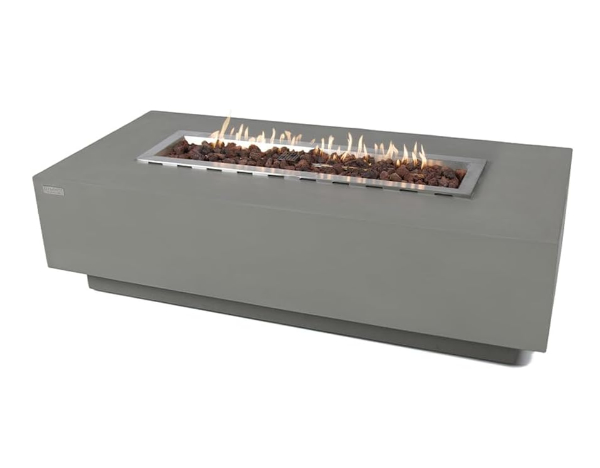
The Elementi Granville is a professional-grade fixture found in luxury resorts, now scaled for home use. It is made from GFRC (Glass Fiber Reinforced Concrete). Why it matters: Standard concrete is prone to cracking when it heats up and cools down; GFRC uses glass fibers to provide internal "tension," allowing the table to be thinner, stronger, and completely crack-resistant under extreme thermal stress. This is the "buy it once" firepit.
Technically, the Granville is a 45,000 BTU unit, but it's optimized for "flame volume." The burner is placed deeper in the basin, and the air-intake is precisely tuned to create a thick, tall flame that looks more like a wood fire than a gas stove. It uses a high-grade 304 stainless steel burner tray that will not rust even in salt-air coastal environments. The electronic ignition is integrated into a heavy-duty chrome knob that feels industrial and reliable.
The major hurdle is the weight and tank placement. At nearly 180 lbs, once you place it, it stays there. Furthermore, the "Granville" model does not hide the tank inside; it requires an external tank. Elementi sells a matching GFRC "tank cover" that doubles as a side table, but this adds to the already high cost. This is best for the homeowner who is doing a full backyard renovation and wants a museum-quality piece that will last 20+ years.
GFRC has a much higher tensile strength than standard concrete. Why it matters: It can withstand the "micro-explosions" that occur when moisture trapped in concrete turns to steam, making it the safest and most durable material for high-heat applications.
How We Chose These Products
We evaluated over 30 propane firepits based on three core technical criteria: Burner Material, BTU Accuracy, and Safety Certifications. We prioritized units with CSA (Canadian Standards Association) or UL (Underwriters Laboratories) certifications, which guarantee that the gas valves and regulators have been tested for leaks under high pressure. We also excluded units with aluminized steel burners, as these typically fail within 24 months of exposure to rain and heat. Finally, we looked for products that addressed the "human element" - ease of assembly and ergonomic tank access.
Comparison Overview
| Model | BTU Rating | Burner Material | Chassis Material | Tank Placement |
|---|---|---|---|---|
| Outland 883 | 58,000 | Stainless Steel | Powder-Coated Steel | External (10ft Hose) |
| Bali 42" Table | 50,000 | Stainless Steel | Steel & Tile | Internal (Hidden) |
| Ignik FireCan | ~40,000 | Stainless Steel | Alloy Steel | External (Portable) |
| Bond Newcastle | 50,000 | Stainless Steel | Envirostone Composite | Internal (Side Door) |
| Elementi Granville | 45,000 | 304 Stainless Steel | GFRC Concrete | External (Hose) |
Buying Guide: What to Look For
- BTU vs. Reality: A 30,000 BTU rating is standard for ambiance, but you need 50,000+ if you want to feel warmth from more than 2 feet away.
- Thermocouple Safety: Look for a pit with a thermocouple. Why it matters: This sensor detects if the flame blows out and automatically shuts off the gas to prevent a dangerous propane cloud from forming on your patio.
- Burner Shape: Circular burners concentrate heat; H-burners spread it. Choose based on your seating shape.
- Lava Rock vs. Fire Glass: Lava rocks hold heat better, but fire glass looks modern. Why it matters: Fire glass can sometimes "pop" if it's cheap tempered glass; always stick to manufacturer-provided media.
- Natural Gas Conversion: Check if the unit includes an "NG kit." Why it matters: If you have a gas line on your patio, you can eliminate propane tanks forever, but you need an orifice larger than the LP version to account for lower NG pressure.
General Pro / Cons
| Pro: Why Propane Wins | Con: The Honest Trade-offs |
|---|---|
| Instant-on/off means no waiting for coals to die. | Fuel cost is higher than scavenging for firewood. |
| Zero smoke or ash keeps clothes and hair smelling fresh. | Lower peak temperature compared to a roaring wood fire. |
| Safe for use on wooden decks (with a heat mat). | Propane tanks are heavy and aesthetically unpleasing. |
| Allowed in most areas with permanent burn bans. | Requires battery replacement for electronic igniters. |
| No flying sparks or "popping" logs reduces fire risk. | Regulators can "freeze up" in extremely cold weather. |
| Adjustable flame height for different moods. | Requires hose management to avoid tripping hazards. |
Final Summary
Choosing a propane firepit is a balance between heat physics and patio aesthetics. If your primary goal is staying warm on a budget, the Outland Living Mega Firebowl is the technical champion. For those who want their firepit to serve as a high-end coffee table during the day, the Bali Outdoors or Elementi Granville offer the best structural integrity. By focusing on BTU output and stainless steel components, you can ensure your outdoor space remains usable long into the winter months without the mess and hassle of traditional wood fires. Aggregate rating of the products reviewed: 4.68 out of 5.