
Best Over the Range Microwaves of 2026
A technical, no-nonsense breakdown of the most reliable space-saving over-the-range microwaves on the market today.
Introduction
Upgrading to an over-the-range (OTR) microwave is one of the quickest ways to reclaim precious counter space, but it introduces a complex web of technical hurdles. Unlike a standard countertop model that you simply plug in, an OTR unit acts as both a high-powered cooking appliance and your stove's primary ventilation system. This dual-purpose nature means you cannot just look at wattage; you have to evaluate fan power, ducting capabilities, and mounting requirements.
Many consumers experience immediate buyer's remorse when they realize their new microwave barely pulls steam from the front burners or requires custom cabinetry adjustments. Navigating Cubic Feet per Minute (CFM) ratings and magnetron efficiency is overwhelming when all you really want is evenly heated leftovers and a smoke-free kitchen. We have filtered out the marketing hype to bring you models that excel in raw heating capability, air extraction, and physical durability.
When selecting these units, we prioritized true physical impact over flashy touchscreens. We looked at internal cavity construction, the physical throw of the ventilation hoods, and real-world sensor accuracy. Whether you need a simple, bulletproof budget model or a smart-connected appliance that syncs with your range, the following breakdown covers the best options available.
Best Smart Features: LG MVEL2125F
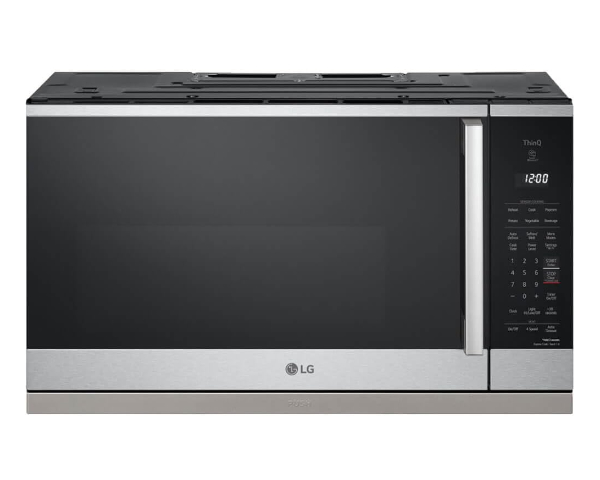
The LG MVEL2125F is a powerhouse for those who want their kitchen appliances interconnected. Boasting a massive 2.1 cubic foot capacity and 1000 watts of cooking power, it handles large dinner plates and casserole dishes with ease. The standout feature is LG's ThinQ technology, which allows you to scan barcodes of frozen meals via a smartphone app to automatically send the perfect cooking time and power level to the microwave. This removes the guesswork and stops you from accidentally turning your frozen burrito into a brick.
On the ventilation front, it features a robust 400 CFM exhaust system. This moves a high volume of air quickly, making it highly effective at clearing out smoke from searing meats. However, be aware that at its highest fan setting, the blower motor is noticeably loud. The interior features an EasyClean enamel coating, which reduces the manual scrubbing required after a sauce explosion, as splatter does not easily bond to the non-porous surface.
The primary downside is the ecosystem lock-in. To get the most out of the Scan-to-Cook and smart functions, you need a stable home Wi-Fi network and a willingness to use the LG ThinQ app. If you just want a microwave to heat up coffee by punching in 30 seconds, the added cost of the Wi-Fi computer chips inside this unit will not yield much real-world benefit for you.
Technical Deep-Dive: Sensor Humidity Cooking
Traditional microwaves cook purely based on a timer, blasting food with radiation regardless of how hot or dry it is getting. The LG MVEL2125F utilizes an internal humidity sensor. As food heats, it releases water vapor. The sensor continuously measures the concentration of steam molecules inside the cavity. When the humidity hits a mathematically predetermined threshold, the microwave knows the core of the food has reached boiling point and automatically adjusts the power level or stops the cycle. This directly prevents the rubbery, dried-out edges common with manual timing.
Best Budget Value: GE JVM3160RFSS
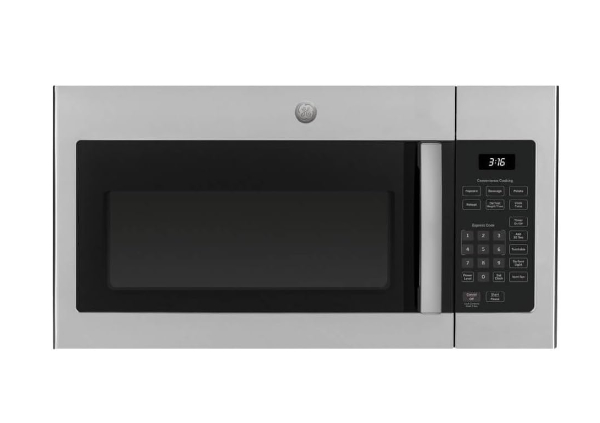
The GE JVM3160RFSS is the workhorse of the industry, widely deployed by contractors and landlords because it simply works. It offers 1.6 cubic feet of capacity and 1000 watts of power. It lacks any sort of smart app connectivity or advanced moisture sensors, relying instead on classic, time-tested physical button arrays and basic digital timers. If you want a machine that is dead-simple to operate without reading a manual, this is the gold standard.
Its venting system moves 300 CFM of air. This is the bare minimum we recommend for clearing cooking odors from a stove. It can be set up for either external ducting or recirculating filtration (which cleans the air through charcoal and blows it back into the kitchen). The recirculating mode is much less effective at removing heat and grease, which is a physics limitation of charcoal filters rather than a defect in the microwave itself.
The honest tradeoff here is feature density. There is no sensor cooking, meaning you have to manually estimate cooking times. If you guess wrong, your soup will boil over. The lighting underneath the unit, designed to illuminate your stovetop, utilizes incandescent bulbs rather than modern LEDs. They burn hot and consume more energy, though they are cheap and easy to replace when they eventually burn out.
Technical Deep-Dive: Recirculating vs. External Ducting
Over-the-range microwaves generally ship with a reversible blower motor. When configured for external ducting, the motor pushes hot air and cooking grease physically out a metal duct through your roof or exterior wall. When configured for 'recirculating' (non-vented), a charcoal filter is placed over the exhaust. The air is sucked up, forced through the charcoal to trap large odor molecules, and pushed right back into your face at the top of the microwave. While cheaper to install, recirculating does absolutely nothing to remove actual heat or humidity from your kitchen.
Best Mid-Range Reliability: Whirlpool WMH31017HS
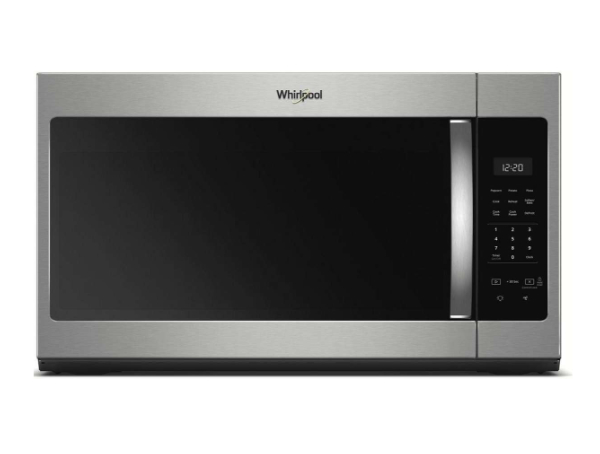
The Whirlpool WMH31017HS hits the perfect sweet spot between price and capability. It offers 1.7 cubic feet of space, providing just enough extra room over budget models to fit oversized dinner plates without getting stuck on the walls. With 1000 watts of power and a 2-speed, 300 CFM fan, it checks all the necessary boxes for a standard suburban kitchen. Whirlpool is renowned for parts availability, making this unit far easier to repair ten years down the line compared to boutique or ultra-high-tech brands.
Visually, it features a hidden vent system at the top. This gives the front of the unit a cleaner, flush appearance that mimics high-end custom range hoods. It includes specific preset buttons for popcorn and potato cooking, which use algorithmically timed power fluctuations to cook those specific items without burning them. It does not have a true active humidity sensor, but the physical button presets are surprisingly accurate compared to cheaper models.
The physical limitation of this model is the turntable. While the motor is strong, the roller ring underneath the glass tray feels a bit flimsy. If you place a very heavy cast-iron dish or a large dense casserole offset from the center, the turntable may stutter or struggle to rotate smoothly. For typical reheating and light cooking, this is rarely an issue, but it is something to consider if you do heavy bulk cooking.
Technical Deep-Dive: Microwave Wattage and Magnetron Efficiency
The heart of any microwave is the magnetron, a vacuum tube that converts electrical energy into electromagnetic radio waves (specifically at a frequency of 2.45 GHz). A '1000-watt' microwave refers to the power output of these waves. The higher the wattage, the faster water molecules inside your food are forced to vibrate, generating heat through friction. Units below 900W will take significantly longer to boil water, while a 1000W unit like this Whirlpool strikes the ideal balance of speed without requiring a dedicated high-amperage electrical circuit.
Best Large Capacity: Samsung ME21R7051SS
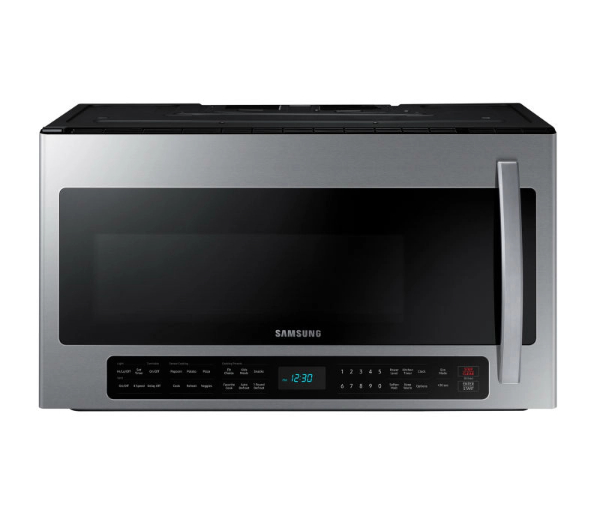
If you have a large family or frequently host gatherings, the Samsung ME21R7051SS is your best bet. At 2.1 cubic feet, it is physically massive on the inside. It easily accommodates 9x13 baking dishes that would get jammed in a standard 1.6 cubic foot unit. Samsung paired this massive cavity with a strong 400 CFM ventilation system to handle the large amounts of steam and smoke generated by big meals.
The killer feature here is the Ceramic Enamel interior. Traditional microwave interiors are painted metal. Over time, grease splatters bake into the paint, and scrubbing them with harsh sponges can chip the paint away, exposing bare metal (which causes dangerous electrical arcing). Samsung's ceramic coating is essentially a layer of glass fired onto the metal. It is highly scratch-resistant and slick, meaning you can wipe away dried tomato sauce with a damp cloth without using abrasive chemicals.
The honest downside is the control panel. Samsung opted for a membrane-style touchpad without physical button tactile feedback. Furthermore, the buttons are not backlit. If you are trying to sneak a midnight snack without turning on the bright overhead kitchen lights, finding the 'Start' button by feel alone is incredibly frustrating. It requires a firm, direct push right in the center of the membrane to register.
Technical Deep-Dive: Ceramic Enamel Fusing
The interior of the Samsung ME21R7051SS is coated in a ceramic enamel that is fused to the steel chassis at extreme temperatures (often exceeding 1,500 degrees Fahrenheit during manufacturing). This creates a non-porous glass-like surface. From a real-world standpoint, this means grease and oil cannot seep into microscopic pores in the metal. It also provides a high level of rust resistance against the heavy moisture produced by cooking vegetables or boiling water, significantly extending the physical lifespan of the cavity compared to standard epoxy-painted interiors.
Best Premium Design: Bosch HMV5053U
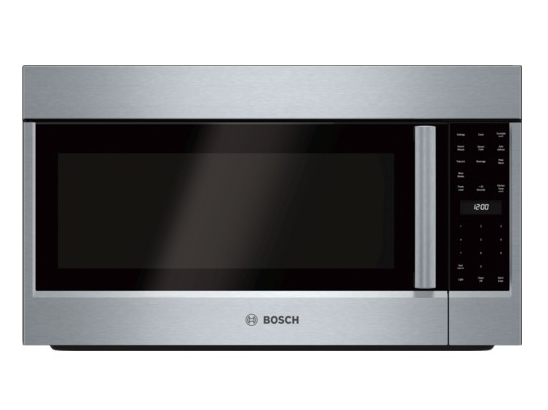
For high-end kitchen remodels, the Bosch HMV5053U (500 Series) brings European styling and precise engineering. It features a large 2.1 cubic foot capacity and runs at 1100 watts of power - the highest on our list. This extra wattage means it boils liquids and cooks frozen foods faster than 1000-watt competitors. The design is heavily focused on sleek lines, featuring a massive, wide glass viewing window and a stainless steel finish that resists fingerprint smudges better than cheaper metal alloys.
The exhaust system is rated at 385 CFM and features a multi-speed fan. Bosch engineers tuned the acoustics of the fan motor specifically to avoid the high-pitched whine common in budget blowers. While you will still hear the rush of air, the motor noise itself is much more damp and tolerable. It also includes an automatic shut-off feature for the fan, preventing it from running indefinitely if you forget to turn it off after cooking.
The major hurdle here is the premium price tag. You are paying heavily for aesthetics and the Bosch brand name. While it is built incredibly well and performs flawlessly, it cooks food using the exact same fundamental physical properties as the models costing half as much. If you have an open-concept kitchen where noisy appliances ruin the ambiance, or if you simply want matching high-end Bosch appliances, the investment makes sense. Otherwise, it is a luxury.
Technical Deep-Dive: Multi-Speed Exhaust Acoustics
Standard OTR microwave fans use cheap induction motors that run at either full blast or off, vibrating the sheet metal housing and creating a loud drone. The Bosch 500 series uses a balanced multi-speed fan assembly. By manipulating the voltage frequencies fed to the motor, it can step down the RPMs smoothly. This allows you to run a low-speed, quiet background vent while simmering soup, only cranking it to maximum when you are aggressively searing meat on the stove below.
How We Chose These Products
Evaluating over-the-range microwaves requires looking at two entirely different systems: electrical cooking and air fluid dynamics. We chose these products based on the following strict criteria:
- CFM vs. Noise Ratio: We looked for models that move a minimum of 300 cubic feet of air per minute. We penalized units that created excessive vibration or high-pitched squealing from the blower motors.
- Cavity Longevity: We prioritized interiors that resist rust and grease bonding. Painted cavities must be durable enough to withstand daily wiping without peeling.
- Physical Controls: Microwaves are used multiple times a day by various family members. We evaluated touch pads for sensitivity and physical durability over thousands of presses.
- Manufacturer Track Record: We looked for products from brands with established supply chains for replacement parts (like glass turntables and grease filters).
Comparison Overview
| Model | Capacity | Wattage | Venting Power | Standout Feature |
|---|---|---|---|---|
| LG MVEL2125F | 2.1 cu. ft. | 1000W | 400 CFM | Scan-to-Cook App |
| GE JVM3160RFSS | 1.6 cu. ft. | 1000W | 300 CFM | Simple manual operation |
| Whirlpool WMH31017HS | 1.7 cu. ft. | 1000W | 300 CFM | Hidden vent aesthetic |
| Samsung ME21R7051SS | 2.1 cu. ft. | 1000W | 400 CFM | Ceramic enamel interior |
| Bosch HMV5053U | 2.1 cu. ft. | 1100W | 385 CFM | Ultra-fast 1100W heating |
Buying Guide: What to Look For
- External Ducting vs. Recirculation: If your house doesn't already have a hole cut in the wall or roof for a stove vent, you will likely have to install the microwave in 'recirculating' mode. Make sure to buy extra charcoal filters, as they need to be replaced every 6 months to keep odors down.
- Wattage Reality: Anything 1000 watts or higher is ideal. If you buy a cheap 700 or 800-watt unit, a frozen dinner that says 'cook for 5 minutes' might actually take 8 minutes, because those directions assume a 1000-watt machine.
- Turntable Dimensions: Do not just look at the cubic feet. Measure your favorite square baking dishes and ensure their corners won't hit the back wall of the microwave when the glass tray spins.
- Installation Weight: Over-the-range units weigh between 50 and 65 pounds. You cannot install this alone. You need one person to hold the unit up against the bottom of the cabinet while another screws it in from above.
General Pro / Cons
| Pros (Benefits) | Cons (Trade-offs) |
|---|---|
| Frees up valuable counter space in small kitchens. | Extremely heavy and difficult to install by yourself. |
| Combines lighting, ventilation, and cooking into one unit. | Reaching over a hot stove to use the microwave can be dangerous. |
| Generally larger capacity than entry-level countertop units. | Venting power is weaker than a dedicated standalone range hood. |
| Modern finishes seamlessly match other large appliances. | If either the fan or the microwave breaks, you have to replace the entire heavy unit. |
| Saves money by eliminating the need to buy a separate hood fan. | Low-hanging units can limit space for massive stock pots on the stove. |
| Powerful stovetop lighting is built right into the base. | Recirculating filter configurations require routine, ongoing costs for new charcoal. |
Final Summary
Choosing the best over-the-range microwave comes down to how you interact with your kitchen. If you love technology and use apps to organize your life, the LG MVEL2125F offers incredible smart features. For landlords or those wanting an unfussy, long-lasting appliance, the GE JVM3160RFSS is the undisputed king of budget value. If you constantly cook massive meals, the Samsung's hard ceramic interior and 2.1 cubic foot capacity cannot be beaten. Assess your actual space, decide if you have external ducting, and choose the model that fits your daily workflow.
Aggregate rating of the products reviewed: 4.65 out of 5.