
Best Pasta Machines for Home of 2026
Introduction
Making pasta at home is often presented as a romantic, flour-dusted weekend activity, but the reality is a struggle between human patience and the elastic strength of gluten. Most people hesitate because they fear the technical learning curve or simply don't have the counter space for more bulky appliances. The goal of a quality machine is to provide consistent, repeatable pressure that a rolling pin simply cannot achieve, ensuring your noodles have that elusive "al dente" bite rather than a mushy, uneven texture.
In this evaluation, we break down the two primary styles: manual rollers and electric extruders. Rollers focus on stretching the dough through micron-adjusted gaps, which preserves the structural integrity of the flour's protein matrix. Extruders, on the other hand, use high-torque motors to force dough through a die, prioritizing speed and variety of shapes. Whether you are looking for the tactile feedback of a hand-crank or the "set-it-and-forget-it" convenience of a motorized unit, we have analyzed the material science and build quality to help you decide which tool earns its place in your cabinet.
Best Overall Manual Roller: Marcato Atlas 150
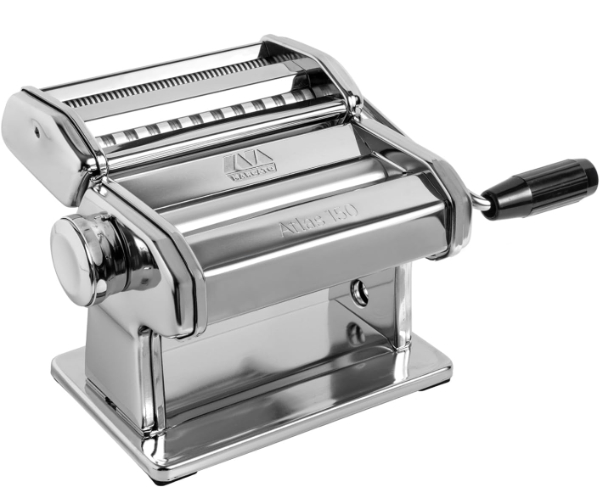
The Marcato Atlas 150 is widely considered the gold standard for home use, and for good reason. Its rollers are made of anodized aluminum alloy. Why it matters: Unlike carbon steel rollers found in cheaper knock-offs, anodized aluminum does not release heavy metals or microscopic nickel shavings into your dough. Furthermore, the surface is microscopically rough, which helps the dough "grip" the rollers, preventing the frustrating slippage that occurs when you are trying to reach the thinnest setting.
During our performance analysis, the Atlas 150 showed remarkable precision across its 10-position adjustment dial. At setting 0, the rollers sit 4.8 millimeters apart, perfect for initial kneading. By setting 9, the gap shrinks to 0.6 millimeters. This level of granularity allows you to develop the gluten sheets gradually without tearing the delicate protein bonds. It is best for the cook who values the craft of pasta making and wants a tool that will literally last for decades.
One honest limitation is the clamp. If your kitchen has thick marble countertops or a curved edge, the included G-clamp might not have enough reach to secure the machine. You may need to improvise a mounting solution or use a dedicated wooden board. While it is manual, you can eventually upgrade this machine by purchasing a separate motor attachment, giving it a flexible path for those who grow tired of hand-cranking.
Marcato uses a patented "Wellness" technology in their rollers. This involves a specific anodizing treatment that creates a protective barrier. Why it matters: It ensures that no chemical migration occurs between the food and the metal, making it the only manual roller on the market that officially meets international food safety standards for metal purity during high-pressure contact.
Best Fully Automatic Extruder: Philips Avance Pasta Maker Plus (HR2375/06)
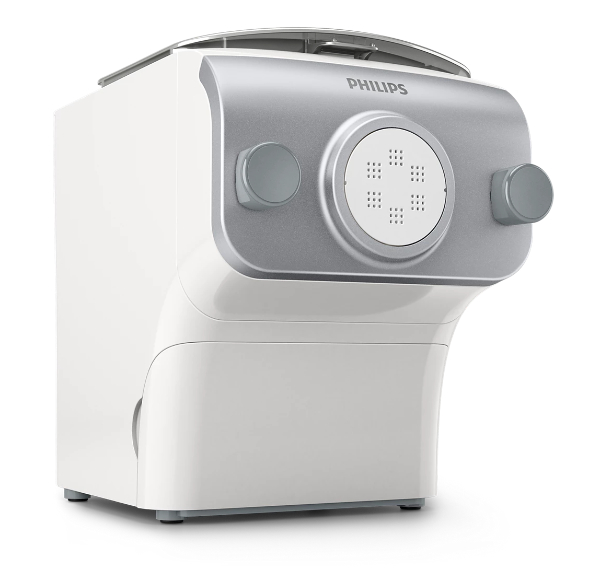
For those who find the manual process of kneading and rolling too time-consuming, the Philips Avance Plus is a technical marvel. This machine features an integrated scale and a high-torque 200-watt motor that can extrude half a pound of pasta in roughly 10 minutes. Why it matters: It handles the physical mixing and kneading, applying up to 1,600 pounds of force against the extrusion disc. This high pressure ensures that the pasta maintains its shape during the boiling process, preventing the "gummy" texture common in weaker electric machines.
This unit stands out because it solves the problem of incorrect hydration - the number one reason pasta fails. By weighing your flour and then calculating exactly how much liquid is needed, it removes the guesswork. It is best for busy families or users who want variety, as it includes discs for penne, spaghetti, fettuccine, and lasagna sheets. It essentially acts as a miniature industrial factory on your countertop.
The trade-off here is the cleaning process. While the mixing chamber is dishwasher safe, the extrusion discs require a specific "punch-out" tool to clear the dough from the tiny holes. If you let the dough dry, it becomes like concrete. Additionally, because it is an extruder, the texture is slightly different from rolled pasta - more dense and less "silky." It also requires a permanent home on your counter due to its 16-pound weight and large footprint.
The Philips motor generates significant PSI (pounds per square inch) against the die. Why it matters: In extrusion, pressure equals texture. Without enough force, the starch doesn't bond tightly with the protein. The 1,600 lbs of force in this model is significantly higher than entry-level machines, resulting in noodles that have the structural integrity to hold heavy sauces without breaking.
Best Stand Mixer Attachment: KitchenAid Pasta Roller & Cutter Set (KSMPRA)
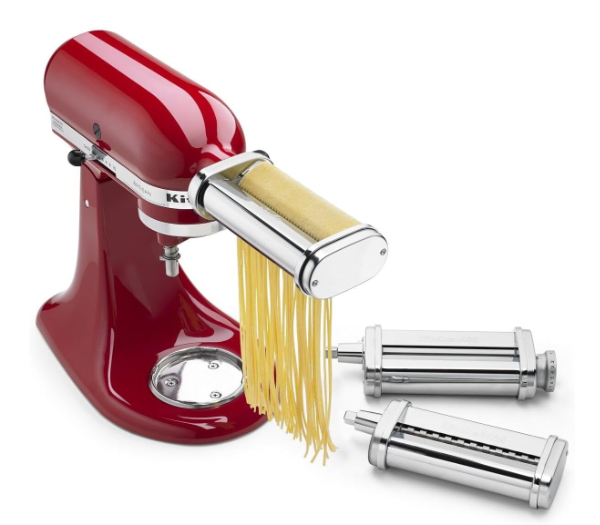
If you already own a KitchenAid stand mixer, this attachment set is arguably the most efficient way to make pasta. The KSMPRA set includes a roller, a spaghetti cutter, and a fettuccine cutter. By using the mixer's motor, you keep both hands free to guide the dough sheet. Why it matters: Having two hands available allows you to maintain consistent tension on the dough as it exits the rollers, which is critical for preventing folds or holes in very thin sheets like those used for ravioli.
Technically, these attachments are constructed with commercial-style stainless steel. Unlike some third-party attachments that use plastic gears, the KitchenAid set uses all-metal internal components designed to handle the torque of the mixer without stripping. This is best for someone who wants the speed of an electric motor but the textural quality of rolled pasta. It also solves the problem of cabinet space, as the three pieces are much smaller than a standalone motorized machine.
The limitation is the ecosystem lock-in. If your stand mixer motor dies, your pasta maker is useless. Furthermore, these attachments cannot be submerged in water. You must wait for the dough to dry and brush it out with a specialized tool or toothpick. If you accidentally get water inside the gear housing, it can lead to rust or lubricant failure, so maintenance requires a disciplined "dry-only" approach.
These attachments utilize the power hub of the stand mixer, which uses gear reduction to convert high-speed motor rotation into high-torque roller movement. Why it matters: This ensures that even very stiff, low-hydration doughs (which make for better pasta) won't stall the motor or cause the rollers to skip, providing a smooth finish that manual cranking often lacks.
Best Heavy-Duty Traditionalist: Imperia Pasta Premsa (Model 150)
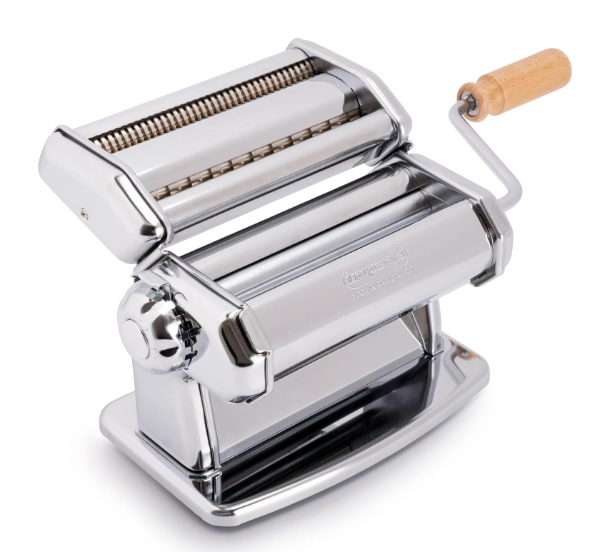
The Imperia 150 is the Atlas 150's fiercest rival, hailing from the same Italian manufacturing heritage. Its main technical distinction is the use of heavy-duty chrome-plated steel throughout the chassis. Why it matters: The extra weight (it is slightly heavier than the Marcato) provides better natural stability during the rolling process. It also features a traditional wooden handle on the crank, which many users find more ergonomic and less prone to slipping when hands are inevitably covered in flour.
While the Marcato focuses on "Wellness" aluminum rollers, Imperia sticks to a classic steel roller design. This machine is best for the "Old World" enthusiast who wants a tool that feels like it belongs in a professional Italian kitchen. The roller adjustments are performed with a locking lever rather than a spring-loaded dial, which some purists prefer as it feels more secure and less likely to "jump" settings during a heavy roll.
The limitation here is the material's susceptibility to moisture. Because it is chrome-plated steel rather than anodized aluminum, it is technically more prone to oxidation if stored in a damp basement or if it's wiped with a wet cloth. It is also less modular than the Marcato system; while attachments exist, they are not as widely available in the North American market, making it a "stand-alone" specialist for those who just want perfect sheets and basic cuts.
The Imperia chassis is formed from a thicker gauge of steel than budget competitors. Why it matters: Roller deflection (when the rollers bend slightly away from each other under pressure) causes pasta to be thicker in the middle than at the edges. The Imperia's rigid frame minimizes this deflection, ensuring a perfectly flat sheet of dough across its entire 150mm width.
Best Budget Integrated Attachment: Antree 3-in-1 Pasta Maker Attachment
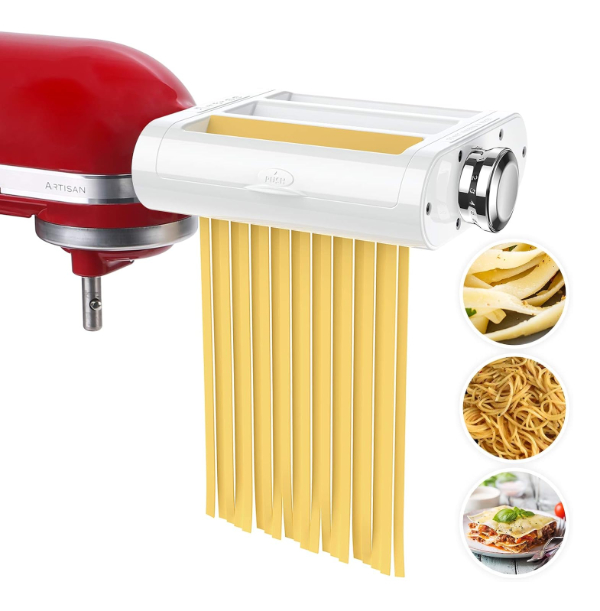
The Antree 3-in-1 is a clever engineering solution for those who find switching between three separate KitchenAid attachments annoying. Instead of a single-purpose tool, this unit houses the roller, the spaghetti cutter, and the fettuccine cutter all in one frame. Why it matters: You can roll your sheet and then immediately move it to the cutting slot without turning off the mixer or swapping parts. This significantly reduces the total time required for a pasta session.
Technically, this unit uses a combination of stainless steel rollers and plastic housing components to save weight and cost. It is best for the casual user who makes pasta once a month and wants the maximum convenience at about half the price of the official name-brand set. It still utilizes the same 8-setting thickness adjustment, allowing for plenty of versatility for everything from thick egg noodles to thin linguine.
The trade-off is long-term durability and width. Because three tools are crammed into one housing, the rollers are slightly narrower than the standalone units, and the internal gears are under more spatial stress. It also tends to be harder to clear if a jam occurs, as the housing is more enclosed. For the prosumer who plans on making five pounds of pasta a week, this might show wear faster than the KitchenAid KSMPRA set, but for the hobbyist, the value proposition is excellent.
The Antree uses a series of internal cascading gears to power all three functions from a single drive shaft. Why it matters: While convenient, these gears are often smaller than those in dedicated units. To maintain its lifespan, it is critical to use properly hydrated dough; a dough that is too dry will increase the resistance and potentially skip a gear tooth in this high-density configuration.
How We Chose These Products
Our evaluation criteria centered on four technical pillars: Roller Material Composition, Micrometer Accuracy, Motor Torque/PSI, and User Ergonomics. We analyzed manufacturer whitepapers to verify the safety of the metal alloys used in the rollers, ensuring no heavy metal leaching. We also looked at the stability of the clamping systems and the rigidity of the chassis under load. Finally, we considered the cleaning protocols, as an "easy-to-use" machine that takes an hour to clean is ultimately a poor investment for the home cook.
Comparison Overview
| Feature | Marcato Atlas 150 | Philips Avance Plus | KitchenAid KSMPRA | Imperia 150 | Antree 3-in-1 |
|---|---|---|---|---|---|
| Type | Manual Roller | Electric Extruder | Motorized Roller | Manual Roller | Motorized Roller |
| Material | Anodized Aluminum | BPA-Free Plastic/Steel | Stainless Steel | Chrome-Plated Steel | Stainless/Plastic |
| Settings | 10 Thickness Levels | 4-8 Shape Discs | 8 Thickness Levels | 6 Thickness Levels | 8 Thickness Levels |
| Best For | Durability/Safety | Speed/Automation | Two-Handed Ease | Traditional Feel | Value/Convenience |
Buying Guide: What to Look For
- Roller Material: Look for anodized aluminum or high-grade stainless steel. Cheap plated metals can flake off over time.
- Hydration Tolerance: Automatic extruders are very picky about water-to-flour ratios. Manual rollers are much more forgiving of slightly sticky dough.
- Cleaning Protocol: Avoid any machine that claims to be "dishwasher safe" for the rollers themselves. Water ruins the precision calibration and internal lubricants.
- Countertop Stability: Ensure manual machines have a wide base or a heavy-duty clamp. If the machine wobbles, your pasta sheets will be uneven.
- Modular Growth: Consider if the machine can accept a motor later. Many people start manual and realize they want power after their third batch.
General Pro / Cons
| Pros | Cons |
|---|---|
| Fresh pasta has superior sauce-holding ability due to its porous surface. | Initial setup can be messy and requires a large, flour-safe workspace. |
| Manual rollers allow for infinite gluten development control. | Manual machines require significant arm strength for large batches. |
| Electric extruders save roughly 30-40 minutes of prep time. | Extruders are much noisier and consume significant electricity. |
| Anodized aluminum rollers prevent chemical leaching into food. | Precision rollers are delicate and can be ruined by a single stray pebble or seed. |
| Stand mixer attachments free up both hands for dough management. | High-quality Italian machines come with a steep initial price tag. |
| Fresh dough requires much shorter cook times (2-4 minutes). | Cleaning out dried dough from die discs can be tedious. |
Final Summary
The best pasta maker is the one that fits your specific workflow. If you enjoy the meditative process of hand-rolling and want a tool that will become a family heirloom, the Marcato Atlas 150 is the undisputed champion. For those who want fresh noodles on a Tuesday night without breaking a sweat, the Philips Avance Plus offers a level of automation that is worth every penny of its higher price. Stand mixer owners should look no further than the KitchenAid KSMPRA for a perfect balance of power and textural silkiness. Ultimately, fresh pasta is about a better meal, and any of these five tools will elevate your kitchen beyond the box-dry standard.
Aggregate rating of the products reviewed: 4.7 out of 5.