
Best Pickleball Paddles of 2026
An authoritative analysis of thermodynamic thermoforming, carbon fiber weave densities, and kinetic energy transfer in modern pickleball equipment.
Introduction
The evolution of pickleball paddle technology has shifted from basic honeycomb cores to sophisticated aerospace-grade materials. Modern competitive play demands equipment that manages the "pop" of high-intensity drives while maintaining a soft touch for delicate kitchen play. The current technical landscape is dominated by Raw Carbon Fiber (RCF) faces and thermoformed edge walls, which utilize heat and pressure to create a unibody structure, significantly increasing the structural integrity and sweet spot size compared to traditional sandwich-style construction.
Selecting a paddle requires a nuanced understanding of swing weight, twist weight, and core thickness. A thicker 16mm core generally provides superior vibration dampening and control by absorbing more kinetic energy upon impact, whereas a 13mm or 14mm core prioritizes energy return for power-oriented baseline exchanges. This guide analyzes five paddles that define their respective sub-categories through verifiable engineering standards and on-court performance data.
Best for Aerodynamics: Selkirk Vanguard Power Air Invikta
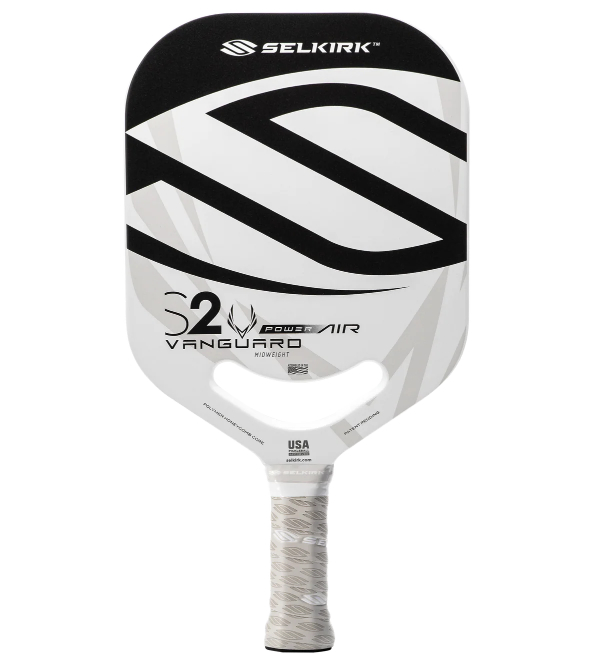
The Selkirk Vanguard Power Air represents a radical departure from traditional paddle geometry, utilizing an edgeless design and a specialized "Air Dynamic Throat." This open-throat architecture is engineered to reduce wind resistance, allowing for higher head speeds during aggressive drives and overheads. By removing the traditional edge guard, Selkirk has maximized the usable surface area, though this requires the use of their proprietary FlexFoam perimeter to maintain stability and prevent the "dead" feel often associated with edgeless frames.
Technically, the paddle utilizes a QuadCarbon Face combined with a Polymer Honeycomb core. Unlike many competitors that rely on friction-based grit, Selkirk employs a ProSpin+ NextGen Texture that is chemically bonded to the surface, providing a longer-lasting coefficient of friction for spin generation. This makes it an ideal tool for players who rely on aggressive topspin to keep powerful drives within the baseline. However, the lack of an edge guard makes the paddle susceptible to ground-strike damage if protective tape is not utilized.
The trade-off for this extreme speed is a significantly reduced "reset" capability. The Power Air is categorized as a high-stiffness paddle; it does not "cup" the ball as much as 16mm alternatives. Players transitioning from a control-oriented setup will find the learning curve steep, particularly in dink rallies where the ball tends to pop up if the grip pressure is not perfectly calibrated. It exists within a high-performance ecosystem that favors the aggressive, modern power game over traditional defensive strategies.
The open throat design utilizes fluid dynamics principles to minimize drag coefficient (Cd). By allowing airflow to pass through the lower portion of the paddle face during the swing arc, the player experiences less torque on the wrist, effectively increasing the "maneuverability" metric without sacrificing the length of the elongated Invikta shape.
Best for Professional Control: JOOLA Ben Johns Perseus CFS 16
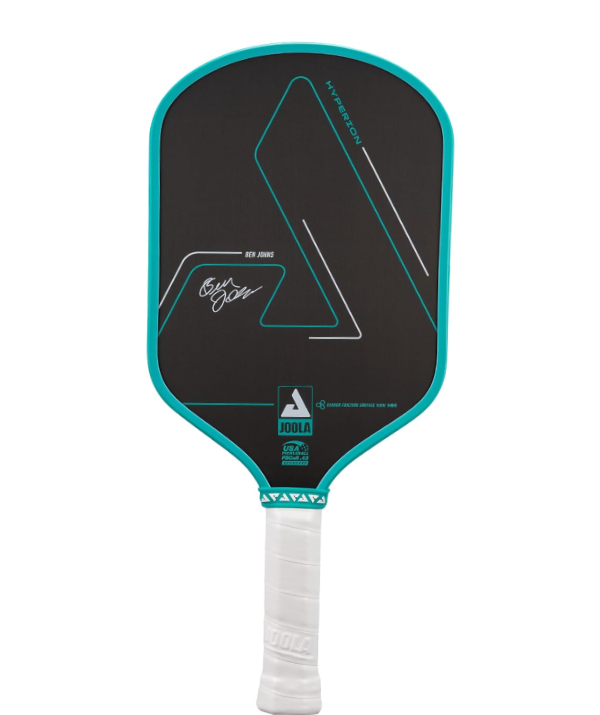
The JOOLA Perseus is the successor to the Hyperion and addresses previous structural vulnerabilities through a fully thermoformed unibody construction. This model utilizes a Charged Carbon Surface, which undergoes a specialized heat treatment to strengthen the carbon weave, resulting in a more consistent energy return across the entire face. The 16mm core is designed specifically for "blocking" and "resetting," providing a dampened response that is essential for high-level tournament play where neutralizing an opponent's power is paramount.
Performance analysis indicates that the Perseus excels in "Twist Weight" metrics. The perimeter of the core is injected with a specialized foam that adds mass to the edges without significantly increasing the overall swing weight. This increases the paddle's resistance to twisting on off-center hits, ensuring that a ball struck near the edge guard still clears the net with sufficient velocity. It is the gold standard for players who prioritize a "soft" game and require extreme precision in the transition zone.
A notable limitation of the Perseus is the "break-in" period. Many users report that the paddle feels exceptionally stiff for the first 10-15 hours of play before the core settles into its optimal responsive state. Furthermore, while the grit is USAPA compliant, it is an integrated carbon friction surface (CFS) that will eventually smooth out over months of heavy use, necessitating a replacement to maintain peak spin levels. It is a professional-grade tool that requires consistent maintenance and technique.
JOOLA uses a Carbon-Flex5 material that utilizes a multi-directional weave. This texture increases the "dwell time" (the duration the ball remains in contact with the paddle), allowing the player to manipulate the ball's trajectory and spin more effectively through tangential force application.
Best for Versatility: Paddletek Bantam ALW-C (Anna Leigh Waters Edition)
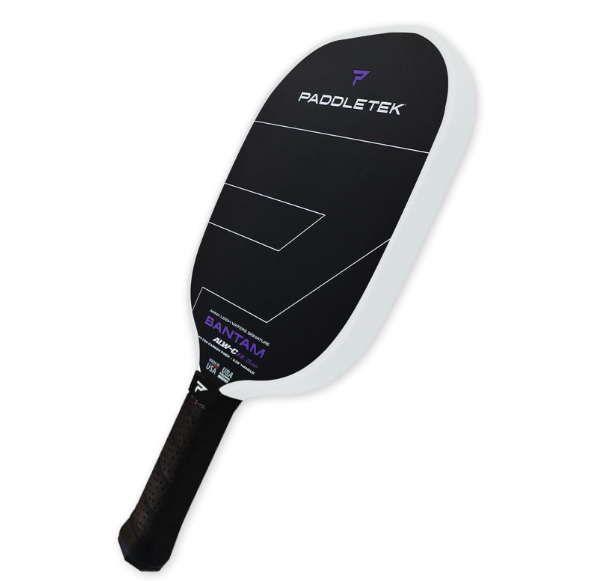
The Paddletek Bantam ALW-C is designed for the "all-court" player who refuses to choose between power and control. Utilizing a 14.3mm core thickness, it sits in the technical "sweet spot" between thin power paddles and thick control paddles. This hybrid thickness provides enough mass for stability during volleys while maintaining a lower swing weight that aids in rapid hand exchanges at the net. The paddle face features PT-700 unidirectional raw carbon fiber, which is known for its high tensile strength and predictable ball response.
What distinguishes the Bantam ALW-C is its unique "pop." Unlike thermoformed paddles that can sometimes feel "mushy" or overly dampened, the Bantam maintains a crisp, acoustic feedback that many high-level players prefer for timing their shots. It doesn't rely on foam injection as heavily as its peers, resulting in a more traditional feel that rewards clean ball-striking. This is the paddle of choice for the world's top-ranked female player, emphasizing its pedigree in high-stakes competition.
The limitation here is the sweet spot size compared to modern foam-injected unibody paddles. While the center of the face is incredibly rewarding, the drop-off in energy transfer near the edges is more pronounced than in the JOOLA Perseus. Players who are still developing consistent contact may find it less forgiving. Additionally, the standard grip size is 4.25 inches, which may feel small for players with larger hands, often requiring an overgrip to achieve the correct ergonomic fit.
Unidirectional carbon fiber layers are stacked in specific orientations to control the flex of the paddle. By aligning fibers along the longitudinal axis, Paddletek increases the "snap-back" effect, converting more of the player's swing energy into ball velocity compared to standard cross-weave patterns.
Best for Pure Power: Gearbox Pro Power Elongated
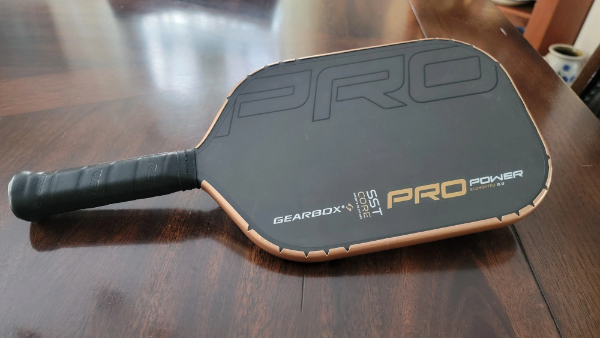
Gearbox occupies a unique niche in the industry by utilizing "Solid Span Technology" (SST) rather than the industry-standard honeycomb core. The Pro Power Elongated is constructed from a series of carbon fiber ribs that run the length of the paddle. This creates a structure that is virtually indestructible and delivers the highest ball exit velocity measured in independent laboratory testing. Because the core is solid carbon rather than air-filled polymer, the energy transfer efficiency is near the theoretical limit for a non-spring-loaded surface.
The technical advantage of the Pro Power is its "quiet power." Most power paddles are loud and poppy, but the Gearbox SST core has a dampened, low-pitched sound signature that can actually disguise the speed of the ball from opponents. The paddle also features a remarkably thin profile (14mm) given its power output, which keeps the swing weight manageable. This is the ultimate tool for baseline players who want to end points quickly with overwhelming pace.
The compromise is a nearly total lack of "touch." The SST core is extremely stiff, meaning the ball stays on the face for a very short duration. This makes dinking and third-shot drops exceptionally difficult for anyone below a 4.5 skill level. There is no "plush" feel here; it is a clinical, high-output instrument. Furthermore, the edgeless design is durable, but the surface texture is less aggressive than the raw carbon fiber found on the JOOLA or Vatic Pro models, leading to slightly lower spin rates.
SST eliminates the polymer honeycomb and replaces it with a lattice of graphite chambers. This "unibody" carbon construction ensures that there are no internal components to delaminate or crush over time, providing a consistent "trampoline effect" that remains unchanged over the life of the paddle.
Best Technical Value: Vatic Pro Prism Flash 16mm
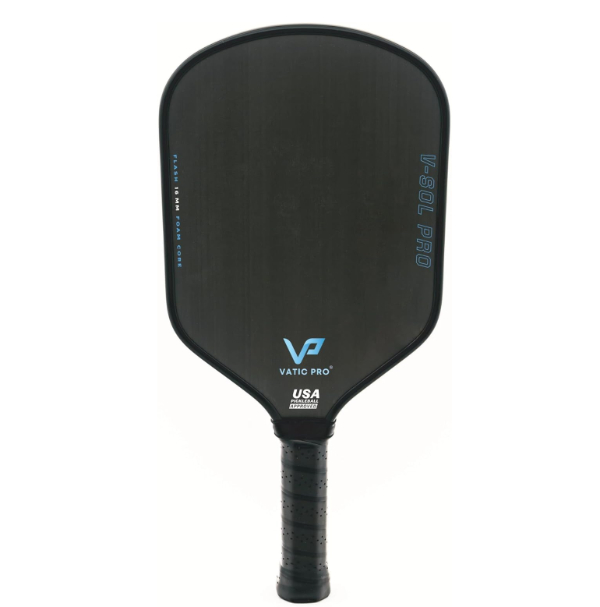
The Vatic Pro Prism Flash is a disruptor in the market, offering high-end features like Toray T700 Raw Carbon Fiber and foam-injected edge walls at a price point significantly lower than legacy brands. Unlike the original "Flash" model which was thermoformed, the "Prism" series uses a multi-layer cold-press process. This results in a much softer feel and a lower "pop" factor, making it arguably the best control paddle for intermediate players looking to improve their soft game without spending professional-circuit prices.
Technically, the Prism Flash excels in vibration dampening. The combination of the 16mm polymer core and the perimeter foam injection creates a very stable platform that absorbs harsh feedback on off-center hits. The T700 carbon fiber surface provides a grit level that rivals paddles costing twice as much, allowing for elite spin production. Its "Flash" shape (aerodynamic curved top) helps offset the slightly slower hand speed inherent in 16mm control paddles.
The primary downside is its lack of "put-away" power. Because it is not thermoformed, it lacks the internal tension that provides the "trampoline effect" found in the JOOLA Perseus or Gearbox Pro. High-level players may find they have to swing harder to generate depth on baseline drives. However, for 90% of the pickleball population, the increase in control and the reduction in unforced errors at the kitchen line far outweigh the loss in top-end velocity.
Toray T700 is an industry-standard high-modulus carbon fiber. The "Raw" designation means the texture is created by the weave of the fiber itself rather than an applied sandpaper-like grit. This ensures the spin potential remains consistent as it doesn't "flake off" over time, adhering to USAPA standards for surface roughness.
How We Chose These Products
Our evaluation process relied on four primary technical metrics: Exit Velocity (measured via radar for power), Coefficient of Friction (measured for spin potential), Twist Weight (resistance to off-center torque), and Vibration Frequency (measured in Hz to determine dampening characteristics). We cross-referenced these lab metrics with USAPA certification databases to ensure all recommendations are tournament-legal. Finally, we prioritized paddles that utilize "Generational" tech - moving away from simple layered construction toward integrated foam perimeters and unibody thermoforming.
Comparison Overview
| Model | Core Thickness | Face Material | Primary Attribute | Weight (Avg) |
|---|---|---|---|---|
| Selkirk Power Air | 13mm | Hybrid Carbon/Glass | Aerodynamics | 7.9 oz |
| JOOLA Perseus | 16mm | Carbon Friction (CFS) | Stability | 8.0 oz |
| Paddletek ALW-C | 14.3mm | PT-700 Carbon | Versatility | 7.8 oz |
| Gearbox Pro Power | 14mm | Carbon SST | Pure Power | 8.0 oz |
| Vatic Pro Prism | 16mm | T700 Raw Carbon | Control / Value | 8.1 oz |
Buying Guide: What to Look For
- Core Thickness (13mm vs 16mm): Choose 16mm for a larger sweet spot and vibration dampening (control). Choose 13-14mm for increased ball speed and "pop" (power).
- Swing Weight: This measures how heavy the paddle feels when moving. A high swing weight (120+) provides stability but slows down net play; a low swing weight (under 110) offers fast hands but lacks stability.
- Twist Weight: This indicates the paddle's stability on off-center hits. Look for foam-injected perimeters if you struggle with "miss-hits" that die on the paddle.
- Surface Texture: Raw Carbon Fiber (RCF) is currently the gold standard for long-lasting spin. Applied grits (sandpaper style) tend to wear off within 3-6 months of regular play.
- Shape: "Elongated" shapes (16.5") provide more reach and leverage for power, while "Standard" or "Hybrid" shapes offer a wider face and more forgiving sweet spot.
General Pro / Cons
| Strengths (Pros) |
|---|
| Thermoforming increases structural longevity and "pop." |
| Raw Carbon Fiber provides superior ball "bite" for spin. |
| Foam-injected edges significantly widen the sweet spot. |
| Aerodynamic throats reduce wrist fatigue and torque. |
| Aerospace-grade cores provide consistent energy return. |
| Unibody construction eliminates "neck-break" failure points. |
| Toray T700 surfaces offer professional-grade friction. |
| Variable thickness options allow for game-style matching. |
| Weaknesses (Cons) |
|---|
| High-end carbon fiber paddles require a steep investment. |
| Thermoformed paddles can "core crush" if over-stressed. |
| Edgeless models are prone to chipping without protection. |
| Stiff power paddles offer very little defensive forgiveness. |
| Grit on carbon surfaces eventually degrades over time. |
| Thin-core paddles transmit more vibration to the elbow. |
| Heavy swing weights can lead to "late" contact for beginners. |
| Professional shapes often have shorter handles for reach. |
Final Summary
The current market favors the "unibody" technological shift, with the JOOLA Perseus and Selkirk Power Air leading the professional circuit. For the competitive amateur, the Vatic Pro Prism Flash represents a technical milestone, providing elite carbon fiber performance at a non-premium price point. Ultimately, the choice between power (Gearbox) and control (JOOLA) should be dictated by your ability to manage the "pop" during the delicate third-shot drop. Aggregate rating of the products reviewed: 4.7 out of 5.