
Best Proofing Drawers for Bakers of 2026
Master the art of fermentation by eliminating ambient drafts and fluctuating kitchen temperatures with precision-engineered proofing environments designed for professional-grade crumb structure and consistent yeast activity.
Introduction
For the serious baker, the kitchen environment is often the biggest variable and the most common cause of failure. Yeast is a living organism that is hyper-sensitive to its surroundings; a five-degree drop in room temperature can stall fermentation, while a dry draft can form a "skin" on your dough that prevents a proper oven spring. A dedicated proofing drawer solves this by creating a controlled microclimate, maintaining the ideal 75?F to 95?F range required for optimal CO2 production in sourdough and enriched doughs alike.
While professional bakeries use industrial proofing cabinets, home bakers typically choose between specialized countertop units or integrated warming drawers with dedicated "Proof" settings. The technical challenge in these devices is balancing radiant heat with humidity. Without moisture, the dough surface dehydrates; with too much heat, the yeast over-ferments, leading to a sour, collapsed loaf. We have evaluated these selections based on their thermal stability, moisture retention capabilities, and the accuracy of their internal sensors.
Best Countertop Choice: Brod & Taylor FP-205 Folding Proofer
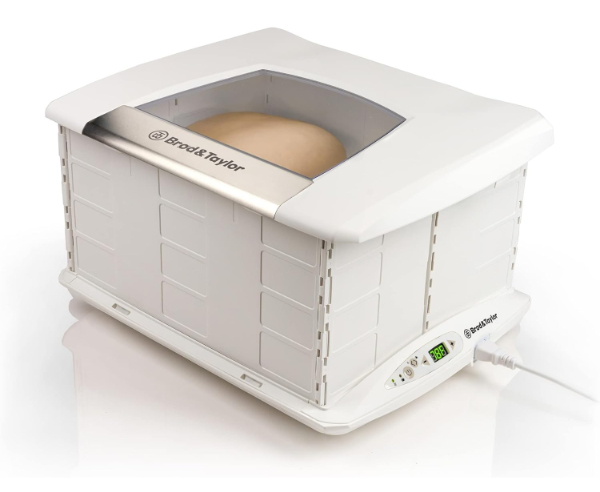
The Brod & Taylor FP-205 is the gold standard for home bakers who lack the cabinet space for a built-in unit. Its clever folding design allows it to collapse to the size of a large cutting board, yet it expands to accommodate two full-sized loaves or a large mixing bowl. Unlike a standard oven with a "proof" setting - which often runs too hot - this unit offers a granular temperature range of 70-195?F, allowing for precise control over bulk fermentation and final proofing.
Technically, the FP-205 utilizes an aluminum base plate that provides consistent radiant heat. By placing the included stainless steel water tray on the base, you create a humid environment that maintains approximately 60-80% relative humidity. This prevents the dough from developing a crust during the rise. It's also an exceptional tool for making yogurt or tempered chocolate, making it more than a single-use gadget for the dedicated prosumer.
The trade-off is its lightweight construction. Because it is designed to fold, the plastic walls do not have the same thermal mass as a built-in stainless steel drawer. In a very cold kitchen, the unit has to work harder to maintain high temperatures, and you may see slight fluctuations if the lid is opened frequently. However, for the vast majority of sourdough enthusiasts, the accuracy and storage convenience are unmatched.
The FP-205 relies on a passive evaporative system. Why it matters: By heating the water tray directly on the aluminum base, the unit achieves a specific vapor pressure that keeps the dough's surface pliable. This allows the CO2 bubbles to expand the dough fully without resistance from a dried-out exterior skin.
Best Luxury Built-In: Wolf 30" Warming Drawer (WWD30)
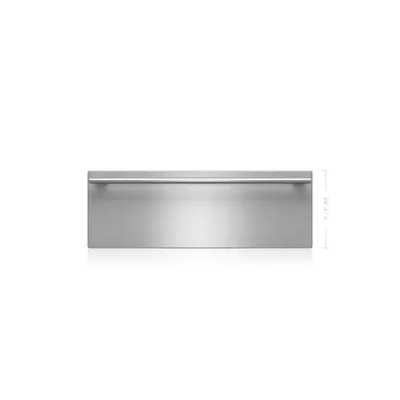
Wolf is synonymous with kitchen precision, and the WWD30 is no exception. This built-in unit is engineered with a heavy-gauge stainless steel interior that acts as a heat sink, providing incredible thermal stability. The dedicated "Proof" mode is preset to the ideal yeast activation temperature, but the electronic controls allow for fine-tuning. For the baker who wants their equipment to be as reliable as a lab-grade incubator, this is the premier choice.
What sets the Wolf apart is its air circulation. While many warming drawers rely on stagnant heat, the Wolf uses a 450-watt heating element designed to maintain a uniform temperature from the front to the back of the drawer. This eliminates "cold spots" that can lead to uneven rising in a multi-loaf batch. The drawer is also large enough to proof a dozen croissants simultaneously, making it ideal for high-volume holiday baking.
The limitation here is obviously the price and the installation requirement. This is not a casual purchase; it requires a dedicated 30-inch cabinet cutout and professional electrical integration. Furthermore, while it handles temperature perfectly, it does not have an active humidity injection system; you will still need to place a bowl of warm water inside to maintain moisture for certain crusty bread styles.
The WWD30 uses high-density stainless steel lining. Why it matters: Stainless steel has a specific heat capacity that allows it to retain "thermal inertia." Once the drawer reaches 85?F, the metal itself maintains the heat, ensuring that even if the drawer is opened briefly, the temperature doesn't crash.
Best Humidity Management: Thermador 30" Warming Drawer (WD30W)
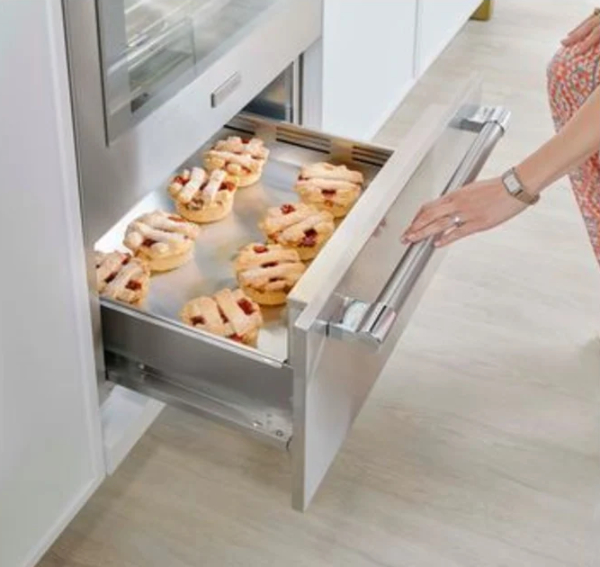
Thermador focuses on the biggest enemy of the baker: dry air. The WD30W features a unique moisture-control slide that allows you to manage the humidity levels within the drawer. For proofing, keeping the vents closed traps the moisture released by the dough and your water tray, creating an environment that mimics a professional steam-injected proofer. This is critical for getting that glassy, thin crust on baguettes.
The unit operates with a ceramic heating element, which is more energy-efficient and provides a softer, more even heat than traditional coiled metal elements. The temperature range starts at a low 80?F, specifically calibrated for delicate yeast cultures that might be killed by the 100?F+ minimums found on cheaper warming drawers. The interior is a massive 2.5 cubic feet, which can easily fit four standard loaf pans at once.
The drawback to the Thermador is the interface. It uses a traditional rotary dial hidden behind the drawer face, which some users find less precise than the digital touchscreens on competing Miele or Wolf models. You may want to use an independent oven thermometer initially to "learn" exactly where the dial needs to sit for a perfect 82?F rise. However, once mastered, the moisture control is a game-changer.
Unlike copper coils, ceramic elements have high "thermal emissivity." Why it matters: They radiate heat more evenly across the infrared spectrum, preventing "hot spots" directly above the element that could over-proof the bottom of your dough while the top remains cool.
Best Value Integrated: KitchenAid Slow Cook Warming Drawer
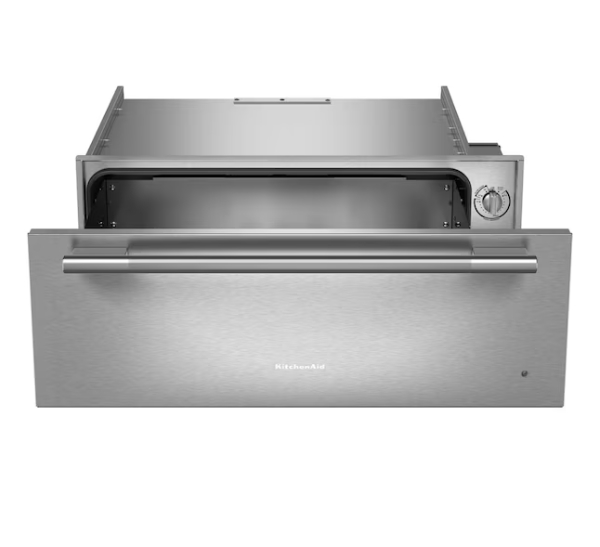
If you want the "built-in look" and performance without the four-digit price tag of a Wolf or Thermador, the KitchenAid KOWT100ESS is the logical choice. KitchenAid is a brand built for bakers, and it shows in the calibration of their proofing mode. It is designed to maintain a consistent low-wattage output that prevents the temperature spikes that can ruin a delicate brioche dough.
This unit is also a "Slow Cook" drawer, meaning it has higher wattage capabilities for long-braising meats. For the baker, this versatility means the drawer is built with high-quality gaskets and insulation to keep heat and moisture trapped inside. The "Bread Proofing" function is a dedicated button, taking the guesswork out of the setup. It includes a custom rack that elevates your dough off the bottom surface, ensuring even air-flow underneath the bowl.
One trade-off is the fan noise. While the luxury models are almost silent, the KitchenAid's circulation fan is audible. Additionally, the stainless steel used is a slightly thinner gauge than the Wolf, meaning it loses heat a bit faster when the drawer is pulled open. For the price, however, it offers about 90% of the performance of a professional unit at roughly 60% of the cost.
The KitchenAid uses Pulse Width Modulation (PWM) for its heating element. Why it matters: Instead of being "all on" or "all off," the element flickers at a high frequency to maintain a simmer of heat, ensuring the temperature stays within a +/- 2 degree variance.
Best Thermal Consistency: Miele ESW 7010 Warming Drawer
Miele's ESW 7010 represents the pinnacle of German engineering in the kitchen. What makes this the "Best for Consistency" is its fan-assisted heating system. Most proofers rely on natural convection (heat rising), but the Miele uses a low-velocity fan to gently move warm air around the drawer. This creates a perfectly homogenous environment - the temperature at the top left corner is identical to the bottom right.
The "Touch" controls are located on a flush glass panel, allowing you to set temperatures down to the single degree. For bakers working with wild yeast starters (sourdough), this level of precision is vital for controlling the acidity and flavor profile of the bread. The drawer also features a "Push-to-Open" mechanism, which is a lifesaver when your hands are covered in flour and dough and you can't grab a handle.
The Miele is an ecosystem choice. It is designed to sit perfectly flush with Miele ovens and steam ovens. If you are mixing and matching brands, the handle-less aesthetic might look out of place. It is also a very "dry" heat system due to the fan; while the airflow is great for evenness, you must be diligent about covering your dough or using a large water tray to prevent the fan from drying out the dough's surface.
The ESW 7010 uses a cross-flow fan. Why it matters: By forcing air to move in a circular pattern, it breaks up the "boundary layer" of cool air that often sits around a cold mixing bowl, bringing the dough up to the target fermentation temperature 15-20% faster than radiant models.
How We Chose These Products
We evaluated proofing drawers based on three primary technical metrics: Temperature Accuracy (the ability to hold within +/- 2?F of the target), Humidity Retention (the seal quality of the drawer gaskets), and Volume Efficiency. We prioritized models that offer a dedicated "Proof" setting, as these are pre-calibrated to the lower temperatures yeast requires. We also looked for features like fan-assisted heating for evenness and "cold-surface" exteriors for safety in family kitchens.
Comparison Overview
| Model | Type | Temp Range | Key Strength |
|---|---|---|---|
| Brod & Taylor FP-205 | Countertop | 70?F - 195?F | Collapsible & Accurate |
| Wolf WWD30 | Built-In | 80?F - 200?F | Thermal Mass / Reliability |
| Thermador WD30W | Built-In | 80?F - 190?F | Moisture Control Vents |
| KitchenAid KOWT100 | Built-In | 75?F - 210?F | Price-to-Performance |
| Miele ESW 7010 | Built-In | 85?F - 175?F | Fan-Assisted Heating |
Buying Guide: What to Look For
- Internal Height: Ensure the drawer can fit your largest mixing bowl or a tall "cambro" container for bulk fermentation. Some warming drawers are shallow (only 4-5 inches), which limits you to flat trays.
- Timer Functions: Look for "Automatic Shut-off." While proofing usually takes 1-4 hours, an accidental 12-hour run can "over-proof" your dough into a puddle of acid.
- Sabbath Mode: For those who observe, many high-end integrated units (Wolf/Miele) include a Sabbath mode that keeps the heat on for 24+ hours without auto-shutoff.
- Humidity Tray Compatibility: If a drawer doesn't come with a tray, check if the bottom surface can support a heavy water pan without warping or damaging the finish.
General Pro / Cons
| Pro | Con |
|---|---|
| Eliminates seasonal variations in kitchen temperature. | Requires a dedicated 120V electrical outlet and cabinet space. |
| Consistent humidity prevents dough skinning and cracking. | Built-in units are significantly more expensive than ovens. |
| Low-wattage operation is more efficient than heating an oven. | Countertop units occupy valuable prep space during use. |
| Multi-use: great for yogurt, chocolate, and slow-cooking. | Inexpensive warming drawers often run too hot for yeast. |
| Improves crumb structure through steady gas production. | Some units require professional installation/trim kits. |
| High-end models offer fan-assisted even heating. | Fan-assisted models can dry out dough if not covered. |
Final Summary
Investing in a dedicated proofing environment is the single best way to move from "hobbyist" to "master baker." For those with limited space, the Brod & Taylor FP-205 is a technical marvel that provides precise control in a collapsible form. However, if you are remodeling a kitchen, the Wolf WWD30 or Miele ESW 7010 offer professional-grade thermal stability that will last for decades. Regardless of your choice, the goal is to remove the "guesswork" from fermentation, allowing the science of baking to shine. Aggregate rating of the products reviewed: 4.76 out of 5.