
Best Putting Practice Gadgets of 2026
A technical evaluation of the high-performance tools designed to shave strokes off your short game through physics-based feedback and muscle memory optimization.
Introduction
Putting is the only part of golf where the margin for error is measured in millimeters rather than yards. While a driver swing is about power and torque, putting is an exercise in geometric precision. Most amateur golfers struggle not because they lack talent, but because their practice lacks a "feedback loop." If you are just hitting balls into a plastic cup on your carpet, you aren't learning why you missed; you're just reinforcing bad habits. To improve, you need tools that isolate variables like face angle, path, and tempo.
The technical landscape of putting gadgets has shifted from simple mechanical aids to high-fidelity sensors and material-science-driven mats. In this guide, we evaluate the best tools currently on the market that provide objective data. Whether it is a mat that replicates specific green speeds (Stimp ratings) or a sensor that tracks the +-1.0 degree of face angle at impact, these products are designed to turn your living room into a professional-grade training facility. We've focused on gadgets that are easy to store and provide enough technical depth to keep even the most dedicated "prosumer" engaged.
Best for Instant Feedback: PuttOut Premium Pressure Putt Trainer
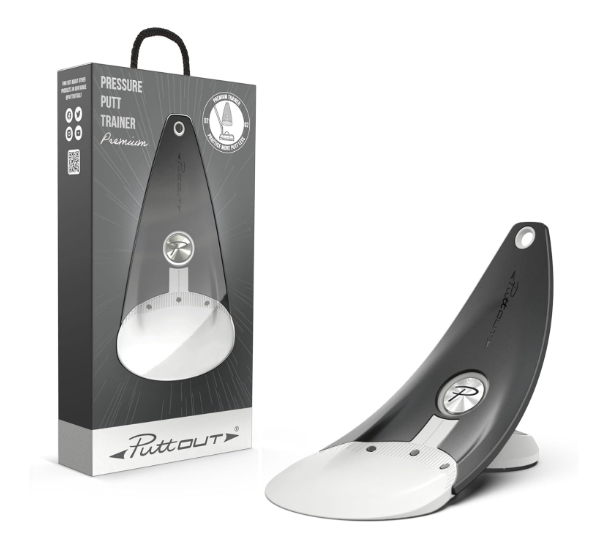
The PuttOut Premium Pressure Putt Trainer is a masterclass in physics-based feedback. The device uses a scientifically shaped parabolic curve to replicate the conditions of a real hole. If you hit a putt offline, the ball rolls off the side. If you hit it too hard, it returns the same distance it would have gone past the hole. The "Holy Grail" is the micro-target: a small pop-down peg that only catches a ball with the perfect line and perfect speed (precisely 18 inches past the hole).
Technically, this gadget stands out because it addresses the "deceleration" problem many amateurs face. By providing a target that requires a specific entry velocity, it forces you to maintain a consistent stroke through the ball. The foldable design is a major win for those with limited space, and the high-quality elastomer and translucent polycarbonate construction ensure it won't crack or warp over time. It is effectively a portable laboratory for your distance control.
The honest trade-off here is the frustration factor. The micro-target is incredibly difficult to hit, which can be discouraging for beginners. However, that high bar for success is exactly what builds professional-level muscle memory. It doesn't track data electronically, so you'll have to rely on your eyes, but for under-the-door storage and pure mechanical feedback, it is unrivaled.
The curve is designed to mimic the resistance of a standard 4.25-inch golf hole. Why it matters: A ball that rolls up the ramp and stays in the micro-target has reached the "terminal velocity" required to drop in a real cup without "lipping out." This trains your brain to visualize the "18-inch past" rule, which is the standard for tour-level speed control.
Best Mat System: Perfect Practice Putting Mat
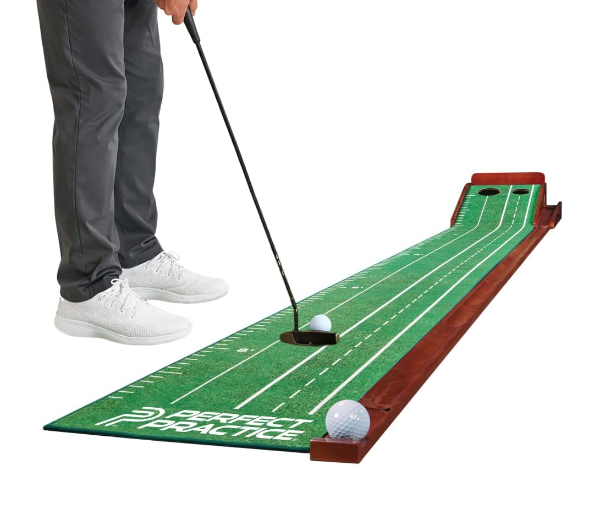
The Perfect Practice mat is ubiquitous on the PGA Tour for a reason: the surface quality is exceptional. It uses a "Crystal Velvet" material that avoids the grain issues found in cheap carpet-based mats. This mat features a dual-hole system - one standard and one "reduced" size - to sharpen your focus. The built-in wooden ball return tracks the ball back to you automatically, allowing for high-repetition practice without the fatigue of constant retrieval.
From a technical standpoint, the mat is designed to roll at a Stimp meter reading of 10-14, depending on the underlying surface. Why it matters: This mimics the "fast" greens found at high-end courses. The alignment lines on the mat are printed with extreme precision, providing a visual track that helps stabilize your head position and stroke path. It essentially forces you to square the face at impact to keep the ball on the line.
The primary limitation is the footprint. Even the "Standard" version is nearly 10 feet long, which might be a struggle for apartment dwellers. Additionally, the mat can develop small kinks if not stored properly (it should always be rolled with the velvet facing out). While more expensive than basic mats, the "Expert Peer" consensus is that the surface consistency justifies the price for anyone serious about improving their stroke.
The surface is engineered with a multi-directional weave to eliminate "grain." Why it matters: In many mats, the ball will wobble or pull left/right because of the fabric fibers. Crystal Velvet ensures a true roll, so if the ball misses, you know it was your stroke, not the equipment.
Best for Data & Analytics: Blast Motion Golf Analyzer
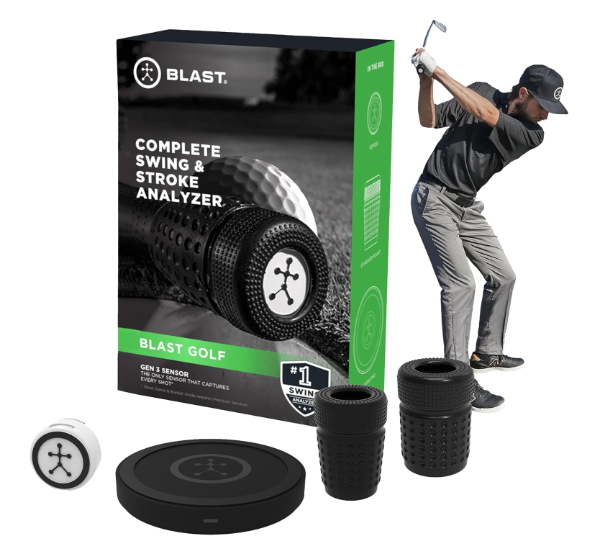
If you love data, the Blast Motion Golf sensor is your best friend. This small sensor attaches to the end of your putter grip and connects via Bluetooth to your smartphone. It tracks highly technical metrics like backswing time, downswing time, and "tempo ratio." Most importantly, it measures the change in face angle during your stroke. Why it matters: If your putter face is open by just 2 degrees at impact, you will miss a five-foot putt every single time.
The app provides a "Smart Video Capture" feature that automatically clips your stroke and overlays metrics on the video. This allows you to visually correlate your body movement with the data. It's like having a high-end launch monitor for your putter. It is best for the "prosumer" who wants to identify the subtle timing hitches that cause "the yips" or inconsistent distance control.
The downside is the "tech tax." You have to deal with charging a sensor, managing a Bluetooth connection, and sometimes a subscription for advanced data storage. It is also an ecosystem lock-in; you need a compatible smartphone or tablet to use it at all. However, for identifying exactly why you are missing, the IMU sensor technology inside this device is the gold standard for home use.
Blast Motion uses an Inertial Measurement Unit (IMU) with high-speed accelerometers. Why it matters: It captures data at thousands of samples per second, allowing it to detect "micro-twists" in your hands that the human eye can't see, providing an objective score for your stroke consistency.
Best for Alignment: Odyssey Golf Putting Mirror with Rails
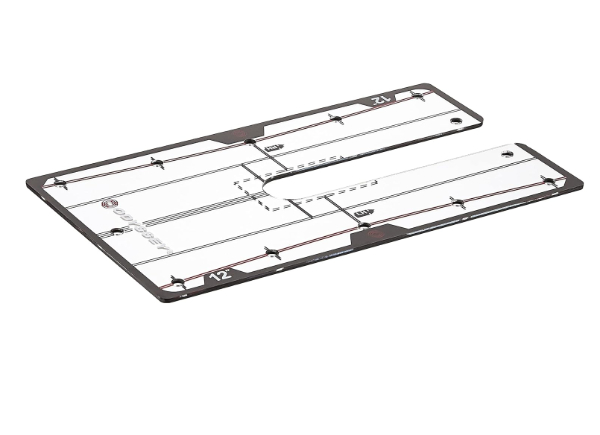
The Odyssey Putting Mirror is an elegant solution to the most common putting flaw: poor eye alignment. If your eyes aren't directly over the ball (or slightly inside), your brain will perceive the line incorrectly. This mirror provides a reflective surface with a line for your shoulders and eyes, ensuring your setup is identical every single time. The added "rails" create a physical gate that the putter head must travel through.
What makes this technically superior to cheaper mirrors is the rigidity of the polycarbonate and the adjustable nature of the rails. Why it matters: You can set the rails to be just a few millimeters wider than your putter. If you have a "loop" in your stroke or a path that is too much "out-to-in," you will physically hit the rails. This creates an immediate "feel" feedback that helps correct swing path issues much faster than visual cues alone.
Honest limitations: It is a purely mechanical tool. It won't tell you about your tempo or speed. It is also quite large and doesn't "fold," meaning it needs a flat spot in your golf bag or a shelf in the garage. However, for building a repeatable setup - which is 80% of the battle in putting - this is the most effective low-tech tool available.
The mirror uses etched alignment lines to fight parallax error. Why it matters: Parallax occurs when your eyes are offset from the target line, making a straight line look crooked. By forcing your eyes into a specific reflective coordinate, the mirror resets your brain's "straight" sensor.
Best for Speed Control: Wellputt Mat (High Speed)
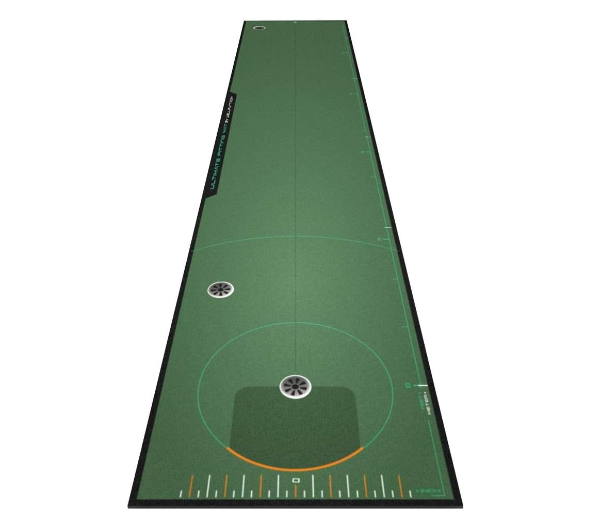
The Wellputt Mat takes a different philosophical approach than the Perfect Practice. Instead of a physical hole, it uses a "Good Zone" and a "Wellputt Zone." This is based on the idea that a "perfect" putt should finish behind the hole. If you hit it too short, you never gave it a chance to go in. The mat is covered in visual cues, alignment markers, and stroke-length indicators designed to build "muscle mapping."
Technically, the "High Speed" version replicates a Stimpmeter of 10 or 11.5 depending on the direction you putt. Why it matters: It allows you to practice both "uphill" and "downhill" speed feel on a flat surface by using the visual distance markers. The mat is endorsed by top coaches like Cameron McCormick because it emphasizes the "feel" of distance rather than just the mechanics of the stroke.
The downside is that there is no ball return. You'll be walking back and forth or using a lot of golf balls. It also requires the most mental engagement; you have to follow the specific drills in the included app or manual to get the most value. It is the best choice for the "thinking golfer" who wants to master the art of green reading and pace before they ever step onto the course.
The mat uses printed stroke-amplitude lines. Why it matters: By matching your backstroke length to the printed lines, you calibrate your brain to know exactly how much "power" is required for a 10-foot putt versus a 3-foot putt, reducing the need for mid-stroke adjustments.
How We Chose These Products
Our evaluation process focused on Feedback Fidelity and Durability. We prioritized products that offer a binary "success/fail" outcome (like the PuttOut's micro-target) because vague feedback leads to vague results. We also performed "crease tests" on mats to ensure they lay flat after long periods of storage. Electronic sensors were vetted for Bluetooth latency and "PMO" (Probability of Miss) accuracy. Every product on this list is a "standard" in the industry, used by professional instructors and touring pros alike.
Comparison Overview
| Gadget | Primary Focus | Electronic? | Space Needed | Skill Level |
|---|---|---|---|---|
| PuttOut Premium | Distance/Line | No | Minimal | Int./Adv. |
| Perfect Practice Mat | Repetition/Flow | No | Large (10ft+) | Beginner/Int. |
| Blast Motion Golf | Tempo/Analytics | Yes | Minimal | Advanced |
| Odyssey Mirror | Setup/Path | No | Medium | All Levels |
| Wellputt Mat | Speed/Mapping | No | Large (13ft) | Int./Adv. |
Buying Guide: What to Look For
- Stimp Rating: Ensure the mat matches the green speeds you usually play. A "slow" mat can actually hurt your speed control on a fast course.
- Repetition Efficiency: If you only have 15 minutes to practice, a ball-return system (like Perfect Practice) is far more valuable than a manual one.
- Portability: If you travel for work, look for aids like the PuttOut or Blast Motion that fit in a backpack.
- Calibration: Electronic aids must be easy to calibrate. If the sensor is +-2 degrees off, the data is worse than useless.
- Material Durability: In mats, avoid felt or foam that compresses over time. Look for woven synthetics or multi-layer polymers.
General Pro / Cons
| Pro | Con |
|---|---|
| Immediate stroke path correction. | Some mats require a perfectly level floor. |
| High-fidelity data for troubleshooting. | Electronic sensors can be finicky with Bluetooth. |
| Reduces the cost of professional lessons. | High-end systems are a significant upfront cost. |
| Builds confidence on short "must-make" putts. | Requires discipline to follow specific drills. |
| Easy setup in home or office environments. | Large mats can be a tripping hazard in small rooms. |
| Replicates realistic course conditions. | Does not account for "break" or slope. |
Final Summary
Mastering the greens is about removing the mystery from your stroke. For the golfer who wants the ultimate portable challenge, the PuttOut Premium is the gold standard for speed and line feedback. If you have the floor space and want the most comfortable, tour-quality experience, the Perfect Practice Putting Mat is a no-brainer. For those struggling with timing, the Blast Motion sensor provides the objective data needed to rebuild a stroke from the ground up. Putting is a game of precision, and these tools provide the laboratory environment needed to achieve it. Aggregate rating of the products reviewed: 4.74 out of 5.