
Best Resistance Bands for Workouts of 2026
Introduction
Transitioning to a home gym often hits a wall regarding square footage and budget. While a rack of dumbbells is iconic, resistance bands offer a distinct physiological advantage: variable linear resistance. Unlike a dead weight, which is limited by gravity, a band's tension increases as it stretches, more closely mimicking the natural strength curve of human muscle tissue. This means you get more tension at the point where your muscles are strongest, maximizing the efficiency of every rep.
However, the market is saturated with thin, molded latex that snaps easily, creating a safety hazard in your living room. When we evaluate these sets, we look beyond the "pounds of tension" listed on the box. We analyze manufacturing methods - like layered dipping versus injection molding - and safety features like inner snap-guard cords. These technical choices determine whether a band lasts for three months or three years, and more importantly, whether it remains a safe tool for high-intensity training.
Best for Total Body Strength: Bodylastics Warrior 14-Piece Set
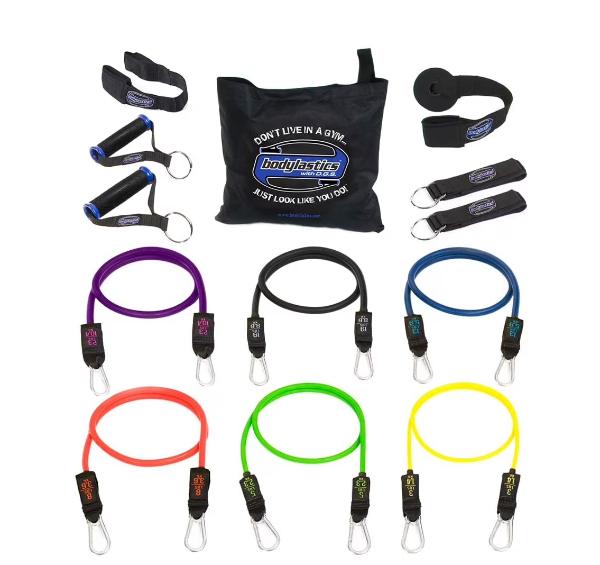
Bodylastics has long been the gold standard for tube-style bands because they addressed the primary fear of every home trainee: the band snapping and hitting them in the face. Their patented Snap-Reduction Technology uses a high-strength inner cord that prevents the latex from over-stretching beyond its elastic limit. Why it matters: If the outer latex fails, the inner cord catches the tension, preventing the band from lashing back at you, effectively turning a dangerous failure into a simple replacement task.
Technically, these are "stackable" bands using a carabiner system. Each band is dipped in high-quality Malaysian latex, a material known for its high tensile strength and consistent elasticity. The Warrior set provides up to 142 lbs of tension when combined, which is sufficient for most upper-body hypertrophy work like chest presses and rows. The heavy-duty door anchor utilizes a dense foam core that won't mar your door frame, solving the common problem of ruined paint or warped wood in rental units.
The limitation of this set is the inherent bulk of the handles and carabiners for certain mobility drills. If you are looking for a sleek, pocket-sized band for travel, the hardware here might feel over-engineered. However, for a legitimate "gym in a bag" that replaces a cable crossover machine, the modularity and safety specs of the Bodylastics system are unmatched.
Most tube bands are hollow. Bodylastics inserts a high-denier nylon cord inside the tube that is slightly longer than the band's maximum safe stretch length. Why it matters: By physically limiting the stretch to a safe range, you prevent micro-tears in the latex that lead to catastrophic failure, significantly extending the lifecycle of the rubber.
Best for Powerlifting & Mobility: Rogue Monster Band Full Set
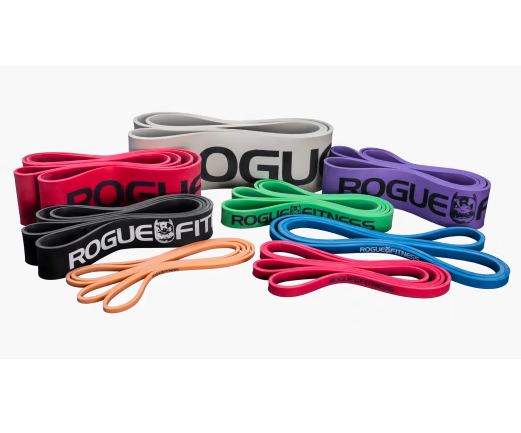
Rogue Monster Bands are 41-inch continuous loop bands used by professional strength athletes. Unlike tube bands with handles, these are raw tools of resistance. They are manufactured using a layered dipping process rather than being molded. Why it matters: Molded bands have a "seam" that acts as a weak point; layered bands are built like an onion, where any potential tear has to fight through multiple independent layers of latex, making them exceptionally durable for heavy compound movements like banded squats or deadlifts.
These bands range from 15 lbs to over 200 lbs of tension. For the home user, they are indispensable for "accommodating resistance." By looping them around a barbell or your feet, they add difficulty at the top of the lift where you are mechanically strongest. They also serve as the best tool for deep tissue mobility; their width allows them to "bite" into the hip or shoulder joint to help reset positioning - a technique used extensively in physical therapy and CrossFit circles.
The "trade-off" here is the lack of comfort. Without handles, the rubber will press directly into your palms or the arches of your feet. This can cause "pinch points" or skin irritation during high-rep sets. If you have sensitive hands, you'll likely need to use gloves or buy a separate set of handles to clip onto the loops. But for pure, unadulterated strength building, Rogue's latex quality is the industry benchmark.
Molded bands are made by injecting liquid latex into a frame. Layered bands are made by dipping a mandrill into latex thousands of times. Why it matters: If you nick a molded band, the crack propagates through the whole structure instantly. In a layered band, a small nick only affects the outermost skin, significantly reducing the risk of a sudden snap.
Best for Lower Body & Comfort: Arena Strength Fabric Bands

Standard latex "mini bands" are notorious for rolling up your legs or pinching the skin during squats and glute bridges. Arena Strength solved this by moving away from raw rubber toward a cotton and polyester blend woven with latex strands. Why it matters: The fabric has a much higher friction coefficient against clothing, meaning the band stays exactly where you put it - even on slippery leggings - and it won't snap if it comes into contact with the sharp edge of a shoe.
Technically, fabric bands offer a much stiffer resistance curve. Because fabric doesn't stretch as far as pure latex, the tension hits much sooner in the range of motion. This is ideal for lateral walks or "clamshell" exercises where the goal is to fire the gluteus medius quickly. The set comes in three distinct levels of resistance, but unlike latex bands, they all remain the same 13-inch length; the resistance is changed by the density of the weave, not the length of the loop.
The downside is that these are highly specialized for the lower body. You cannot easily use these for overhead presses or bicep curls due to their limited stretch capacity and circular shape. They are also harder to clean; while latex can be wiped with a sanitizer, these require a laundry cycle if they get sweaty. But for anyone focused on "booty" workouts or hip stability, the fabric design is a massive ergonomic upgrade.
These bands typically use a ratio of 40% latex and 60% cotton/polyester. Why it matters: This specific blend ensures the band retains "snap-back" elasticity while providing the "soft-touch" comfort of a textile. The interior usually features two strips of grippy rubber to prevent vertical migration (rolling) during dynamic movement.
Best for Pull-Up Assistance: Serious Steel Fitness 41" Bands
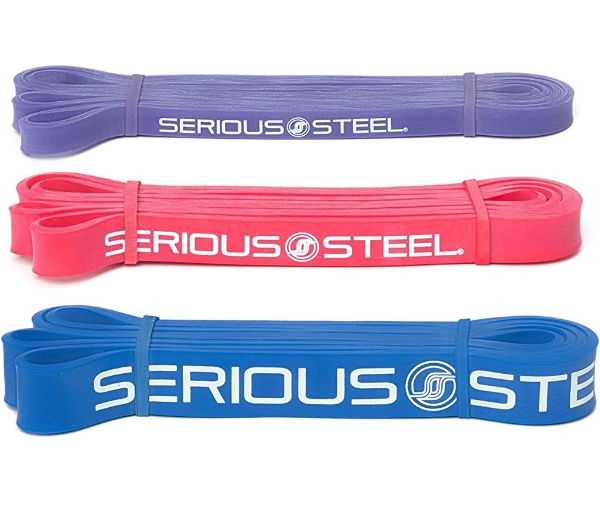
Serious Steel has carved a niche by focusing on the calibration of their resistance. Many cheap sets claim "50 lbs," but the tension is wildly inconsistent. Serious Steel bands are measured at 25%, 50%, and 100% stretch to provide a realistic resistance profile. Why it matters: If you are using these for pull-up assistance, you need a predictable amount of help at the bottom of the rep to ensure you are actually progressing toward an unassisted pull-up rather than just bouncing on a rubber string.
Like Rogue, these are layered latex bands, but Serious Steel offers a much wider variety of "micro" bands. These ultra-thin bands are perfect for high-rep rehabilitation work like face pulls or rotator cuff rotations where a standard band would be too heavy. Their "Purple" and "Green" bands are the industry standards for helping beginners achieve their first chin-up, providing a wide platform for the foot to sit in without the band digging in painfully.
The main limitation is that they are sold in sets that can sometimes overlap in resistance, leading to redundant bands you might not use. Also, the 100% natural latex construction means those with a latex allergy must stay far away. But for a home gym owner who needs precise tension for skill work (like muscle-ups or front levers), the technical consistency of Serious Steel is a major advantage.
Resistance is defined by Hooke's Law: $F = k \cdot x$. Serious Steel ensures the $k$ (spring constant) remains stable through the band's life. Why it matters: Cheap bands lose their "memory" and become permanently elongated, which ruins the resistance curve. These bands are tested to withstand 3x their resting length without losing their original shape.
Best for Physical Therapy: Theraband CLX Sequential Loops
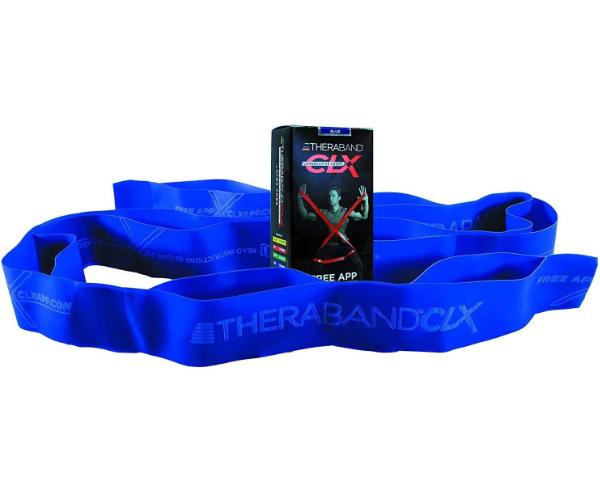
Theraband CLX is a radical departure from traditional bands. It is a single, continuous strip consisting of sequential loops. Why it matters: This "Easy Grip" loop system means you don't have to wrap rubber around your hands (which cuts off circulation) or hold bulky handles. You simply slide your hands or feet into the loops, allowing for "open hand" exercises that are critical for hand and wrist rehabilitation.
Technically, the CLX is made of a non-latex synthetic polymer. Why it matters: It is 100% safe for individuals with latex allergies, and it doesn't have the "powdery" feel or "rubber smell" associated with natural latex. The sequential loops also allow for simultaneous upper and lower body work; you can have your feet in one set of loops and your hands in another, creating a total-body tension system that is very difficult to achieve with standard loops.
The trade-off is the resistance ceiling. These are not designed for powerlifting. Even the heaviest "Gold" level resistance is relatively light compared to a Rogue Monster Band. If your goal is to add 50 lbs to your bench press, these aren't for you. But if you are recovering from surgery, managing joint pain, or looking for the most travel-friendly option in the world, the CLX is a masterpiece of functional design.
Traditional non-latex bands often felt "brittle." Theraband developed a proprietary thermoplastic elastomer (TPE) that mimics the recovery and stretch of natural latex without the allergen. Why it matters: TPE is more resistant to UV light and oils from the skin, meaning these bands won't get "sticky" or degrade as fast if left in a sunny room or used with lotions.
How We Chose These Products
Our selection process was driven by three technical metrics: Elastic Memory, Manufacturing Integrity, and User Safety. We evaluated over 20 sets, dismissing those that used cheap "injection molded" processes which are prone to air bubbles and snapping. We prioritized brands that provide "Force-Extension" data - actual proof of how the resistance scales. Finally, we looked for versatility; a great set shouldn't just do one thing well; it should replace multiple pieces of gym equipment while taking up less space than a pair of shoes.
Comparison Overview
| Model | Type | Material | Max Resistance | Best Feature |
|---|---|---|---|---|
| Bodylastics Warrior | Tube w/ Handles | Dipped Latex | 142 lbs | Snap-Reduction Cord |
| Rogue Monster Bands | Loop | Layered Latex | 200+ lbs | Extreme Durability |
| Arena Strength | Fabric Loop | Cotton/Latex Blend | Heavy (Stiff) | Non-slip / No-roll |
| Serious Steel 41" | Loop | Layered Latex | 150 lbs | Tension Calibration |
| Theraband CLX | Sequential Loop | Non-Latex TPE | Moderate | Easy-Grip Loops |
Buying Guide: What to Look For
- Layered vs. Molded: Always check if the band is "layered." Layered bands (like Rogue or Serious Steel) are significantly safer because they don't snap all at once if they get a small tear.
- Latex vs. TPE: Latex has a better "snap-back," but TPE is better for allergies and lasts longer in UV light (near windows).
- Safety Cords: For tube bands, never buy a set without an internal safety cord. It is the only thing preventing a facial injury if the rubber fails.
- Hardware Quality: Look for steel carabiners and nylon webbing. Avoid plastic clips, as they become brittle and can shatter under high tension.
- Anchor Versatility: A good set should include a door anchor with a large "stopper" to ensure it cannot slip through the door gap under load.
General Pro / Cons
| Pros | Cons |
|---|---|
| Variable resistance mimics the body's natural strength curve. | Latex can cause skin irritation or allergic reactions for some. |
| Extremely portable; a full gym fits in a carry-on bag. | High-quality layered bands are more expensive than molded ones. |
| Safe for joints as there is no heavy "momentum" or dropped-weight risk. | Resistance levels are estimates and can vary with temperature. |
| Versatile enough for strength, mobility, and rehabilitation. | Rubber degrades over time when exposed to sunlight and oils. |
| Low footprint; requires zero floor space for storage. | Requires a secure anchor point (door or heavy furniture). |
| Layered construction provides a "fail-safe" safety margin. | Progressive overload is harder to track than with iron plates. |
| Fabric options eliminate the painful rolling and pinching of rubber. | Tube bands can feel "snappy" and unpredictable if overstretched. |
| Non-latex options exist for clinical or allergen-sensitive settings. | Naked rubber loops can be uncomfortable on bare skin. |
Final Summary
Investing in a resistance band set isn't just about finding the cheapest rubber; it's about choosing the right mechanical tool for your specific goals. If you want a traditional weight-lifting feel with maximum safety, the Bodylastics Warrior Set is the clear winner. For those focused on raw powerlifting and durability, the Rogue Monster Bands are a lifetime investment. No matter which you choose, you are opting for a scientifically sound method of training that prioritizes joint health and space efficiency.
Aggregate rating of the products reviewed: 4.74 out of 5.