
Best Robot Vacuums of 2026
A technical analysis of the industry's most advanced autonomous floor cleaners, evaluated for suction pressure, navigational precision, and maintenance automation.
Introduction
The robotic vacuum market has evolved from simple bump-and-turn devices into sophisticated mobile platforms utilizing LiDAR, RGB cameras, and AI-driven neural networks. The current technical landscape is defined by the "All-in-One" docking station, which automates the most labor-intensive aspects of floor care: dust bin emptying, mop washing, and high-temperature drying. For consumers, the choice now hinges on specific floor types and the complexity of the household environment, as navigational algorithms vary significantly in their ability to detect low-profile obstacles like power cables or pet waste.
When evaluating these machines, raw suction power - measured in Pascals (Pa) - is only one variable in a complex equation. Airflow velocity, brushroll geometry, and edge-cleaning mechanics are equally critical for effective debris removal. Furthermore, the integration of mopping systems has introduced new variables, such as downward pressure and sonic vibration frequencies. This guide analyzes five premier models that represent the current peak of autonomous domestic cleaning engineering.
Best Overall Performance: Roborock S8 MaxV Ultra
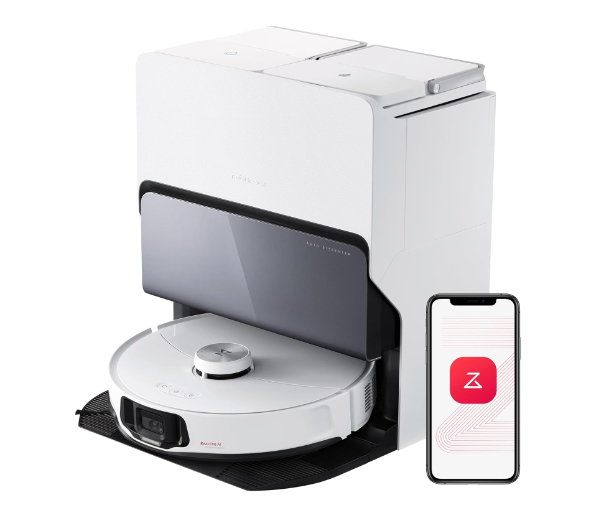
The Roborock S8 MaxV Ultra stands as a masterclass in navigational redundancy and sheer power. Utilizing a 10,000 Pa suction motor, it effectively extracts fine particulates from deep carpet fibers that lower-tier models miss. The flagship feature is the FlexiArm Design, which extends a side brush to clean into corners and edges where round robots traditionally fail. Navigational tasks are handled by Reactive AI 2.0, combining structured light and an RGB camera to identify 73 unique object types, ensuring the robot bypasses hazards even in pitch-black environments.
The "RockDock" Ultra station is arguably the most advanced on the market, featuring 60?C (140?F) hot water mop washing and heated air drying to prevent microbial growth and odor. The robot also includes an integrated voice assistant, "Hello Rocky," which operates locally for privacy-conscious users, and supports the Matter protocol for seamless smart home integration. The VibraRise 3.0 mopping system uses dual vibration modules to scrub floors at 4,000 times per minute, providing the necessary mechanical friction to lift dried-on stains.
Despite its dominance, the S8 MaxV Ultra requires significant physical space for its large docking station and carries a premium price. The reliance on dual rubber brushes is excellent for avoiding hair tangles but can be louder on hard floors than traditional bristled alternatives. For users seeking the highest level of automation and the most reliable obstacle avoidance currently available, this model remains the benchmark.
Roborock Official Product PageRoborock utilizes two counter-rotating all-rubber brushes. This geometry increases the "grab" on debris while minimizing hair wrap. Specifically, the Riser system allows the brushes to lift when in mop-only mode, preventing the cross-contamination of wet spills into the vacuum's internal airway - a common failure point in hybrid designs.
Best for Carpet & Pet Hair: iRobot Roomba Combo j9+
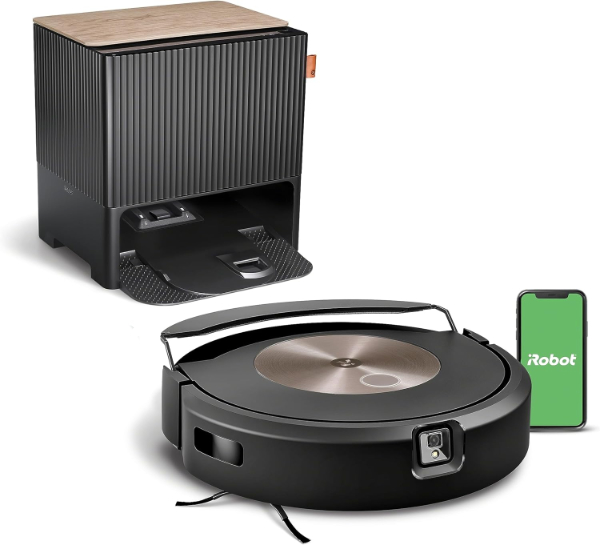
While many competitors focus on high suction numbers, the Roomba Combo j9+ excels through its iRobot OS and superior mechanical agitation. It features a unique auto-retracting mop that lifts completely to the top of the robot when carpet is detected, ensuring that even high-pile rugs stay bone-dry. The system's "Dirt Detective" software analyzes historical cleaning data to prioritize the grimiest rooms and automatically adjusts suction and scrubbing intensity based on the room type and floor material.
iRobot's dual multi-surface rubber brushes are specifically engineered for pet owners; they stay in constant contact with varying floor surfaces to loosen and lift hair without tangling. The j9+ also features the Clean Base Auto-Fill Station, which not only empties the dust bin but also refills the robot's liquid tank for up to 30 days. Navigational reliability is bolstered by the P.O.O.P. (Pet Owner Official Promise), guaranteeing a replacement if the robot fails to avoid solid pet waste.
The primary limitation is the lack of LiDAR. The j9+ relies on VSLAM (camera-based navigation), which can be slower to map and may struggle in pitch-black rooms without sufficient light. It also lacks the hot-water mop washing found in its Chinese competitors. However, for households with heavy carpet and pets, iRobot's localized software support and superior mechanical agitation remain a significant advantage.
iRobot Official Product PageUnlike LiDAR-only systems, iRobot's PrecisionVision uses machine learning to identify objects in real-time. This allows the j9+ to recognize cords, shoes, and pet waste, creating a "hazard map" that is shared with the user. This visual confirmation is critical for high-stakes environments where a LiDAR robot might simply see pet waste as a low-profile "obstacle" to be nudged.
Best Innovative Features: Dreame X40 Ultra
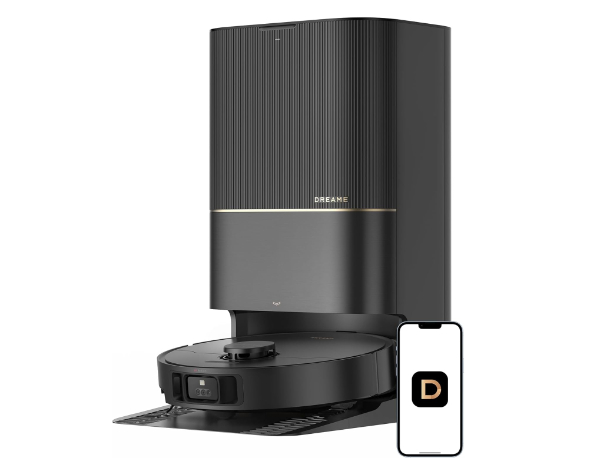
The Dreame X40 Ultra pushes the boundaries of robotic flexibility with its industry-leading 12,000 Pa suction and MopExtend RoboSwing technology. This allows the robot to swing its mop pads outward to reach deep into crevices and under furniture where the robot's body cannot fit. Furthermore, the X40 Ultra features a liftable side brush, preventing cross-contamination when the robot transitions from wet mopping to dry vacuuming on delicate surfaces.
Technically, the X40 Ultra is a powerhouse of sensors, using dual-laser LiDAR and an AI Action camera to create high-definition 3D maps. The base station is equally impressive, utilizing 70?C hot water to wash the dual-rotating mop pads, effectively dissolving grease and heavy stains. It also features an auto-empty system with a 3.2L dust bag that can last up to 75 days, depending on home size and debris levels.
The sheer amount of moving parts - extendable arms, lifting brushes, and rotating pads - does raise concerns regarding long-term mechanical durability compared to simpler designs. Additionally, the software ecosystem can be overwhelming due to the sheer volume of customization options. For the technophile who wants the most powerful and mechanically capable robot on the market, the X40 Ultra is currently unrivaled.
Dreame Official Product PageThis mechanism uses a specialized actuator to push the right-side mop pad beyond the robot's perimeter. By using a position-sensitive detector (PSD), the robot measures the distance to the wall and adjusts the extension in real-time, maintaining a <2mm gap. This solves the "dead zone" problem inherent in round robot mop designs.
Best Mopping Technology: Eufy Omni S1 Pro
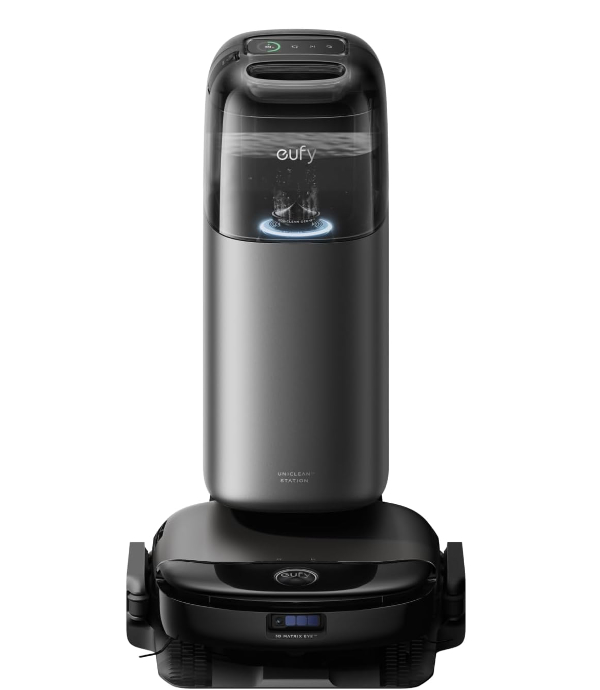
The Eufy Omni S1 Pro departs from the industry standard of rotating or vibrating pads in favor of a "Always-Clean" Roller Mop. This system works like a professional floor scrubber: it applies fresh water to a rotating roller while a scraper removes dirty water into a separate internal tank. This ensures that the robot is never simply pushing dirty water around the floor. To further hygiene, the S1 Pro includes an Eco-Clean Ozone system that generates aqueous ozone to sanitize floors and the mopping assembly, killing 99.9% of bacteria without chemicals.
On the vacuum side, it offers a respectable 8,000 Pa of suction and uses 3D Matrix Eye obstacle avoidance. This system utilizes a TrueCourse LiDAR hidden inside the body (lowering the robot's height) and infrared sensors to navigate complex chair legs and scattered toys. The station is designed with a sleek, transparent aesthetic that allows users to monitor the ozone generation and water levels at a glance.
The innovative roller mop design is superior for hard floors but can be less effective on very deep carpets where the roller may struggle to lift fine dust compared to a dedicated rubber brush. Additionally, the proprietary roller will likely need more frequent replacement than standard flat pads. For homes dominated by hardwood, tile, or marble, the S1 Pro offers the most hygienic and effective mopping solution on the market.
Eufy Official Product PageThe S1 Pro utilizes an electrolytic cell to convert oxygen (O2) in water into Ozone (O3). Ozone is a powerful oxidizer that breaks down the cell walls of bacteria and viruses. When the S1 Pro mops, this ozonated water sanitizes the floor surface and then reverts back to oxygen and water, leaving no chemical residue, making it ideal for households with toddlers or pets.
Best Low-Maintenance Design: Narwal Freo X Ultra
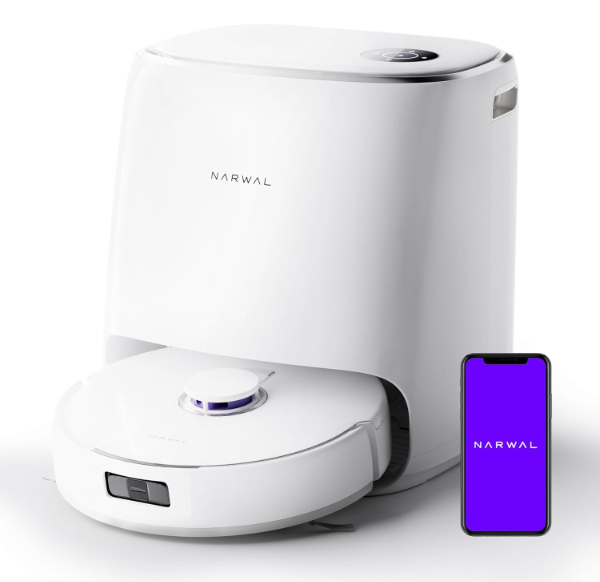
The Narwal Freo X Ultra addresses the two biggest pain points of robot vacuum ownership: hair tangles and dock maintenance. It features a certified Zero-Tangle Floating Brush that uses a conical shape to funnel hair into the suction port rather than allowing it to wrap around the bristles. This is complemented by a unique on-board dust compression system, which uses airflow to compact debris, allowing the robot to store up to 7 weeks of dust within the robot itself using a disposable HEPA bag, eliminating the need for a loud auto-empty station.
The Freo X Ultra is also a capable mopper, utilizing triangular "Rouleaux" pads that rotate and apply 12N of downward pressure. The "Freo Mode" uses sensors to detect how dirty the floor is and will automatically re-mop an area until the water sensors indicate it is clean. The station is remarkably quiet, focusing on low-decibel drying and washing that won't disrupt a household.
While the internal dust compression is innovative, it means the robot is slightly heavier and lacks the "unlimited" capacity of a dedicated auto-empty base. Additionally, its obstacle avoidance - while good - is not as precise as the RGB-camera systems from Roborock or iRobot. For users who hate cleaning the vacuum cleaner as much as they hate cleaning the floors, the Narwal's tangle-free design is a significant quality-of-life upgrade.
Narwal Official Product PageTraditional brushes are cylindrical, providing a uniform surface for hair to wrap. Narwal's brush is conical and only supported on one side. As the brush spins, centrifugal force and the conical geometry naturally push hair toward the smaller, unsupported end, where it is instantly sucked into the vacuum's airway. This eliminates the need for manual blade-cutting of hair wraps.
How We Chose These Products
Our selection process involves a rigorous analysis of three primary vectors: Mechanical Agitation, Navigational Intelligence, and Maintenance Autonomy. We prioritized robots that utilize standardized high-precision sensors (LiDAR or VSLAM) and those that provide verifiable data on suction pressure and airflow. Each model chosen represents a "best-in-class" for a specific use case - ranging from high-pile carpet cleaning to chemical-free floor sanitization.
Comparison Overview
| Model | Suction (Pa) | Navigation | Mop Type | Dock Features |
|---|---|---|---|---|
| Roborock S8 MaxV | 10,000 | LiDAR + RGB | Sonic / Dual Vibrating | Hot Water Wash / Dry |
| iRobot Combo j9+ | High (Unrated) | VSLAM | Retractable Flat Pad | Auto-Empty / Refill |
| Dreame X40 Ultra | 12,000 | LiDAR + RGB | Rotating / Extendable | 70?C Wash / Dry |
| eufy Omni S1 Pro | 8,000 | LiDAR (TrueCourse) | Rotating Roller | Ozone Sterilization |
| Narwal Freo X Ultra | 8,200 | LiDAR | Rotating Triangular | Dust Compression / Dry |
Buying Guide: What to Look For
- Mapping Technology: LiDAR is generally faster and works in total darkness, while VSLAM (cameras) is superior for specific object identification like cables or pet waste.
- Suction vs. Airflow: High Pascal (Pa) ratings are important, but look for dual-brush systems if you have thick carpets, as agitation is what truly releases trapped dirt.
- Obstacle Avoidance: AI-based camera systems (RGB) significantly reduce the "robot babysitting" required, as they can navigate around temporary clutter.
- Docking Infrastructure: Ensure you have a dedicated space with a nearby power outlet. All-in-one docks are roughly 1.5 to 2 feet wide and require clearance for the robot to maneuver.
- Consumable Costs: Factor in the price of HEPA filters, mop pads, and specialized cleaning solutions, which vary significantly by brand.
General Pro / Cons
| Strengths (Pros) |
|---|
| Complete floor care automation (Vacuum & Mop) |
| Advanced scheduling and room-specific cleaning |
| Drastic reduction in daily household allergens |
| Voice control and smart home integration |
| Efficient cleaning under low-profile furniture |
| Self-cleaning docks minimize manual labor |
| Weaknesses (Cons) |
|---|
| High initial investment for flagship models |
| Noise levels during the auto-empty cycle |
| Potential for software/mapping glitches |
| Physical size of the docking stations |
| Regular maintenance of the dock itself is still needed |
| Limited ability to navigate high thresholds/stairs |
Final Summary
The current generation of robot vacuums has largely solved the problem of "getting stuck," transitioning the focus toward cleaning efficiency and maintenance automation. For the majority of high-traffic homes, the Roborock S8 MaxV Ultra offers the most balanced feature set, while the Dreame X40 Ultra provides the raw power needed for edge-to-edge perfection. Specialized needs, such as pet hair management or hygienic mopping, are best met by iRobot and Eufy, respectively. Aggregate rating of the products reviewed: 4.7 out of 5.