
Best Smart Ceiling Fan Controllers of 2026
Introduction
Most of us interact with our ceiling fans via a dangling pull chain or a basic wall toggle. While functional, these methods lack the nuance required for a truly comfortable environment. Smart fan controllers bridge the gap between "dumb" AC motors and the modern smart home. They allow you to set specific speed percentages, integrate with thermometers for automatic cooling, and use voice commands when you're already tucked into bed. The primary hurdle for most users is understanding their existing wiring - specifically, whether a neutral wire is present in the wall box - and whether their fan uses a standard AC motor or a more complex DC motor with an integrated remote.
In this guide, we evaluate controllers based on their signal reliability and ease of installation. We have moved away from basic on/off switches, which can actually damage fan motors over time, focusing instead on true speed controllers that modulate power safely. Whether you are comfortable digging into the electrical box or prefer a plug-and-play bridge that mimics your fan's existing remote signals, these picks represent the highest technical standards in the industry today.
Best for Reliability: Lutron Caseta Smart Fan Speed Control
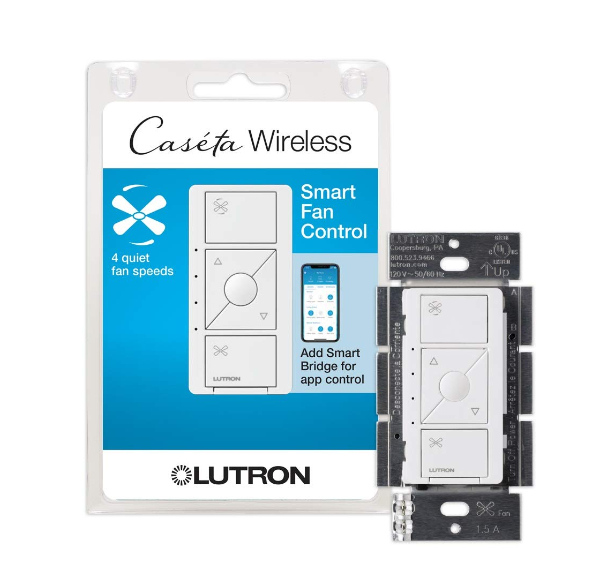
The Lutron Caseta system is the industry benchmark for one reason: it almost never fails. Unlike Wi-Fi switches that can lose connection when your router is bogged down, Lutron uses a proprietary "Clear Connect" wireless protocol operating at 434 MHz. Why it matters: This lower frequency passes through walls and floors much better than the crowded 2.4 GHz Wi-Fi band, ensuring that when you tap the button, the fan responds instantly without lag.
This switch provides four distinct fan speeds and a favorite button for one-touch access to your preferred airflow. It is important to note that this is a "Neutral Wire Required" switch, which is standard for homes built after the mid-1980s. If you have an older home with only two wires in the box, you may need an electrician. It integrates flawlessly with Apple HomeKit, Alexa, and Google Home, but it does require the Lutron Smart Bridge to unlock these features.
The trade-off here is the ecosystem lock-in and the initial cost. You are paying a premium for the hardware and the mandatory hub. However, for users who want to set up an automation - such as having the fan turn on when the bedroom hits 74 degrees - and want it to work 100% of the time, the Caseta is the most technically sound investment available.
Clear Connect works in an uncongested radio frequency band (434 MHz), which is separate from Wi-Fi and Bluetooth. Why it matters: This avoids "interference-induced latency," meaning your smart home commands don't have to compete with your neighbor's Wi-Fi or your microwave for signal space.
Best No-Wiring Solution: Bond Bridge
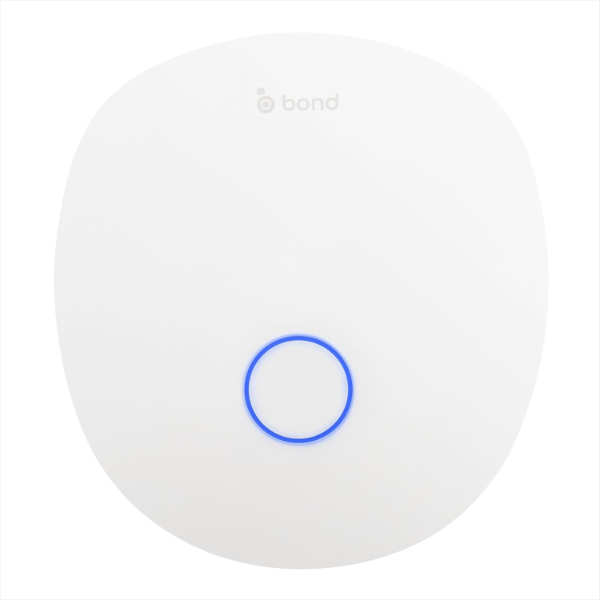
The Bond Bridge is a unique problem-solver for fans that already come with a handheld remote. Instead of replacing a wall switch, the Bond Bridge acts as a "universal translator." It contains Radio Frequency (RF) and Infrared (IR) blasters that record the signal from your existing remote. Why it matters: You don't have to touch a single wire or climb a ladder. You simply point your old remote at the Bond puck, and it learns the "Increase Speed" or "Light Off" commands.
This is the ideal solution for renters or owners of high-end DC motor fans that use complex internal receivers. One Bond Bridge can control up to 30 fans across a 2,500-square-foot home. It bridges your fans to Wi-Fi, allowing for full Alexa, Google, and SmartThings integration. It effectively turns a "dumb" remote-controlled fan into a smart one in under five minutes.
The limitation is "state awareness." Since the Bond Bridge just mimics a remote, it doesn't technically know if the fan is currently on or off; it just knows the last command it sent. If someone pulls the chain or uses the physical remote, the app might show the fan as "On" when it is actually "Off." However, for a setup that requires zero electrical knowledge, this is a masterful piece of engineering.
Most ceiling fan remotes operate in the 300-450MHz range using OOK (On-Off Keying) modulation. Why it matters: Bond's hardware can scan and replicate these specific sub-GHz pulses, allowing it to control almost any remote-based fan manufactured in the last 20 years.
Best No-Hub Option: Leviton Decora Smart Fan Speed Controller
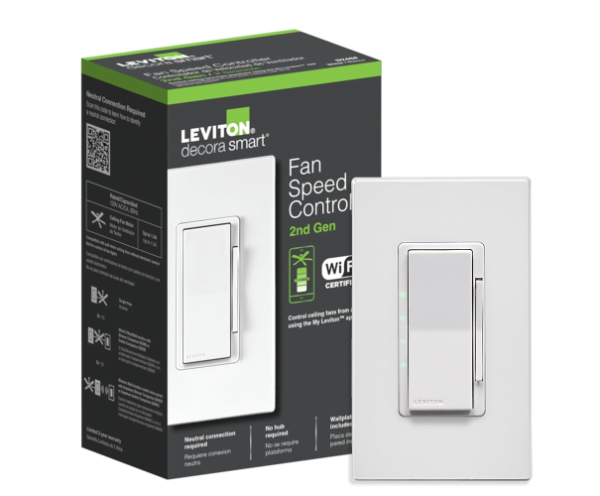
Leviton's Decora Smart line is designed for users who want to avoid extra hardware hanging off their router. This switch connects directly to your home's 2.4 GHz Wi-Fi network. Why it matters: You save money on a hub and reduce the number of devices you have to plug into your wall. It features a classic rocker design with a small vertical bar of LEDs that show your current speed level at a glance.
Technically, the Leviton stands out for its "off-network" capabilities. Many smart switches become useless "dumb" buttons if the Wi-Fi goes down, but the Decora maintains internal scheduling. It also supports 3-way setups (where two switches control one fan) using their "Anywhere Companion" remotes, which don't require any new wiring between the switches. This is a massive labor saver for hallways or large master bedrooms.
While convenient, Wi-Fi switches are inherently more taxing on your router. If you plan to put 50 of these in a house, your network might struggle. However, for a single room or a small apartment, the Leviton provides a high-fidelity experience with excellent app support and no monthly fees. It also supports the Matter protocol in newer revisions, ensuring it will work with future smart home platforms.
Matter is a unified local communication standard. Why it matters: It allows the switch to talk directly to your Apple HomePod or Amazon Echo without going to the "cloud" first, resulting in faster response times and better privacy.
Best for Fan/Light Combos: Treatlife Smart Fan and Light Switch
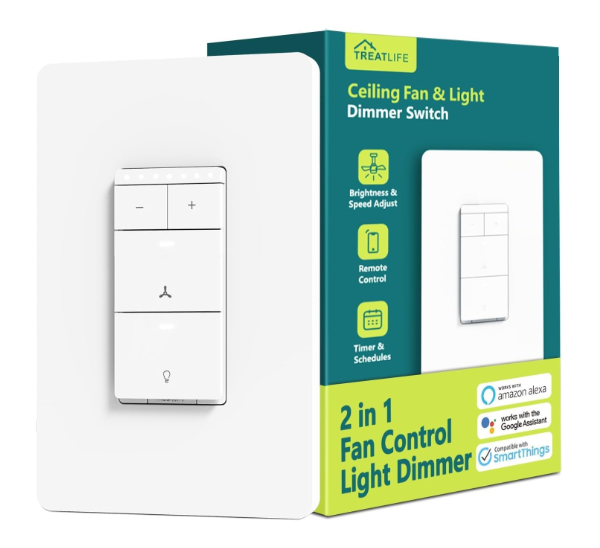
Many homes have a single "gang" (the hole in the wall) that needs to control both the fan speed and a dimmable light kit. Usually, this requires two separate switches. The Treatlife Smart Fan and Light Switch squeezes both controls into a single panel. Why it matters: You don't have to cut into your drywall to expand the electrical box, saving you hours of patching and painting.
The technical achievement here is the dual-load management. The switch independently handles up to 1.5A for the fan and 150W for LED lights. It uses a high-sensitivity touch panel for speed and dimming adjustments. It connects via 2.4 GHz Wi-Fi and is compatible with the Smart Life/Tuya ecosystem, which is one of the most widely supported platforms globally.
The honest trade-off is the wiring complexity during installation. To make this work, your fan must have two separate "load" wires (usually one black and one blue) running back to the wall box. If your fan is currently controlled by a single pull chain that does both, this switch won't work without pulling new wires through your ceiling. However, if the wiring is already there, this is the most space-efficient solution on the market.
This controller uses Pulse Width Modulation (PWM) to step through four fan speeds. Why it matters: PWM is a digital way of "chopping" the power to slow the motor down without creating the annoying "hum" or "buzz" found in cheap analog dimmers.
Best for DIY Customization: Sonoff iFan04-L Smart Controller

The Sonoff iFan04-L is designed for the user who wants to hide the smarts inside the fan itself. This module is installed in the "canopy" - the decorative bowl against the ceiling. Why it matters: It's the perfect solution for rooms that don't have a wall switch at all, or where the wall switch only provides power and the pull chains do the rest. It even comes with its own physical RF remote so you aren't 100% dependent on your phone.
Technically, the iFan04-L is a favorite among the "prosumer" crowd because it uses the ESP8285 chipset. Why it matters: Advanced users can "flash" custom firmware like Tasmota or ESPHome onto it. This allows the device to run entirely locally without ever talking to a Chinese server, which is a significant win for privacy and speed.
The limitation is the installation environment. You will be working on a ladder and fitting a plastic box into a very tight space inside the fan mounting bracket. Additionally, because the device is surrounded by the fan's metal housing, the Wi-Fi signal can be weakened. However, for a budget-friendly way to add smarts and a remote to a basic pull-chain fan, the Sonoff is unbeatable.
The ESP8285 is an integrated Wi-Fi MCU with 1MB of built-in flash memory. Why it matters: It provides a stable platform for high-level IoT logic and allows the device to act as its own "Access Point" during setup, making it very easy to configure on your phone.
How We Chose These Products
Our evaluation process for smart fan controllers is rooted in signal integrity and motor safety. We prioritized products that offer dedicated speed steps (3-speed or 4-speed) rather than generic dimmers, as improper voltage regulation can cause AC motors to overheat or emit a loud hum. We also tested for latency - the time between pressing a button and the fan moving. Finally, we ensured that each product has a verifiable manufacturer presence and a track record of security updates to protect your home network.
Comparison Overview
| Model | Installation Type | Protocol | Neutral Wire? | Hub Required? |
|---|---|---|---|---|
| Lutron Caseta | Wall Switch | Clear Connect (434MHz) | Yes | Yes |
| Bond Bridge | External Puck | RF / IR / Wi-Fi | No | No |
| Leviton Decora | Wall Switch | Wi-Fi / Matter | Yes | No |
| Treatlife Dual | Wall Switch | Wi-Fi | Yes | No |
| Sonoff iFan04 | Canopy Module | Wi-Fi / RF | Yes (at fan) | No |
Buying Guide: What to Look For
- AC vs. DC Motors: Standard AC fans are compatible with most wall switches. If your fan has an integrated DC motor (often advertised as "energy efficient"), you almost certainly need a Bond Bridge because these motors don't respond to traditional wall speed controllers.
- The Neutral Wire: Before buying a wall switch, pull your existing switch out (with the power off!) and look for a bundle of white wires tucked in the back. If you only see black/ground, you are limited to the Bond Bridge or specific no-neutral models.
- Signal Interference: If your router is far from the fan, avoid Wi-Fi switches. Use Lutron for its superior range or a canopy module like Sonoff which might have a better line-of-sight to an extender.
- Ecosystem Compatibility: Ensure the device supports your preferred assistant (Alexa, Google, or Siri). Matter-certified devices like the Leviton offer the best long-term compatibility.
General Pro / Cons
| Pros | Cons |
|---|---|
| Voice control allows for hands-free adjustments. | Most wall switches require a neutral wire for power. |
| Automated schedules can lower energy bills. | Installation often requires basic electrical knowledge. |
| Precision speed control eliminates the "too fast or too slow" pull-chain dilemma. | Wi-Fi-based models can congest your home network. |
| Integration with temp sensors enables "Smart Cooling" routines. | Hub-based systems like Lutron add to the total cost. |
| 3-way support allows for multiple control points in one room. | DC motor fans are largely incompatible with wall controllers. |
| Local control protocols (Matter/Lutron) work without internet. | Canopy modules are difficult to install on high ceilings. |
| RF cloning avoids all wiring for remote-based fans. | Physical remotes for canopy modules are easily lost. |
| Sleek LED indicators provide visual feedback of fan state. | Initial setup can be buggy on 2.4 GHz mesh networks. |
Final Summary
Upgrading to a smart fan controller is one of the most practical home automation steps you can take. For those who value a "set it and forget it" experience, the Lutron Caseta is the undisputed king of reliability. If you are a renter or own a complex DC-motor fan, the Bond Bridge offers a brilliant no-wire workaround. For everyone else, the Leviton or Treatlife options provide modern Wi-Fi convenience with minimal footprint. By matching the controller to your specific wiring and motor type, you can enjoy a perfectly regulated environment with zero pull-chain frustration.
Aggregate rating of the products reviewed: 4.52 out of 5.