
Best Digital Meat Thermometers of 2026
Introduction
Cooking meat to a specific internal temperature is the only verifiable way to guarantee both safety and quality. While many home cooks rely on "feel" or time-based estimates, these methods are notoriously inaccurate due to variables like meat thickness, starting temperature, and oven calibration. A digital meat thermometer removes the guesswork by providing real-time data on the thermal energy at the core of your food. This is the difference between a dry, overcooked chicken breast and one that is safely pasteurized yet retains its moisture.
In the technical landscape of kitchen tools, thermometers fall into two main camps: thermistors and thermocouples. Thermistors are generally more affordable but take a few seconds to stabilize. Thermocouples are the precision instruments of the culinary world, using high-speed circuitry to deliver readings in one second or less. When choosing a thermometer, you must weigh the speed of the reading against the complexity of the setup. Whether you need an instant-read probe for a quick steak or a leave-in wireless sensor for a 12-hour smoked brisket, the following products represent the pinnacle of current sensor technology.
Best Instant-Read: ThermoWorks Thermapen ONE

The Thermapen ONE is the undisputed gold standard for professional chefs and serious home cooks. Its primary technical advantage is its Type K thermocouple sensor, which achieves a stabilization time of one second or less. Why It Matters: When you are checking a roast in a hot oven, every second the door is open, the ambient temperature drops. The ONE allows you to dip the probe, get a final reading, and close the door before the cooking environment is compromised.
The build quality is industrial-grade. It features an IP67 waterproof rating, meaning it can survive a drop into a full sink or a heavy rainstorm during a barbecue. The display is motion-sensing and auto-rotating; if you hold it in your left hand or upside down, the numbers flip to meet your eye. It also includes an intelligent backlight that activates only when it is dark, preserving the battery life of its single AAA power source for thousands of hours of use.
The obvious hurdle for many is the price, which is significantly higher than generic alternatives. However, the Thermapen ONE is a NIST-traceable instrument, meaning its accuracy is verified against national standards. While it lacks "smart" phone connectivity, its reliability in the heat of a professional kitchen makes it a tool that likely will last a decade, whereas cheaper models often fail after a few months of heavy steam exposure.
Standard thermometers use thermistors, which change electrical resistance as they heat up. The Thermapen uses a thermocouple, which generates a tiny voltage at the junction of two different metals. Why It Matters: This voltage change is nearly instantaneous, allowing the device to calculate temperature in under 1,000 milliseconds, compared to the 3,000-5,000 milliseconds required by thermistor-based units.
Best Wireless Leave-In: MEATER 2 Plus
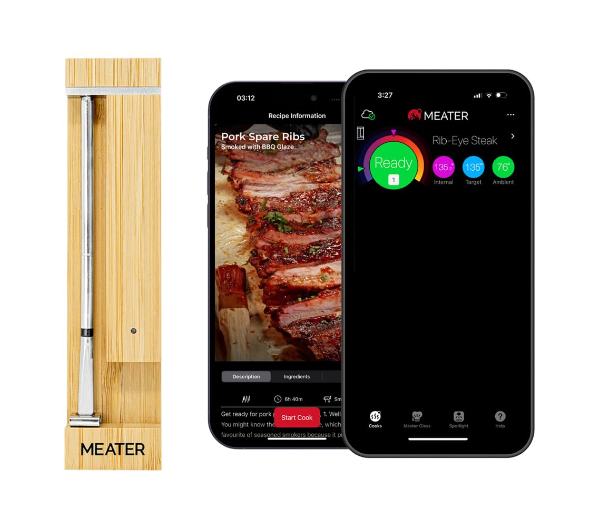
The MEATER 2 Plus addresses the primary pain point of traditional leave-in thermometers: tangled wires that get caught in oven doors or grill lids. This probe is entirely wireless, using Bluetooth 5.2 Coded Phy technology to transmit data through thick metal grill walls to your phone. Why It Matters: You can monitor a long-duration cook, like a Thanksgiving turkey or a brisket, from your living room without physically checking the oven, ensuring you don't lose heat by peeking.
Technically, the MEATER 2 Plus stands out for its multi-sensor array. It has five internal sensors and one ambient sensor on the ceramic handle. Why It Matters: Most thermometers only measure at the very tip. If the tip is slightly off-center in the meat, you get a false reading. This probe finds the absolute lowest temperature across its shaft, ensuring the true core of the meat has reached the safety threshold. Furthermore, the probe is now fully waterproof and can withstand ambient temperatures up to 550?C (1000?F), allowing it to stay inside a steak during high-heat searing.
The trade-off is the reliance on a smartphone app. If your phone battery dies or the Bluetooth connection drops, you lose your monitoring capability. Additionally, because the probe is thicker than an instant-read needle, it leaves a slightly larger hole in the meat. It is best suited for "low and slow" cooking where constant monitoring is more valuable than instantaneous speed.
The MEATER app uses a proprietary algorithm called the Smart Temp Estimator. Why It Matters: It calculates how long the meat needs to rest after being removed from the heat. By tracking the rate of temperature rise, it predicts "carry-over cooking," preventing a steak that was pulled at medium-rare from climbing into the medium-well range while sitting on the cutting board.
Best Compact Performance: ThermoWorks ThermoPop 2
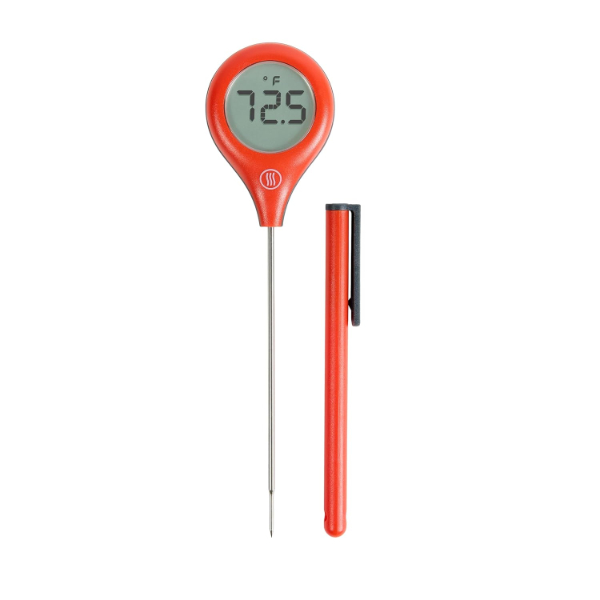
The ThermoPop 2 is designed for the home cook who wants Thermapen-like accuracy without the professional price tag. While it uses a thermistor rather than a thermocouple, it is one of the fastest thermistors on the market, providing a reading in about 2-3 seconds. Why It Matters: This is fast enough for 95% of home cooking tasks, from checking bread dough to verifying a burger's doneness, without feeling like you are waiting on the tool.
Ergonomics are the highlight here. The screen is 33% larger than the previous generation and features a 360-degree rotating display. Why It Matters: Whether you are reaching into a deep stockpot or checking an oven rack, you can read the temperature without craning your neck. The backlight is exceptionally bright, making it a favorite for nighttime grilling on a patio where lighting is sparse.
Limitations include the lack of a folding probe; the long needle is always extended, making it slightly more difficult to store in a shallow silverware drawer. It is also not as ruggedly waterproof as the Thermapen ONE, though it still carries an IP67 rating. For those who prioritize a lightweight, pocketable tool with verified accuracy, this is the most logical step up from a $10 supermarket thermometer.
The ThermoPop 2 uses a bead thermistor calibrated to +/- 1?F accuracy up to 200?C. Why It Matters: While thermistors are slower to react than thermocouples, the high-quality circuitry in the Pop 2 minimizes the "drift" often seen in cheaper units, ensuring the final number doesn't change after it stabilizes.
Best Wired Leave-In: ThermoWorks ChefAlarm
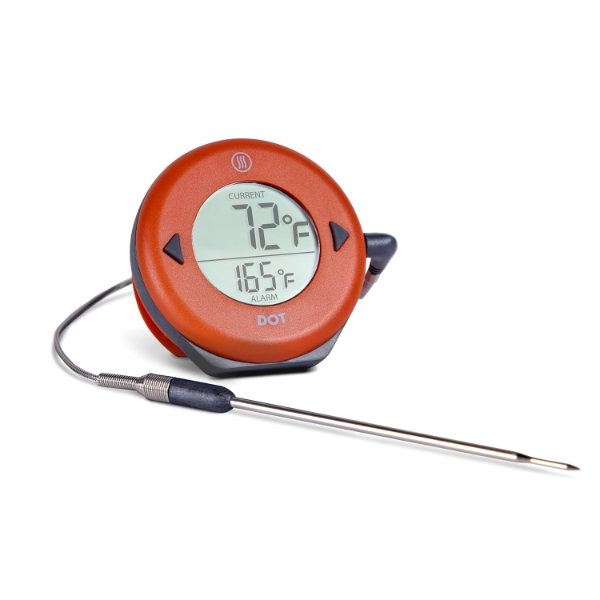
The ChefAlarm is the tool of choice for kitchen tasks that require strict process control, such as candy making, deep-frying, or roasting large meats. Unlike wireless models that rely on apps, the ChefAlarm is a dedicated standalone base station with loud, adjustable alarms. Why It Matters: You don't have to worry about Bluetooth range or phone notifications; the base station will beep up to 92 decibels when your food hits its target, ensuring you hear it even over a loud range hood or a conversation.
The Pro-Series probe technology is what justifies the investment. The included probe is rated for high heat and features a transition seal that prevents moisture from getting into the sensor. Why It Matters: Most cheap wired thermometers fail because steam enters the probe, causing the internal wiring to short out. The ChefAlarm probes are designed to survive the humid, high-heat environment of a commercial oven for years of service.
The "friction" here is the physical cable. It can be a nuisance to route out of an oven door, and if the door is slammed too hard, the cable can eventually fray. However, the ChefAlarm includes a "Min/Max" feature that tracks the fluctuations in your oven's temperature over time, a technical detail that helps you understand if your oven has cold spots or poor calibration.
The ChefAlarm features a "CAL" button that allows you to fine-tune the reading based on an ice-water test. Why It Matters: Over years of use, all sensors can drift slightly. The ability to manually recalibrate the device ensures that a reading of 74?C is actually 74?C, maintaining food safety standards without needing to buy a new unit.
Best Value Choice: ThermoPro TP19H
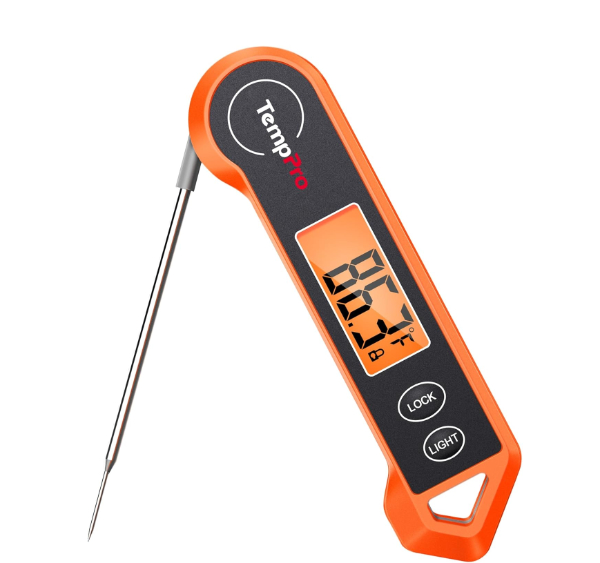
The ThermoPro TP19H offers features usually found in high-end models at a fraction of the cost. Its most impressive technical feature is its motion-sensing sleep and wake mode. Why It Matters: If you leave the thermometer on the counter, it automatically powers down after 90 seconds to save battery. As soon as you pick it up, it wakes up instantly. This removes the annoyance of finding a dead battery right when you need to check a roast.
It utilizes an advanced thermistor that provides a reading in about 3 seconds with an accuracy of +/- 0.9?F. The probe is folding, which acts as the power switch, and the back of the unit is magnetized. Why It Matters: You can stick it to the side of your refrigerator or the front of your oven, keeping it within reach at all times without cluttering your workspace or losing it in a drawer.
The honest trade-off here is durability and speed. While 3 seconds is fast, it's three times slower than the Thermapen ONE. The plastic housing, while IP65 water-resistant, feels less robust and may not survive high-velocity impacts on a tile floor as well as the professional-grade competition. However, for the casual cook who grills once or twice a week, the value proposition is hard to ignore.
The TP19H features a "step-down" tip, where the needle narrows significantly at the very end. Why It Matters: A thinner tip creates less surface area for the meat to resist, allowing the probe to enter easily without tearing the muscle fibers. It also speeds up the heat transfer to the internal sensor, contributing to the 3-second read time.
How We Chose These Products
Our evaluation criteria for meat thermometers are based on three pillars of performance: Speed, Accuracy, and Durability. We excluded any model that took longer than 5 seconds to stabilize, as slow thermometers increase the risk of user error and heat loss in the oven. Accuracy was verified against the "ice-point" test (32?F / 0?C) and the boiling-point test (adjusting for altitude). We also prioritized physical controls over software-only solutions for reliability, and only recommended models with high-grade moisture sealing to ensure longevity in steamy kitchen environments.
Comparison Overview
| Product | Sensor Type | Read Time | Accuracy | Key Benefit |
|---|---|---|---|---|
| Thermapen ONE | Thermocouple | 1 Second | +-0.5 F | Unrivaled Speed |
| MEATER 2 Plus | Multisensor | Leave-in | +-1.0 F | 100% Wireless |
| ThermoPop 2 | Thermistor | 2-3 Seconds | +-1.0 F | Rotating Display |
| ChefAlarm | Wired Probe | Leave-in | +-1.8 F | Dedicated Base |
| ThermoPro TP19H | Thermistor | 3 Seconds | +-0.9 F | Value / Magnetic |
Buying Guide: What to Look For
- Sensor Speed: If you cook over high flames (grilling), look for a thermocouple (under 2 seconds). For slow baking, a thermistor (3-5 seconds) is sufficient.
- IP Rating: Look for at least IP65. This prevents steam and grease from entering the internal circuitry, which is the #1 cause of thermometer failure.
- Calibration: High-end units allow you to "reset" the accuracy. If you can't calibrate a thermometer, you have to throw it away if it drifts.
- Display Type: Backlit, large digits are essential. You will often be reading these through smoke or in a dimly lit oven.
- Probe Thickness: A needle thinner than 3mm is ideal to prevent juices from leaking out of the meat after you test it.
General Pro / Cons
| Pros | Cons |
|---|---|
| Eliminates foodborne illness by verifying 165?F for poultry. | High-end thermocouple models can be expensive ($100+). |
| Prevents overcooking, keeping expensive proteins juicy. | Wireless probes can lose signal through thick metal smokers. |
| NIST-traceability provides lab-grade confidence in results. | Wired cables are fragile and can fray over time. |
| Auto-rotating displays make left-handed use easy. | Cheaper models require frequent battery changes. |
| Magnetic mounts keep the tool within reach while cooking. | Smartphone apps add a layer of complexity to simple tasks. |
| Backlit screens allow for safe night-time grilling. | Thin probes can bend if inserted into frozen meat. |
| Waterproof ratings allow for easy soap-and-water cleanup. | Thermistor models may take 5+ seconds to stabilize in cold meat. |
Final Summary
For the professional or the dedicated hobbyist, the ThermoWorks Thermapen ONE remains the technical peak of the category due to its instant thermocouple response. However, the MEATER 2 Plus has revolutionized long-form roasting by removing the physical tether between the oven and the cook. If budget is your primary concern, the ThermoPro TP19H offers a robust, magnetic solution that far outperforms the unbranded alternatives. A thermometer is not just a gadget; it is a safety tool that pays for itself by ensuring you never ruin a piece of meat again.
Aggregate rating of the products reviewed: 4.74 out of 5.