
Best Smart Sprinkler Controllers of 2026
A technical evaluation of the industry's leading intelligent irrigation systems for automated water conservation and lawn health.
Introduction
The traditional sprinkler timer is a "set it and forget it" relic that effectively burns money every time it rains while your system is running. Upgrading to a smart sprinkler controller isn't just about the convenience of using an app; it's about moving toward a precision irrigation strategy. These devices replace your existing wall-mounted timer and use hyperlocal weather data to determine exactly how much water your specific soil and plant types need. For most homeowners, the anxiety of "doing it wrong" and killing an expensive lawn is the primary hurdle, but today's controllers have demystified the process through high-fidelity automation.
When selecting a controller, we look for EPA WaterSense certification, which ensures the device can save at least 20% more water than standard clocks. We also prioritize units that offer "weather intelligence" - the ability to track Evapotranspiration (ET) rates. ET is a measurement of how much water is leaving your soil through evaporation and plant transpiration. Why it matters: Instead of watering because it's Tuesday, a smart controller waters because the "water bank" in your soil has been depleted by the sun and wind. This guide breaks down the best options currently available, focusing on ease of wiring, software stability, and real-world water savings.
Best Overall Technology: Rachio 3 Smart Sprinkler Controller
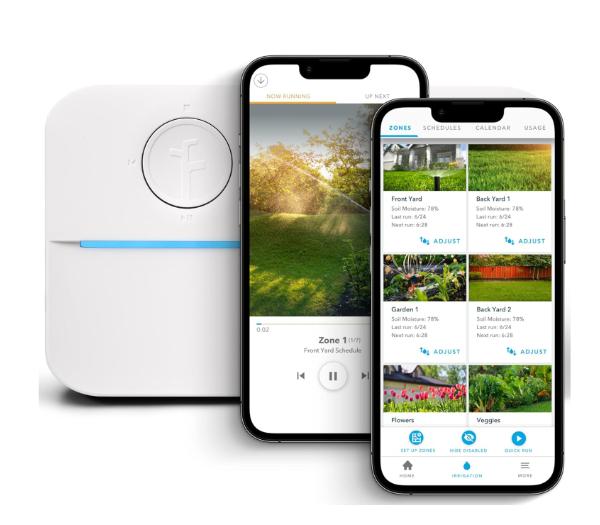
The Rachio 3 remains the gold standard for smart irrigation because of its "Weather Intelligence Plus" engine. While many controllers look at a single national weather station (often miles away at an airport), the Rachio 3 aggregates data from over 300,000 personal weather stations. Why it matters: This prevents the "rain skip" failure where it's pouring at the airport but bone-dry at your house. The hardware features easy-press terminals that don't require a screwdriver, making the transition from a 20-year-old "dumb" box a 15-minute DIY task.
Technically, the Rachio 3 stands out due to its support for dual-band Wi-Fi (2.4GHz and 5GHz) and its integration with the Rachio Wireless Flow Meter. The flow meter can detect 0.5 GPM (gallons per minute) leaks. Why it matters: If a sprinkler head breaks or a pipe bursts underground, the controller recognizes the abnormal flow rate and shuts down that specific zone instantly to prevent a massive water bill and property damage. It's a level of proactive security that standard timers simply cannot provide.
The primary downside is the lack of physical controls on the unit itself. If your phone isn't handy or the Wi-Fi is down, you are limited to a few basic "Run" buttons under the magnetic cover. It is heavily reliant on the cloud, so users in areas with spotty internet might find it frustrating. However, for the tech-savvy homeowner who wants the most granular control over soil type, sun exposure, and nozzle inches-per-hour, the Rachio 3 is unrivaled.
Rachio calculates the "Managed Allowed Depletion" of your soil. It uses the current temperature, wind speed, and humidity to estimate how many microns of water are lost daily. Why it matters: By calculating water loss at the root level, the system ensures the plants are never over-saturated (which leads to fungal growth) or underwatered (which leads to dormancy).
Best Hybrid Interface: Orbit B-hyve Smart Indoor/Outdoor Controller
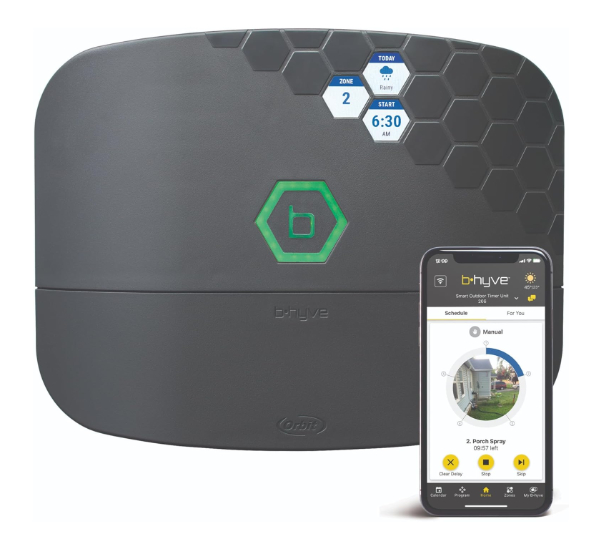
The Orbit B-hyve is the bridge between the old guard of irrigation and the smart home era. Unlike the Rachio, the B-hyve includes a full digital display and a physical dial on the faceplate. Why it matters: If you have a professional landscaper or a "hands-on" family member who hates using apps, they can still operate the sprinklers manually without needing access to your smartphone. The hardware is housed in a locking, weather-resistant cabinet that is rated for outdoor installation without needing a separate enclosure.
On the technical side, the B-hyve features a built-in "catch cup" test utility within the app. By placing cups around your yard and measuring how much water is collected in 10 minutes, the app calculates your system's efficiency and distribution uniformity. Why it matters: Most controllers guess your water output; the B-hyve uses physical data to calibrate the run times, ensuring that your clay soil doesn't turn into a swamp due to high-output nozzles.
The trade-off is the software interface, which can be less intuitive than Rachio's. It occasionally suffers from sync delays between the app and the physical hardware. However, since it is priced lower and comes "outdoor-ready" out of the box (Rachio requires an extra $30 enclosure), it represents the best value for users who want smart features but aren't ready to give up physical buttons entirely.
The B-hyve monitors the electrical resistance (measured in Ohms) of your zone valves. Why it matters: If a solenoid is failing or a wire is corroded, the controller will alert you to a "Short Circuit" or "Open Circuit" error before your plants start dying, allowing for faster troubleshooting of the physical infrastructure.
Most Reliable Hardware: Rain Bird ST8-2.0 Smart Controller
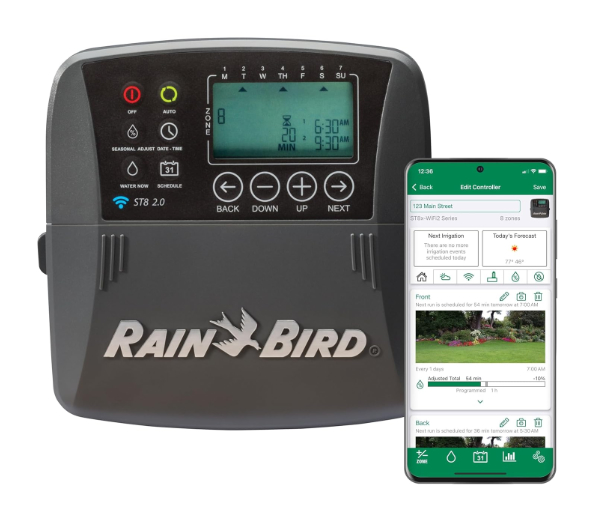
Rain Bird is the industry heavyweight for commercial irrigation, and the ST8-2.0 brings that "overbuilt" philosophy to the home. While other controllers feel like consumer electronics, the ST8 feels like a tool. It features non-volatile memory, which means if the power goes out and the internal battery dies, your programming is saved forever on a physical chip. Why it matters: You won't have to re-configure your 8 zones after a summer thunderstorm - the system simply resumes where it left off.
Technically, the ST8 utilizes a highly robust 24VAC power management system designed to resist electrical surges. Why it matters: Sprinkler wires are essentially lightning rods buried in the ground; Rain Bird's circuitry is better equipped to handle minor electrical spikes than more delicate, tech-first controllers. The Wi-Fi module is also replaceable, meaning if Wi-Fi standards change or the module fails, you don't have to replace the entire $150 unit.
The "honest limitation" here is the app. It is functional but dated, lacking the slick animations and "plant library" features of its competitors. It follows a traditional "programs" logic (A, B, and C programs) rather than a fully dynamic AI approach. This makes it the best pick for homeowners who want the reliability of a professional-grade brand and only care about the smart features as a secondary convenience.
Rain Bird uses heavy-duty MOVs (Metal Oxide Varistors) on the circuit board. Why it matters: These act as "safety valves" for electricity, diverting surge energy away from the processor. Combined with NV-RAM, the ST8 is arguably the most resilient smart controller for areas with frequent power fluctuations.
Best Budget Entry: Wyze Sprinkler Controller
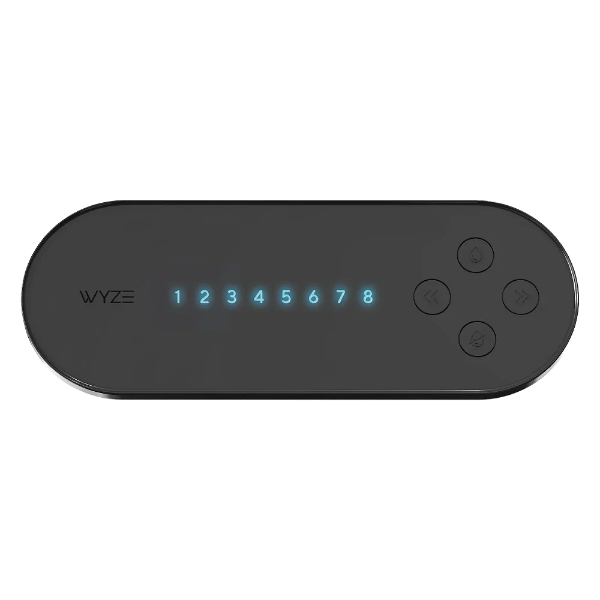
Wyze has made a name for itself by stripping out the "luxury tax" of smart home gear, and their 8-zone sprinkler controller is no different. It offers a clean, minimalist design with a low-profile footprint that fits into tight cabinet spaces. Why it matters: For many homeowners, the $200+ price tag of a Rachio is a barrier; the Wyze provides basic scheduling, remote app control, and weather skips for less than half that cost.
Technically, the Wyze uses a cloud-based algorithm for its "Sprinkler Plus" service, which provides advanced ET data and hyper-local forecasting. Why it matters: It uses the same meteorological principles as the expensive brands to predict when a "saturation skip" should occur. It also features a "Cycle and Soak" function which breaks up watering times into shorter bursts. Why it matters: This prevents runoff on sloped lawns by giving the water time to move from the surface into the root zone before the next pulse of irrigation begins.
The trade-off is the subscription model. To get the most "intelligent" features (like the weather-based auto-scheduling), you have to pay a small annual fee for Sprinkler Plus. Without the subscription, it's essentially just a Wi-Fi remote for a standard timer. For those who already use Wyze cameras or sensors, the integration into a single app is a major convenience, but the long-term cost of the subscription should be weighed against the higher upfront cost of a Rachio.
Instead of a 20-minute continuous run, Wyze can perform four 5-minute runs with 30-minute gaps. Why it matters: This mimics a natural rain event, allowing the soil's hydraulic conductivity to keep up with the nozzle's output, preventing the wasting of water down the gutter.
Best for Plant Variety: Netro Sprite Smart Watering Controller
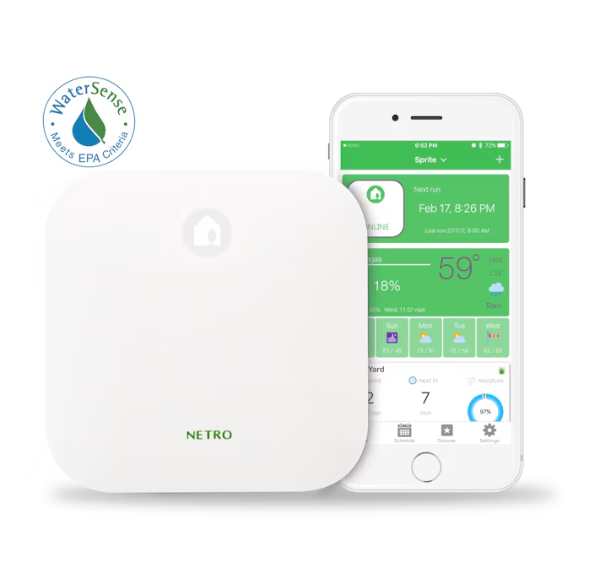
The Netro Sprite is a "data-first" controller that excels in yards with complex landscaping - think vegetable gardens mixed with succulents and fescue grass. It features a massive internal database of thousands of plant species. Why it matters: Instead of you guessing how many inches of water a "Boxwood" needs, you simply select the plant in the app, and the Netro adjusts the watering frequency based on that specific species' biological needs.
Technically, the Sprite is designed to comply with strict local water restrictions. You can input your specific "no-water" days or hours into the system, and it will re-calculate the entire week's schedule to ensure the lawn stays healthy while staying within the law. Why it matters: Many smart controllers will accidentally violate local ordinances by watering on a restricted day because the "ET data" said the soil was dry; Netro prioritizes compliance alongside plant health.
The downside is the hardware footprint. It feels slightly more "plasticky" than the Rain Bird or Orbit, and it is strictly for indoor use (you cannot mount this on an outside wall without a heavy-duty weather box). However, if your primary goal is the health of a diverse garden, the Netro's botanical intelligence is the best in the category.
Netro uses a "Dynamic Root Zone" model. It estimates the depth of the root system based on the age of the plant and the soil type (loam, sand, clay). Why it matters: Deep-root plants need infrequent, long soakings, while shallow-root plants need frequent, light mistings. Netro automates this distinction without user intervention.
How We Chose These Products
Our evaluation criteria were built on three pillars: Data Accuracy, Ease of Wiring, and Fail-Safe Reliability. We only recommended controllers that are EPA WaterSense certified, as this is the industry benchmark for actual conservation. We performed a "blind wiring" test on each unit to ensure that a homeowner with basic hand tools could identify the Common (C) wire and Zone wires without professional assistance. Finally, we favored controllers with "non-volatile memory" or robust cloud-recovery features to ensure that your lawn doesn't die during an internet outage.
Comparison Overview
| Model | Zones | Outdoor Ready? | On-Device Controls | Key Advantage |
|---|---|---|---|---|
| Rachio 3 | 8 / 16 | No (Enclosure Req) | Minimal | Best Weather Data |
| Orbit B-hyve | 6 / 12 | Yes | Full Dial/LCD | Ease of Manual Use |
| Rain Bird ST8 | 8 | No | Full Buttons | Electrical Surge Resilience |
| Wyze | 8 | No | None | Lowest Initial Cost |
| Netro Sprite | 6 / 12 | No | None | Plant Species Library |
Buying Guide: What to Look For
- Zone Count: Count your existing wires before buying. Most homes have 4 to 8 zones. Buying an 8-zone controller when you have 9 zones will leave a section of your yard dead.
- Common Wire (C-Wire): All these controllers require a 24V power supply. Ensure your current setup has a "Common" wire (usually white) that completes the circuit for all valves.
- Transformer Location: Does the unit have an internal or external transformer? Internal transformers (like Orbit) look cleaner on the wall but make the unit larger.
- Hyperlocal vs. National Weather: Look for "PWS" (Personal Weather Station) support. Why it matters: It ensures the controller knows if it rained in your backyard, not just the general zip code.
- App Ecosystem: If you already use Alexa, Google Home, or Apple HomeKit, verify compatibility. Rachio and Orbit have the widest integration support.
General Pro / Cons
| Pro: Smart Advantage | Con: Smart Trade-off |
|---|---|
| Reduces water bills by up to 50% via weather skips. | Requires strong Wi-Fi signal near the mounting point. |
| Remote control allows for testing heads without walking back to the garage. | Cheaper models often require recurring annual subscriptions. |
| EPA WaterSense rebates often make the unit nearly free. | Software updates can occasionally break third-party integrations. |
| Automatic seasonal adjustments (watering more in July, less in Sept). | Setup can be frustrating for those not comfortable with apps. |
| Protects local watersheds by preventing chemical runoff from overwatering. | Cloud reliance means features disappear if the company goes under. |
| Identifies electrical issues with solenoids before they fail. | Initial DIY installation takes 20-60 minutes depending on wiring. |
Final Summary
The transition from a manual timer to a smart controller is one of the few home upgrades that actually pays for itself. If you want the absolute best in weather intelligence and are comfortable with an app-only interface, the Rachio 3 is the clear winner. For those who want a more traditional "dial and screen" experience with smart "brains," the Orbit B-hyve is the superior choice. Regardless of which you pick, the move toward data-driven irrigation is a win for both your wallet and the environment. Aggregate rating of the products reviewed: 4.48 out of 5.