
Best Smart Leak Detectors of 2026
Introduction
Water damage is the "silent killer" of home equity. While we all fear fire, you are statistically far more likely to deal with a burst pipe or a slow-dripping water heater. The problem is that most water damage happens behind cabinets or in basements where you won't see it until the mold has set in. Smart water leak detectors have evolved from simple "beeping boxes" into sophisticated monitoring systems that can actually turn off your water main automatically before a drip becomes a flood.
When shopping, you need to decide between two categories: point-of-leak sensors and inline monitors. Point sensors sit on the floor near appliances and alert you when their gold-plated probes get wet. Inline monitors are installed directly into your plumbing; they measure pressure and flow to detect leaks inside the walls. Choosing the right one depends on your plumbing confidence, your budget, and whether you live in a sprawling house or a compact apartment.
Best Whole-House Protection: Moen Flo Smart Water Monitor and Shutoff
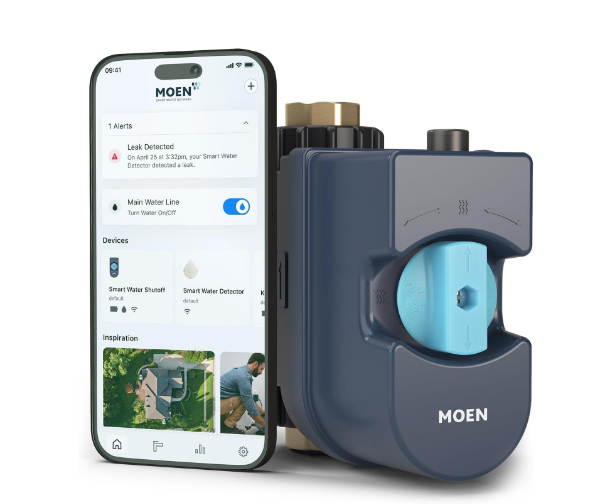
The Moen Flo is the heavyweight champion of leak prevention. Unlike a sensor that sits on the floor waiting for a puddle, the Flo is installed directly onto your main water line. It uses ultrasonic technology to track every drop of water that enters your home. If it detects an unusual flow - like a pipe bursting while you are at work - it can automatically twist its internal ball valve to shut off your water in seconds. This proactive approach turns a potential five-figure renovation into a minor plumbing repair.
Technically, the Flo stands out because of its nightly "Health Tests." Every night, the device shuts off your water and monitors the pressure to see if it drops by even a fraction of a PSI (pound per square inch). This identifies "micro-leaks," such as a pinhole in a pipe or a running toilet that wastes hundreds of gallons. It provides data on your GPD (Gallons Per Day) consumption, helping you spot high-usage appliances and lower your utility bills.
The trade-off is the installation. Because this involves cutting into your main water line, most homeowners will need to hire a licensed plumber, which adds to the initial cost. It also requires a nearby power outlet and a strong 2.4GHz Wi-Fi signal. However, many insurance companies offer significant premium discounts for homes with an automatic shutoff valve installed, often paying for the device over a few years.
The Flo uses ultrasonic transducers to send sound waves through the water. Why It Matters: Since there are no moving parts (like a turbine) inside the water stream, the device won't get clogged by mineral buildup or scale over time, ensuring it works ten years from now just as well as it does today.
Best Budget Value: Govee WiFi Water Sensor (3-Pack)
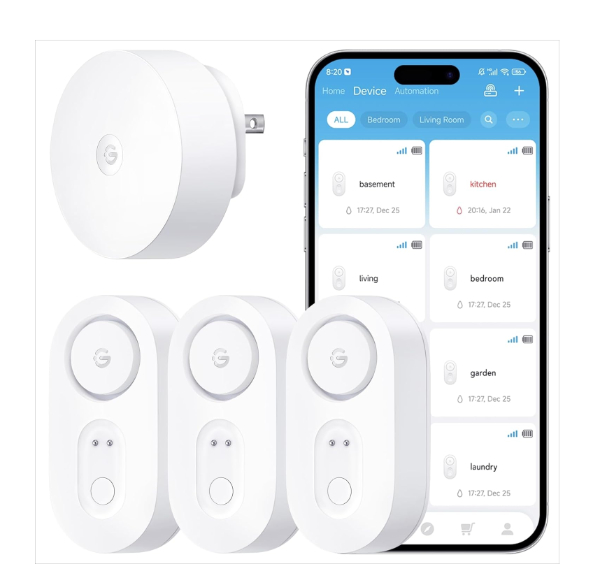
If you aren't ready to cut into your pipes, Govee offers the most accessible "entry point" to leak detection. This kit comes with three small sensors and a central gateway. You simply place a sensor under your kitchen sink, behind the toilet, or next to the washing machine. Each sensor has two sets of probes on the bottom and a set on the top, ensuring it catches water whether it's a floor puddle or a dripping pipe from above.
The tech here is surprisingly robust for the price. The sensors use the 433MHz frequency to talk to the gateway, which then connects to your Wi-Fi. This is important because 433MHz signals can travel through walls and floors much better than standard Wi-Fi. When the sensor hits water, it triggers a 100dB alarm (about as loud as a lawnmower) and sends a push notification to your phone instantly. It's a simple "if/then" logic that works reliably without a monthly subscription.
The honest trade-off here is the lack of an automatic shutoff. If a pipe bursts while you are on vacation, Govee will tell you that your house is flooding, but it won't stop the water. You'll have to call a neighbor or the fire department. Also, the sensors are battery-powered (AAA), so you'll need to test them occasionally to ensure the batteries haven't leaked or died. For renters or those in apartments, this is the most logical choice.
These sensors rely on the electrical conductivity of water to complete a circuit. Why It Matters: Because even a tiny amount of moisture can bridge the gap between the gold-plated pins, the sensor can trigger with as little as 0.5mm of water, giving you an alert long before the carpet is soaked.
Best for Long Range: YoLink Water Leak Sensor Hub Kit
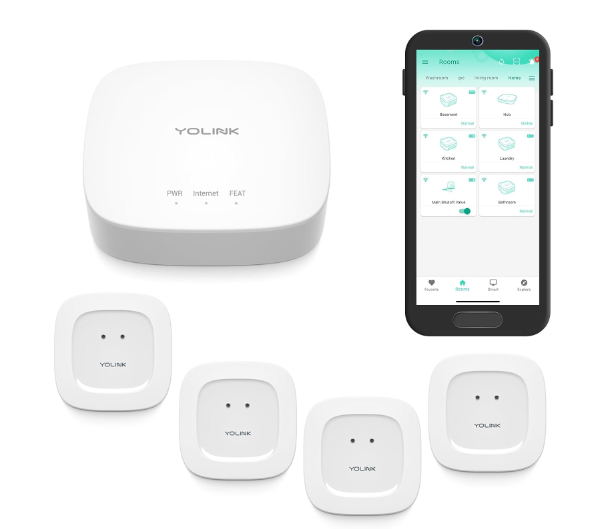
YoLink is the specialist choice for large properties or homes with detached garages and sheds. Most smart sensors fail when they are separated from the hub by more than 50 feet of concrete and wood. YoLink solves this by using LoRa (Long Range) technology. This protocol allows the sensors to communicate with the hub over distances up to a quarter-mile away. It is the only consumer-grade system that can reliably monitor a pool pump house or a basement in a large estate without needing Wi-Fi extenders.
Beyond the range, YoLink's biggest technical advantage is its "Hub-less" communication. Even if your internet goes out or your hub loses power, the sensors can be "paired" directly to a YoLink Bulldog Valve Manipulator (sold separately). If a leak is detected, the sensor sends a LoRa signal directly to the valve to shut it off without needing the cloud. This redundancy is critical for remote cabins where power and internet are often unreliable.
The downside is the ecosystem. YoLink's app and hardware feel a bit more "industrial" and less polished than Moen or Ring. The sensors themselves are utilitarian plastic. However, they are incredibly power-efficient; a single pair of batteries can last up to 5 years because the LoRa signal uses very little energy compared to Wi-Fi. If range and reliability are your primary concerns, this is the tech to beat.
LoRa operates on sub-GHz frequencies (typically 900MHz in the US). Why It Matters: These lower frequencies have much longer wavelengths that can "wrap" around obstacles and penetrate thick walls much better than the high-frequency signals used by Wi-Fi or Bluetooth.
Best for High-Fidelity Data: Phyn Plus Smart Water Assistant + Shutoff
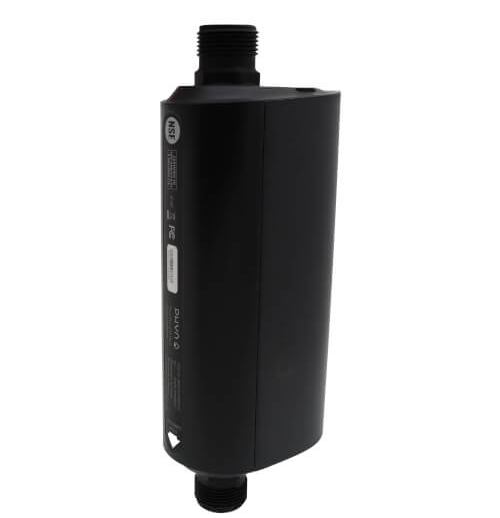
The Phyn Plus is the high-tech alternative to the Moen Flo. While the Flo uses ultrasonic tech, Phyn relies on "Pressure Wave Sensing." It analyzes the microscopic changes in water pressure 240 times every second. This high-frequency sampling allows the device to create a "fingerprint" for every fixture in your house. It can eventually distinguish between a flushing toilet, a dishwasher filling, and a pinhole leak in the wall based on the specific "vibration" that fixture sends through the pipes.
Phyn's app is arguably the best in the business for data junkies. It categorizes your water usage by fixture type, showing you exactly how many gallons were used for showers versus irrigation. It also monitors the temperature of the water to provide freeze alerts before your pipes actually burst. Like the Moen, it has an automatic shutoff valve that can be triggered remotely or automatically during a catastrophic event.
The "friction" here is the learning curve. Because Phyn uses AI to learn your fixtures, it can send false alarms for the first few weeks as it gets used to your specific plumbing setup. It is also a physically large device, requiring about 10 inches of straight pipe for installation, which can be difficult in tight crawlspaces. However, for those who want the most detailed "MRI" of their home's plumbing health, Phyn's sensor technology is top-tier.
Phyn measures the "water hammer" effect - the pressure wave that travels back through the system when a tap is turned off. Why It Matters: By analyzing these waves at 240Hz, the system can detect leaks as small as 0.1 GPM (gallons per minute), often catching a drip before it's even visible on the surface.
Best for Ecosystem Security: Ring Flood & Freeze Sensor
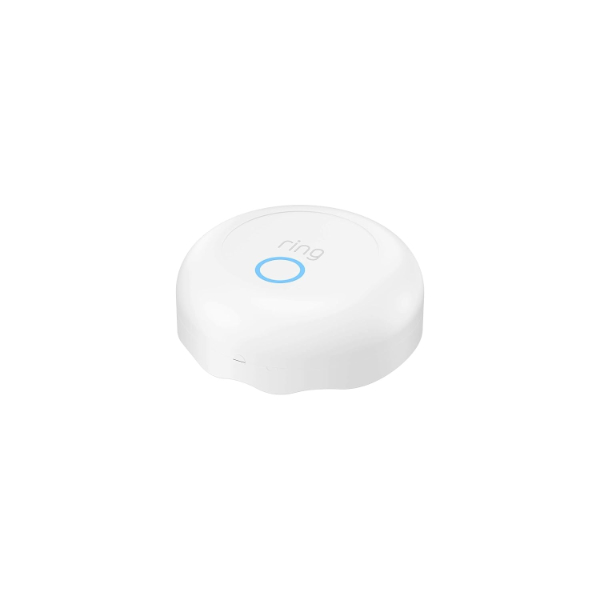
For those who already have a Ring Alarm system, the Flood & Freeze sensor is an effortless add-on. It's a small, palm-sized puck that sits on the floor. Unlike the standalone Govee sensors, the Ring sensor integrates with your professional monitoring. If you pay for the Ring Protect Plan, a leak detection can trigger an automated call from the monitoring center, ensuring you don't miss the notification if you are asleep or away from your phone.
The sensor uses Z-Wave technology to communicate with the Ring Base Station. Z-Wave is a "mesh" network, meaning each device can pass signals to the next, increasing the reliability of the system. In addition to water detection, it monitors for temperatures below 40?F. Why it matters: In cold climates, knowing your furnace has failed and your basement is approaching the freezing point can prevent pipes from bursting in the first place.
The major limitation is that it requires the Ring Alarm Base Station to function; it is not a standalone Wi-Fi device. It also doesn't have a loud local siren on the puck itself - the siren comes from the base station. This means you rely entirely on your phone or the central hub to hear the alert. It is a "set it and forget it" device that makes the most sense if you are already paying for the Ring ecosystem.
Z-Wave operates in the 908MHz band. Why It Matters: It doesn't interfere with your Wi-Fi (which runs on 2.4GHz or 5GHz), and because it uses a mesh architecture, adding more sensors actually makes the network stronger and more reliable at the edges of your home.
How We Chose These Products
We evaluated dozens of detectors based on four primary metrics: Response Latency (how fast do you get the alert?), Connectivity Reliability (does it drop off the Wi-Fi when you need it?), Ecosystem Openness (does it work with Alexa, Google, or HomeKit?), and Physical Durability. We prioritized products that offer "local" alarms so you can hear them even if the internet is down, and we favored companies with a proven track record in plumbing or security to ensure the app software will be supported for years to come.
Comparison Overview
| Model | Type | Protocol | Shutoff? | Best For |
|---|---|---|---|---|
| Moen Flo | Inline | Wi-Fi | Yes (Auto) | Total Protection |
| Govee | Floor Sensor | 433MHz/Wi-Fi | No | Budget/Renters |
| YoLink | Floor Sensor | LoRa | Optional | Large Properties |
| Phyn Plus | Inline | Wi-Fi | Yes (Auto) | Usage Analytics |
| Ring | Floor Sensor | Z-Wave | No | Ring Ecosystem |
Buying Guide: What to Look For
- Communication Protocol: Wi-Fi is easiest to set up but uses more battery. Z-Wave and LoRa are better for battery life and range but require a hub.
- Siren Volume: If you sleep on the third floor and the sensor is in the basement, you need a local siren that is at least 90dB or an app that can override your "Do Not Disturb" settings.
- Maintenance: Look for sensors with replaceable batteries. Some cheaper models are "disposable" once the battery dies, which is terrible for the environment and your wallet.
- Shutoff Capability: Decide if you just want to know about a leak or if you want the system to stop it. Inline shutoffs are more expensive but can save your home from total destruction.
General Pro / Cons
| Pros | Cons |
|---|---|
| Detects leaks in seconds to prevent mold and structural rot. | Inline models require expensive professional plumbing installation. |
| Can lower your annual home insurance premiums significantly. | Batteries must be checked annually to ensure reliability. |
| Monitors daily water usage to help lower utility bills. | Wi-Fi models can fail if your internet service goes down. |
| Provides freeze alerts to prevent pipes from bursting in winter. | AI-based systems can have "false alarms" during the learning phase. |
| Peace of mind while traveling or away on vacation. | Sensors must be placed exactly where water will pool to be effective. |
| Whole-house shutoff can stop a 100-gallon-per-minute burst. | Some features require a monthly cloud subscription fee. |
Final Summary
Investing in a smart water leak detector is one of the few smart home upgrades that actually pays for itself. If you own your home and have the budget, the Moen Flo is the most complete safety net you can buy. For those who want high-fidelity data and fixture-by-fixture tracking, the Phyn Plus is the technical leader. If you are looking for a simple, affordable solution to protect a few specific appliances, the Govee 3-pack provides excellent coverage for the price of a dinner out. Regardless of which you choose, the cost of the hardware is a tiny fraction of what a standard water damage insurance deductible would be. Aggregate rating of the products reviewed: 4.7 out of 5.