
Best Solar-Powered Outdoor Security Lights of 2026
A technical analysis of high-efficiency photovoltaic lighting systems for perimeter protection and reliable motion detection.
Introduction
Transitioning to solar security lighting often feels like a gamble between sustainability and reliability. The primary frustration for most homeowners is "vampire drain" - where the light's internal sensors consume more power than the solar panel can generate during the day - resulting in a dead unit when you need it most. To find a truly effective system, you have to look beyond the raw lumen count and investigate the conversion efficiency of the photovoltaic cells and the sensitivity of the Passive Infrared (PIR) sensors.
Technical performance in this category is defined by the "Autonomy Ratio," which is the balance between battery capacity (measured in milliamp-hours or mAh) and the power draw of the LEDs. A high-quality light should be able to trigger its motion sensor at least 100 times on a single charge while maintaining enough reserve to prevent deep-cycle battery damage. This guide prioritizes units that use monocrystalline silicon panels, as they offer the highest conversion rates, especially in northern latitudes where direct sunlight is limited.
Best Ecosystem Integration: Ring Solar Floodlight
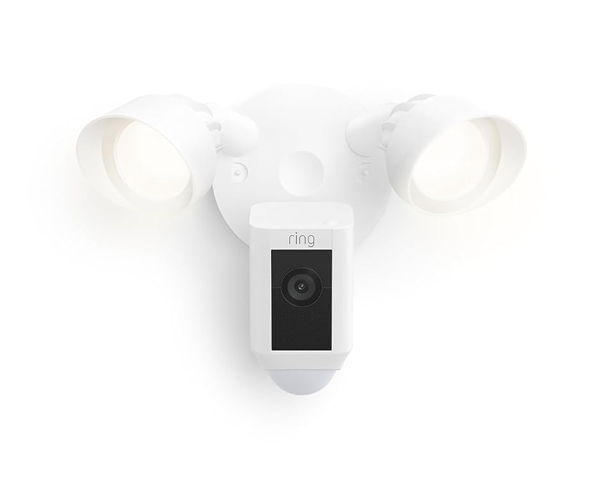
The Ring Solar Floodlight is engineered for users who already occupy the Ring ecosystem, providing a seamless bridge between lighting and surveillance. It outputs 1,200 lumens of cool-white light, which is bright enough to wash out shadows across a standard two-car driveway. Unlike "all-in-one" units, this floodlight uses a detached solar panel connected via a 13-foot cable. Why it matters: This allows you to mount the light in the shade under an eave while placing the panel on the roof where it can actually capture photons, preventing the common issue of "shadow-stalled" charging.
Technically, the unit stands out due to its advanced motion-zoning capabilities when paired with the Ring Bridge. You can calibrate the PIR sensor to ignore street traffic while remaining sensitive to movement within 45 feet of your property. The battery system utilizes a rechargeable Quick-Release Battery Pack, allowing for manual USB charging during extreme winter months when solar gain is virtually non-existent. This redundant power path is a significant advantage over sealed budget units that simply die once the battery voltage drops below the operating threshold.
The primary trade-off is the requirement of a Ring Bridge for smart features. Without the Bridge, the light operates as a "dumb" motion light, losing the ability to trigger your cameras or send smartphone alerts. This ecosystem lock-in can be expensive for new users but offers unparalleled automation for those already invested. It is best for homeowners who want their security lights to talk to their doorbell and indoor sirens simultaneously.
The Ring unit uses a Passive Infrared sensor that detects "blackbody radiation" (heat) rather than just pixel movement. Why it matters: This significantly reduces false alarms caused by wind-blown branches or shadows, as the sensor only triggers when it identifies a moving heat source, like a human or a vehicle, crossing its 180-degree field of view.
Best High-Tech Surveillance: Arlo Pro 4 with Solar Panel Bundle
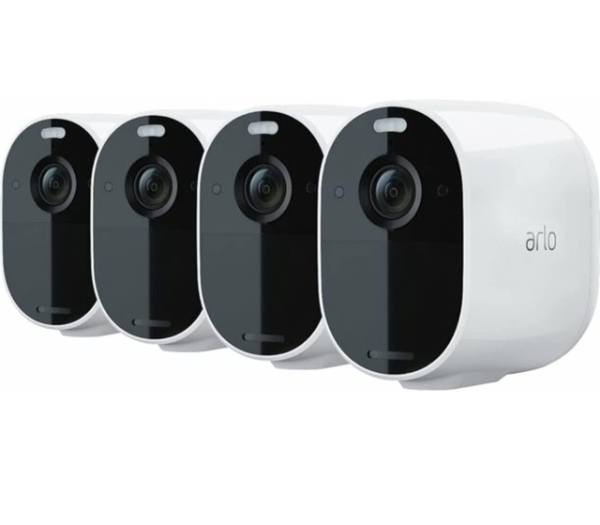
While often categorized as a camera, the Arlo Pro 4 functions as an elite security lighting tool thanks to its integrated spotlight. It provides 2K resolution video while simultaneously illuminating the target area. The solar bundle ensures that the high-power Wi-Fi radio and 2K sensor don't drain the battery, provided you receive at least 3 hours of direct sunlight per day. Why it matters: Instead of just seeing a bright light on your lawn, you get high-definition color night vision that can identify faces and license plates at 25 feet.
The technical sophistication of the Arlo Pro 4 lies in its 160-degree diagonal field of view and its ability to connect directly to Wi-Fi without a separate hub. The included solar panel uses high-efficiency monocrystalline cells. Why it matters: Monocrystalline silicon is more pure than the polycrystalline used in cheaper lights, allowing for roughly 20-22% energy conversion efficiency versus the 15% seen in budget competitors. This extra 5-7% is often the difference between a functional camera and a "low battery" notification during a week of rain.
The limitation here is the subscription model. To access 30 days of cloud video history and advanced AI detection (which differentiates between a person and a pet), you must pay a monthly fee. This "software-as-a-service" model may deter those looking for a one-time hardware purchase. However, if you need a light that also acts as a digital witness, the Arlo Pro 4 is technically superior to standard floodlights.
The Pro 4 utilizes HDR processing to balance bright highlights and dark shadows. Why it matters: When the spotlight hits a person, it often "washes out" their face in video. HDR rapidly captures multiple exposures to ensure the intruder's facial details are visible even when the light is at maximum intensity.
Best Brightness to Size Ratio: Linkind Star-L Series
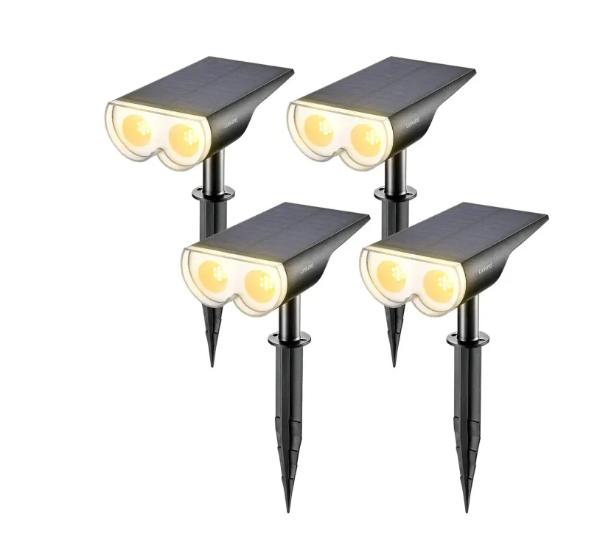
The Linkind Star-L series represents the "prosumer" level of standard motion lights, pushing a massive 650 lumens from a very compact housing. It is primarily a spotlight designed for narrow corridors or side-alleys where a massive floodlight would be overkill. The unit features two brightness modes and a dusk-to-dawn sensor that is highly reactive. Why it matters: Many budget lights have a "sleepy" sensor that doesn't trigger until a person is five feet away; the Linkind triggers at nearly 26 feet, giving you much earlier illumination.
Technically, the Star-L uses a 2200mAh Li-ion battery, which is significantly larger than the 1200mAh found in cheaper "six-pack" lights. Why it matters: A higher mAh rating means the light can run for longer durations without dropping the voltage to a level that damages the battery cells. The casing is rated at IP67, which is a rare spec at this price point. IP67 means the unit can actually be submerged in water for 30 minutes, so it will easily survive the most violent thunderstorms or snowmelt cycles.
The downside is the fixed mounting bracket. You cannot independently tilt the solar panel away from the light head. If your wall faces north, the panel will always be in the shade while the light faces the yard. This makes the Star-L best for south-facing installations where the panel can be oriented directly toward the sun's path.
While most lights are IP65 (protected against water jets), Linkind's IP67 rating indicates a "dust-tight" seal that can withstand immersion. Why it matters: Over years of service, IP65 units often suffer from internal condensation (fogging) that corrodes the circuit board. An IP67 seal effectively prevents any humidity from entering the electronics housing.
Best Energy Efficiency: Aootek Solar Motion Sensor Lights
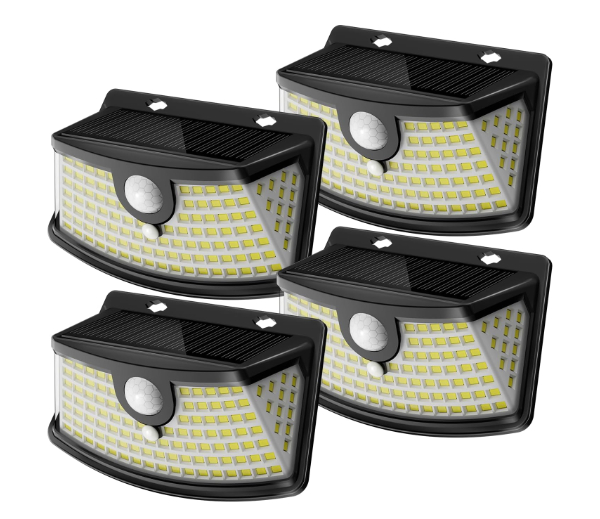
Aootek has consistently dominated the budget-performance category by focusing on three distinct operating modes: permanent on, dim-to-bright, and motion-only. The triple-head design provides a 270-degree illumination angle. Why it matters: Most security lights are "tunnel-visioned," but the Aootek can light up a corner of your house and the side path simultaneously, eliminating blind spots where intruders could hide.
Technically, these lights use an upgraded PIR sensor that detects motion up to 26 feet away within a 120-degree arc. The solar panel is built with monocrystalline silicon with a conversion rate of up to 20.5%. Why it matters: This high conversion rate allows the unit to recharge even on partially overcast days, ensuring the "motion-only" mode remains active through long winter nights. The LEDs are SMD2835 chips, which are known for high thermal stability. Why it matters: Cheaper LEDs overheat and dim over time; these chips maintain their brightness for thousands of hours of use.
The casing is made of high-impact ABS plastic. While durable, it lacks the heat dissipation of aluminum. In desert climates with extreme summer heat, ABS can become brittle after several years of UV exposure. This unit is best for temperate climates where wide-angle lighting is the primary requirement for backyard or shed security.
Surface Mounted Device (SMD) 2835 chips are designed for high efficiency. Why it matters: These chips have a larger heat sink on the back compared to the older 3528 chips, allowing them to run cooler while producing more lumens per watt, which is critical when you are operating on a limited solar battery budget.
Best Industrial Build Quality: LEONLITE LED Solar Security Light
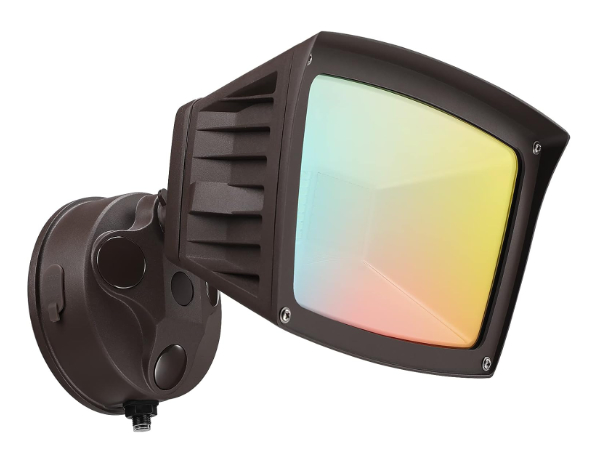
LEONLITE is the choice for users who want to "buy once, cry once." This unit looks and feels like a commercial-grade fixture, featuring a heavy-duty housing and an exceptionally large solar panel. It delivers 1,000 lumens of brightness and features a fully adjustable triple-head design. Why it matters: The build quality is noticeably sturdier than the plastic shells of Aootek or Linkind, which prevents the light heads from "drooping" or shifting after high winds or heavy snowfall.
The technical standout here is the 180-degree detection range and the 15-foot cord for the solar panel. The battery is a 3000mAh Lithium-ion cell. Why it matters: Most residential solar lights cap out at 2000-2200mAh. That extra 800mAh acts as a massive "buffer," allowing the light to stay functional through multiple days of total cloud cover without entering a low-voltage shutdown. The PIR sensor is also adjustable for time (how long the light stays on) and sensitivity, which helps prevent the light from staying on too long and wasting battery.
The honest trade-off is the size. This is a large, conspicuous fixture that may not look "elegant" on a small cottage or near a decorative garden. It is a functional security tool, not a landscape accent. It is the best choice for protecting detached garages, workshop entries, or commercial properties where aesthetics are secondary to raw durability and power reserves.
By using a 3000mAh battery, LEONLITE ensures the unit rarely hits its 0% state of charge. Why it matters: Lithium-ion batteries degrade quickly if they are frequently emptied to 0%. By having a larger capacity, the unit keeps its "normal" operations within the 20-80% charge range, significantly extending the lifespan of the internal cells to 3+ years.
How We Chose These Products
We evaluated security lights based on three non-negotiable criteria: Conversion Efficiency, Sensor Reliability, and Thermal Management. Many Amazon-generic lights boast 5,000 lumens, but a technical audit usually reveals that these numbers are only achievable for the first 30 seconds of battery life before a drastic drop-off. We chose products that have verifiable manufacturer support and use monocrystalline panels, which are more efficient at harvesting energy from indirect light than cheaper polycrystalline alternatives.
Comparison Overview
| Product | Lumens | Panel Type | Battery (mAh) | IP Rating |
|---|---|---|---|---|
| Ring Solar Floodlight | 1,200 | Detached Mono | Quick-Release | IPX5 |
| Arlo Pro 4 Bundle | Integr. Spotlight | Detached Mono | Rechargeable Pack | IP65 |
| Linkind Star-L | 650 | Integrated Mono | 2200mAh | IP67 |
| Aootek Sensor Lights | Varies (High) | Integrated Mono | 2200mAh | IP65 |
| LEONLITE Triple Head | 1,000 | Detached Mono | 3000mAh | IP65 |
Buying Guide: What to Look For
- Color Temperature (K): Security lights are usually 5000K to 6500K (Daylight/Cool White). Why: High color temperatures provide higher contrast, making it easier to see movement and details on camera than "warm" yellow light.
- Lux Sensors vs. PIR: A "Lux" sensor detects light levels (for dawn-to-dusk), while "PIR" detects heat. You want both. Why: This ensures the light doesn't waste battery by turning on during a bright afternoon just because a car drove by.
- Hydrostatic Head and IP Ratings: IP65 is the minimum for outdoor use. If you live in a hurricane or high-snow zone, prioritize IP67.
- Mono vs. Poly Panels: If the panel looks dark black with rounded edges, it's monocrystalline (better). If it's blue and speckled, it's polycrystalline (cheaper/less efficient).
General Pro / Cons
| Category Pro | Category Con |
|---|---|
| Zero monthly electrical costs for operation. | Dependent on geographic location and sun exposure. |
| No professional wiring or electricians required. | Batteries eventually lose capacity and require replacement. |
| Works during local power outages (Grid-Independent). | Mounting height is limited by the solar panel's reach. |
| Low voltage makes them safer to handle and install. | Intensity (lumens) is often lower than hardwired equivalents. |
| Reduces your carbon footprint by using renewable energy. | High-performance units have a higher upfront hardware cost. |
Final Summary
Choosing the best solar security light requires a shift in focus from "how bright is it?" to "how well does it charge?" For most users, the Ring Solar Floodlight or the LEONLITE model offer the most reliable balance of build quality and energy management. If your goal is integrated surveillance, Arlo is the technical leader. By understanding the physics of PIR sensors and the efficiency of monocrystalline panels, you can secure your property without the hassle of trenching wires. Aggregate rating of the products reviewed: 4.66 out of 5.