
Best High-Performance Stand Mixers of 2026
An exhaustive technical evaluation of planetary mixing systems, motor torque efficiency, and mechanical durability for the modern culinary environment.
Introduction
The stand mixer is the mechanical cornerstone of the serious kitchen, serving as a force multiplier for complex emulsions and heavy glutinous structures. Unlike handheld alternatives, these machines utilize high-torque motors and sophisticated gearing to maintain consistent rotational velocity under significant resistance. To evaluate these tools, one must look beyond simple wattage - which often measures energy consumption rather than output power - and instead analyze the drive system architecture, heat dissipation, and the precision of the planetary mixing path.
Modern stand mixers generally fall into two categories: tilt-head models for convenience and bowl-lift models for structural stability during high-load tasks. In this guide, we investigate the technical merits of all-metal gear trains versus nylon sacrificial gears, the efficiency of Alternating Current (AC) versus Direct Current (DC) motors, and the material science behind bowl construction. These five selections represent the pinnacle of currently available consumer technology, vetted for their ability to withstand the rigors of heavy bread production and delicate pastry work alike.
Best Overall for Home Bakers: KitchenAid Artisan Series 5-Quart
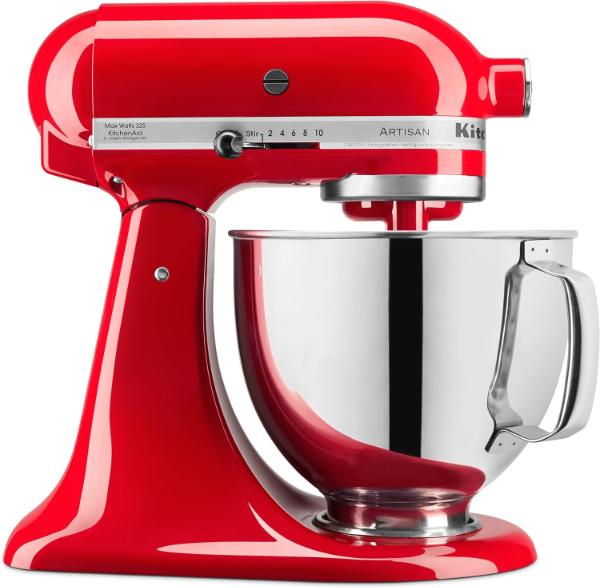
The KitchenAid Artisan remains the benchmark for home mixing through its robust 325-watt AC motor and legendary all-metal gear construction. Its primary technical advantage is the 59-point planetary mixing action, which ensures that the beater touches the side of the bowl nearly 60 times per rotation, eliminating unmixed pockets. The tilt-head design provides immediate access to the bowl and beaters, making it ideal for multi-stage recipes where frequent ingredient additions are required.
While often criticized for lower wattage numbers compared to budget rivals, the Artisan utilizes a worm-gear drive system that prioritizes torque over raw speed. This allows it to handle dense cookie doughs without the mechanical slip common in belt-driven competitors. The universal attachment hub also transforms the mixer into a power take-off for various peripherals, leveraging the central motor for tasks ranging from grain milling to pasta extrusion, making it a highly versatile ecosystem hub.
Limitations involve the AC motor's tendency to generate heat during prolonged heavy dough kneading, which can lead to thermal shutdown as a safety precaution. Furthermore, the tilt-head hinge can develop slight play over years of heavy use, requiring occasional adjustment of the "dime screw" to maintain proper beater-to-bowl clearance. It is best suited for the versatile home cook who balances baking with diverse culinary preparations.
Planetary action involves the mixer shaft rotating in one direction while the attachment itself rotates in the opposite direction. This dual-axis movement mimics the motion used by professional bakeries to ensure total ingredient incorporation without overworking the gluten or incorporating excess air into delicate batters.
Best for Heavy Doughs and Bread: Ankarsrum Assistant Original
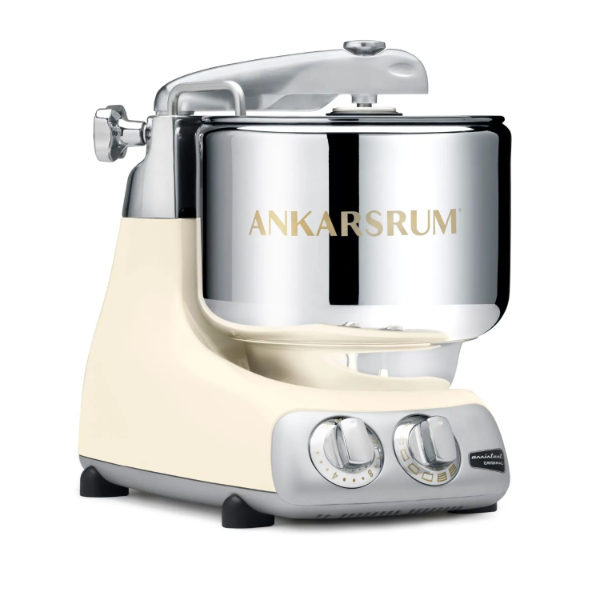
The Ankarsrum Assistant Original utilizes a unique design philosophy that sets it apart from traditional planetary mixers: the motor is located in the base and rotates the bowl itself, rather than the attachment. This engineering choice lowers the center of gravity and allows for a massive 600-watt motor that can handle up to 11 pounds of dough without the risk of tipping or motor strain. This "bottom-drive" system is technically superior for bread production, as it mimics the hand-kneading process more accurately than a descending hook.
The machine includes both a stainless steel bowl for yeast doughs and a plastic whisking bowl for lighter tasks. Its speed control is continuously variable rather than stepped, allowing for precise RPM management. Because the bowl is open at the top, adding ingredients like flour or liquids is significantly easier and safer than with planetary models, where a spinning head often obstructs the workspace. The technical endurance of the Ankarsrum is noted in its 7-year manufacturer warranty, a rarity in the small appliance market.
However, the Ankarsrum has a steeper learning curve. The use of the dough roller and scraper requires a different technique than a standard dough hook, and it can be less efficient for very small quantities of egg whites or cream. For the dedicated artisan baker focusing on high-hydration sourdoughs or heavy ryes, the Ankarsrum offers mechanical advantages that planetary mixers simply cannot match.
The Ankarsrum uses a high-efficiency worm gear that translates the motor's high speed into extreme torque. By rotating the bowl, the machine avoids the stress points inherent in a cantilevered mixing head, allowing for consistent power delivery even as the dough develops a high degree of elasticity and resistance.
Best High-Capacity Performance: KitchenAid Pro Line Series 7-Quart
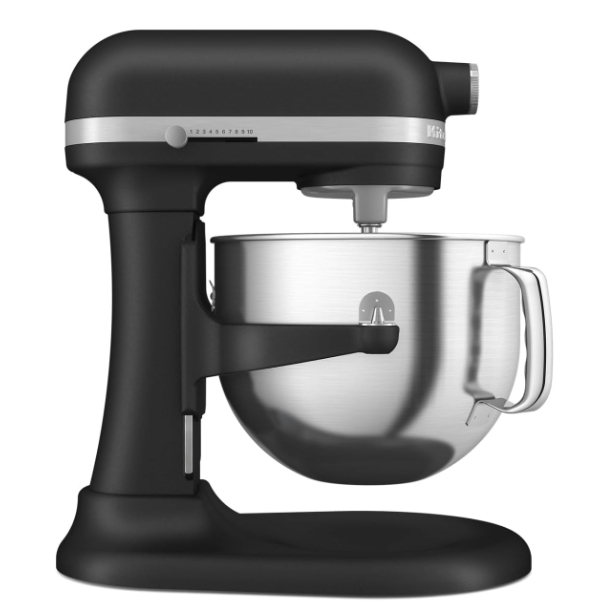
The KitchenAid Pro Line distinguishes itself from the Artisan through the implementation of a 1.3 horsepower DC (Direct Current) motor. Unlike AC motors, DC motors offer higher torque at low speeds and operate with significantly less noise and heat generation. This makes the Pro Line capable of mixing multiple batches of heavy dough without the thermal degradation of the motor's windings, positioning it as a bridge between consumer and commercial-grade equipment.
The bowl-lift design provides a more rigid foundation than the tilt-head, using a dual-arm support system to lock the bowl in place. This prevents the "head bounce" commonly seen when mixing heavy ingredients at high speeds. With a 7-quart capacity, it is designed for high-volume output, comfortably handling up to 14 dozen cookies in a single batch. The all-metal gears are precision-cut to reduce mechanical friction, contributing to its exceptionally quiet operation.
The primary tradeoff is size and weight; at nearly 30 pounds, this is not a machine intended for frequent storage and retrieval from a cabinet. It requires dedicated counter space. Additionally, because the head does not tilt, removing the bowl and attachments requires a specific sequence that some users find less intuitive than the Artisan's simplicity. It is the definitive choice for the serious home professional or the large family.
Direct Current motors in stand mixers provide constant torque regardless of the speed setting. This is critical for dough kneading, as it prevents the motor from slowing down or "stalling" as the dough becomes tougher, ensuring a consistent mix and protecting the internal circuitry from voltage spikes.
Best Budget-Friendly Power: Cuisinart Precision Master 5.5-Quart
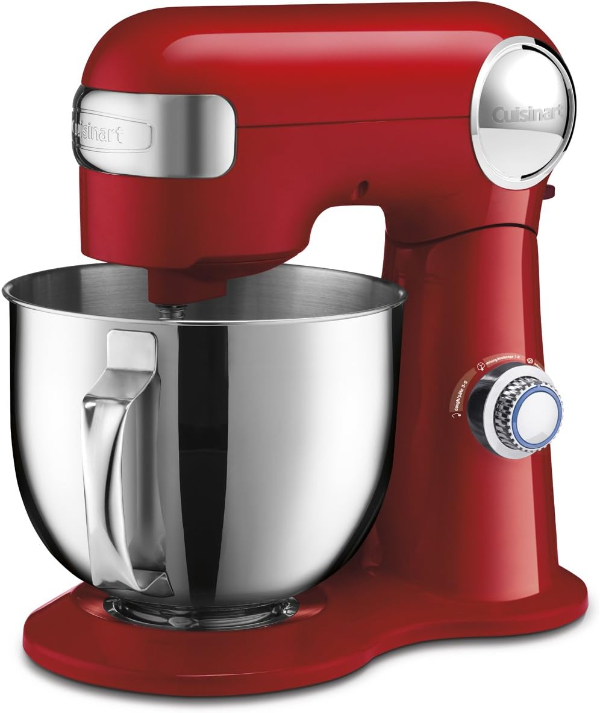
The Cuisinart Precision Master challenges the mid-range market with a powerful 500-watt motor and a 12-speed dial for granular control over the mixing process. While most mixers in this price tier rely on plastic housings, Cuisinart utilizes die-cast metal construction to provide the necessary weight for stability. The 5.5-quart polished stainless steel bowl is slightly larger than the standard home size, offering extra room for aerating sponges or large-scale meringue production.
Technically, the Precision Master excels in its speed-ramping circuitry, which prevents "flour puff" by starting the motor slowly regardless of the selected setting. The planetary action is consistent, though the beater-to-bowl clearance may require more frequent manual scraping compared to the high-end competition. It also features a power hub for optional attachments, though the ecosystem is less expansive than KitchenAid’s.
The limitation of the Cuisinart lies in the gear train's longevity under extreme stress. While it performs admirably for standard baking, it uses a combination of metal and high-impact nylon gears. This design is intended to protect the motor by providing a failure point if the machine is overloaded, but it means it is not a "generational" appliance in the same way an all-metal unit is. For the casual baker seeking modern features without the premium price tag, it is a highly capable alternative.
Cuisinart utilizes a pulse-width modulation (PWM) controller to manage motor speed. This allows for the "soft start" feature and ensures that the motor delivers consistent power even at lower RPM settings, which is essential for folding in dry ingredients without losing aeration.
Best Professional-Grade Construction: Wolf Gourmet High-Performance Stand Mixer
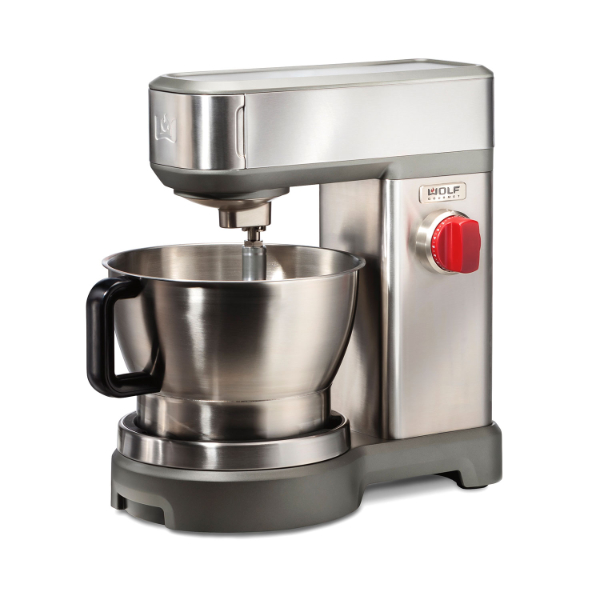
Wolf Gourmet enters the stand mixer category with a machine built to the same standards as their commercial-grade ranges. The 500-watt motor is paired with a unique gear-driven system that manages the bowl-lift mechanism with industrial precision. The hallmark of the Wolf's performance is its speed stability; it maintains the exact RPM regardless of the dough's resistance, a feat achieved through a sophisticated load-sensing electronic control system.
The build quality is exceptional, featuring a stainless steel bowl with a flared rim for easy pouring and a heavy-duty whisk that utilizes more tines than standard consumer models for faster aeration. The distinctive red control knob provides tactile feedback, and the mixer includes a pulse setting - a rarity for stand mixers - which allows for careful incorporation of inclusions like nuts or chocolate chips without crushing them.
The downside is the extreme price point, which targets the luxury market. While the performance is impeccable, the attachment ecosystem is currently more limited than its competitors. It is designed for the user who values material excellence and industrial aesthetics above all else, offering a level of fit and finish that surpasses even the KitchenAid Pro Line. It is a "buy-it-for-life" appliance with a construction that suggests a multi-decade operational lifespan.
The Wolf Gourmet mixer utilizes a hall-effect sensor to monitor the rotation of the motor shaft. If the sensor detects a drop in speed due to increased load (such as a heavy dough ball), the processor increases voltage to the motor to compensate, maintaining perfectly consistent mixing cycles.
How We Chose These Products
Our selection process focused on Mechanical Reliability and Mixing Efficiency. We prioritized models with metal-dominant gear trains and those that demonstrated minimal vibration under load. We analyzed motor types - favoring DC motors for high-volume use and AC motors for their proven track record in home environments. Each product was evaluated for its beater-to-bowl clearance (the "Dime Test") and its ability to maintain a consistent speed ramp. Only products currently in active production with verifiable manufacturer support were considered to ensure long-term parts availability.
Comparison Overview
| Model | Motor Type | Capacity | Drive System | Weight |
|---|---|---|---|---|
| KitchenAid Artisan | 325W AC | 5-Quart | Tilt-Head / Worm Gear | 26 lbs |
| Ankarsrum Original | 600W AC | 7.4-Quart | Rotating Bowl / Worm Gear | 19 lbs |
| KitchenAid Pro Line | 1.3 HP DC | 7-Quart | Bowl-Lift / All-Metal Gear | 29 lbs |
| Cuisinart SM-50 | 500W AC | 5.5-Quart | Tilt-Head / Nylon-Metal Hybrid | 17 lbs |
| Wolf Gourmet | 500W AC | 7-Quart | Bowl-Lift / Gear Driven | 29 lbs |
Buying Guide: What to Look For
- Motor Torque vs. Wattage: High wattage doesn't always equal power. DC motors (measured in HP) are generally more efficient and quieter than AC motors (measured in Watts) for heavy tasks.
- Bowl-Lift vs. Tilt-Head: Tilt-head mixers are easier to fit under cabinets and provide better bowl access, but bowl-lift models are more stable for large batches of yeast dough.
- Gear Material: All-metal gears are more durable but can be louder. Some brands use a single nylon gear as a "mechanical fuse" to protect the motor from burnout.
- Weight and Stability: A heavy mixer (20+ lbs) is desirable; it prevents the machine from "walking" across the counter during high-speed kneading.
- Attachment Versatility: Consider if you need a mixer that can also grind meat, roll pasta, or spiralize vegetables. KitchenAid currently leads in the variety of power-hub accessories.
General Pro / Cons
| Strengths (Pros) |
|---|
| Unmatched hands-free power for gluten development. |
| Consistent results in aeration for meringues and sponges. |
| Multi-purpose functionality through attachment hubs. |
| High-mass construction reduces vibrations and counter-walking. |
| Ability to process large batches (up to 14 lbs) in premium models. |
| Planetary action ensures superior ingredient incorporation. |
| Generational durability in models with all-metal gear sets. |
| Time-saving efficiency compared to hand-mixing or handheld blenders. |
| Weaknesses (Cons) |
|---|
| Significant counter footprint and weight hinder storage. |
| High initial capital expenditure for professional-grade units. |
| Loud decibel levels, particularly in high-wattage AC models. |
| Thermal shutdown risks during consecutive heavy dough batches. |
| Potential for "gray streaks" in food if beater clearance is misaligned. |
| Cleaning complexity of attachments and planetary head crevices. |
| Requirement for regular maintenance (lubrication/screw adjustments). |
| High replacement costs for proprietary stainless steel bowls. |
Final Summary
Selecting the ideal stand mixer requires balancing your specific volume requirements with the technical limitations of motor design. For the majority of home bakers, the KitchenAid Artisan remains the superior choice for its versatility and ecosystem. Professional-level users will find the silent power of the KitchenAid Pro Line or the industrial stability of the Wolf Gourmet more suited to their needs. Meanwhile, the Ankarsrum Original stands alone as the definitive tool for serious bread artisans, and the Cuisinart Precision Master provides a reliable entry point for those on a budget. Aggregate rating of the products reviewed: 4.76 out of 5.