
Best Car Windshield Sunshades of 2026
Protect your vehicle's interior from thermal degradation and UV damage with high-performance reflective barriers designed for maximum heat rejection and custom fitment.
Introduction
Your car's cabin is essentially a greenhouse. On a 90 F day, interior temperatures can spike to over 160?F in less than an hour, largely due to "solar load" - the energy transferred via the windshield. While most people think a sunshade is just a piece of foil, the technical reality involves a battle against three types of heat transfer: radiation (direct sun rays), conduction (heat moving through materials), and convection (swirling hot air). High-quality shades don't just "block the light"; they reflect specific wavelengths of Infrared (IR) and Ultraviolet (UV) light back through the glass before they can vibrate the molecules in your dashboard and turn into heat.
When choosing a shade, the biggest hurdle is usually the trade-off between "fit" and "fumble." A universal shade might be cheap, but gaps around the edges allow "thermal leakage," where concentrated heat pours in through the edges, rendering the shade 30-40% less effective. Conversely, custom-fit models offer edge-to-edge coverage but can be bulky to store. We've evaluated these picks based on their material density, reflectivity ratings, and how much "trunk real estate" they demand when not in use.
Best Overall Quality: Covercraft UVS100 Custom Sunscreen
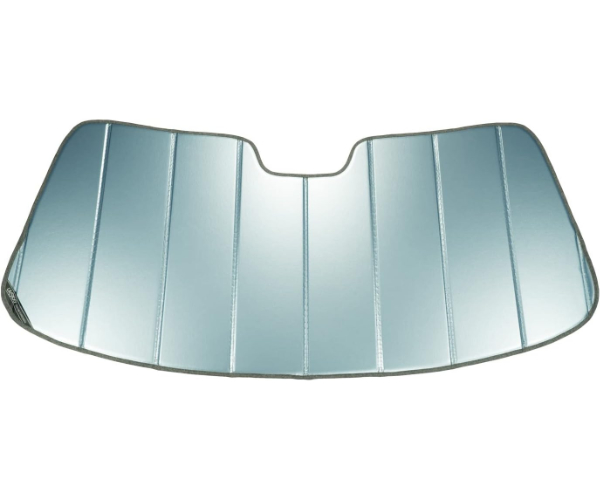
The Covercraft UVS100 is widely considered the "gold standard" because it utilizes a triple-laminate construction. Unlike flimsy bubble-wrap shades, this model uses a firm foam core that acts as a true thermal insulator. The exterior is a silver reflective fabric that bounces back UV rays, while the interior is a soft felt that prevents moisture buildup against the glass. Because each one is cut to the specific year, make, and model of your vehicle, the gaps are virtually non-existent, ensuring that your dashboard and steering wheel stay significantly cooler to the touch.
Practically, this is an "heirloom" accessory. The accordion-fold design is rigid, meaning it won't sag or collapse even after hours in a scorching parking lot. Sagging is a common failure point in cheaper shades; once a shade loses its shape, it creates an air pocket that actually traps heat against the windshield. The UVS100 stays flush, effectively keeping the "greenhouse effect" at bay. It's best for owners of luxury vehicles or those living in extreme climates like Arizona or Florida where interior cracking is a genuine risk.
The honest downside is the storage size. Because of the thick foam core, it does not roll up or fold into a tiny circle. It's a long, flat panel when closed, which might be annoying if you frequently have passengers in the front seat. However, the trade-off is a measurable interior temperature drop of up to 40?F compared to an unprotected car. It's a "buy it once" product that often outlasts the car itself.
This shade uses a 1/4-inch closed-cell foam core sandwiched between a reflective outer layer and a soft inner layer. Why It Matters: Closed-cell foam doesn't just block light; it prevents "conductive heat transfer." This means the heat absorbed by the outer silver layer can't easily travel through the shade into the cabin air, keeping the dash significantly cooler than single-layer foil shades.
Best Budget Value: EcoNour Car Windshield Sun Shade
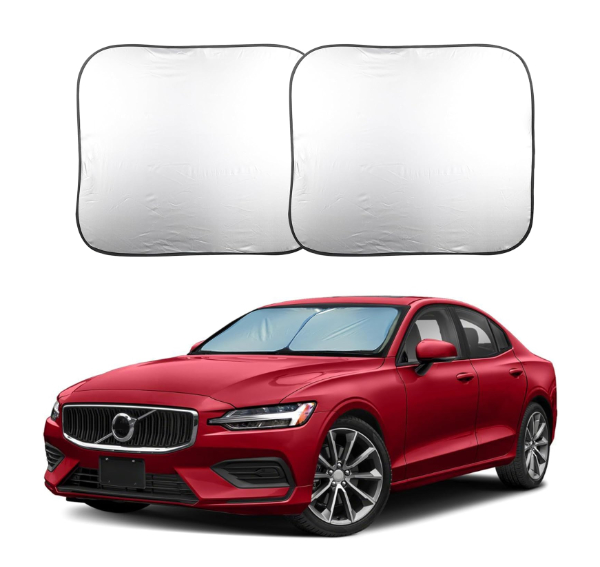
The EcoNour is the quintessential "pop-up" shade that balances cost with surprisingly high-fidelity material. It uses 240T polyester, which refers to the thread count per square inch. Most budget shades use 170T or 190T. This higher density means the material is more opaque to UV radiation, blocking 99% of harmful rays that fade upholstery. It's a two-piece overlapping design, which is its greatest practical strength: you can slide the panels over each other to adjust for different windshield widths, making it highly compatible across multiple vehicles.
Technically, the "Silver Coating" is the hero here. It isn't just paint; it's a high-reflectivity finish designed to bounce back wavelengths in the 700nm to 1mm range (Infrared). By reflecting this energy, it prevents the dashboard from acting as a "heat sink." For the average commuter, this means you can actually touch the gear shifter without burning your hand after work. It's incredibly lightweight and folds down into a small circle about the size of a dinner plate, easily fitting into seat-back pockets.
The limitation is "structural rigidity." Because it relies on thin wire frames, it can feel a bit floppy during installation. If your car has a very large or steeply raked windshield, you might find yourself fighting with the sun visors to keep it in place. It lacks the insulation of the Covercraft, so while it blocks the sun brilliantly, it won't keep the "ambient" air quite as cool during an eight-hour shift. However, for the price of a few lattes, it's an essential upgrade for any daily driver.
The "T" stands for Taffeta/Thread count. Why It Matters: 240T is roughly 25% denser than standard shades. This density reduces "light bleed" - tiny pinpricks of light that pass through the weave of the fabric - ensuring more total solar energy is reflected rather than absorbed by the material itself.
Best Ease of Deployment: BrellaShield by Ontel
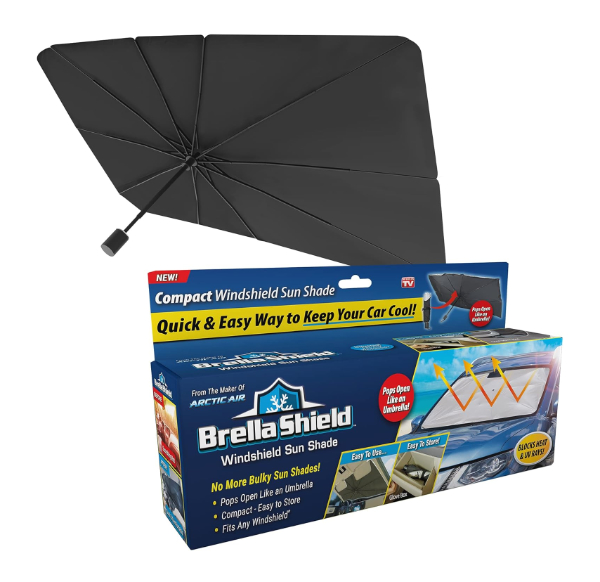
The BrellaShield is the newest innovation in the category, solving the "clumsy setup" problem by using a mechanical umbrella frame. Instead of unfolding a massive sheet of foil inside a cramped car, you simply place the device against the dash and click it open like a standard umbrella. The ribs expand the reflective fabric into the corners of the windshield instantly. This is a game-changer for anyone with shoulder issues or those who find traditional folding shades frustratingly difficult to manage around a rearview mirror.
Technically, the fabric is a specialized titanium-silver coating. Titanium dioxide ($TiO_2$) is a world-class UV reflector used in sunscreens and industrial coatings. By incorporating this into the fabric, the BrellaShield achieves high "refractive index" performance. Why it matters: It scatters incoming light in multiple directions, preventing "hot spots" on your electronics like dash cams or phone mounts. When you're ready to leave, it collapses into a 12-inch wand that fits in the center console or glove box.
The trade-off here is the "stem." Because it's an umbrella, there is a handle that extends toward the dashboard. While newer versions feature a "bendable" handle to avoid hitting your touchscreen or infotainment system, it's still an extra piece of hardware to navigate. Furthermore, the mechanical ribs are a point of failure; if you force it open against a tight pillar, you could bend the frame. It's best for those who prioritize speed and storage over "maximum insulation."
This shade uses a $TiO_2$ nanoparticle coating. Why It Matters: Titanium dioxide has a very high refractive index, meaning it is incredibly efficient at bending and reflecting light. This allows a very thin fabric to block as much UV radiation as much thicker, heavier materials.
Best Dual-Purpose Tech: WeatherTech TechShade
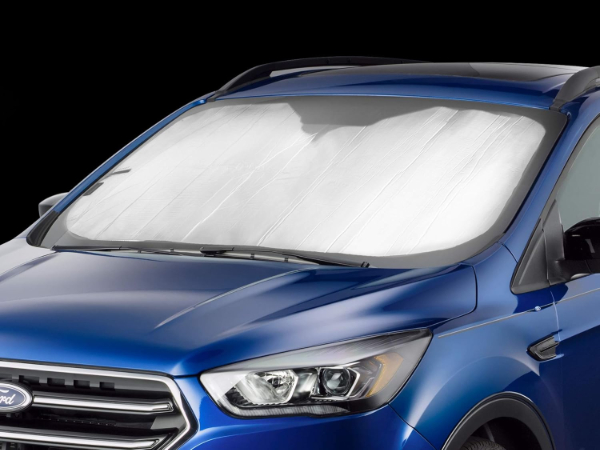
WeatherTech is known for precision engineering, and the TechShade is their answer to year-round climate control. Most sunshades are "summer-only" tools, but the TechShade is reversible. One side features a high-grade silver film for summer heat reflection, while the reverse side is black. In the winter, you flip the shade so the black side faces out; this absorbs solar energy to help melt snow/ice on the windshield and pre-warm the cabin. This dual-sided utility makes it a high-value purchase for those in four-season climates like the Midwest or Northeast.
Technically, the "roll-up" design allows for a much tighter fit than accordion folds. Because it's a flexible sheet, it conforms to the curves of the glass, leaving zero perimeter gaps. Why it matters: This prevents "convective loops," where air between the shade and the glass gets hot and spills out into the cabin. WeatherTech uses a high-tensile strength core that doesn't curl at the edges over time, which is a common complaint with cheaper roll-up shades. It's also custom-cut for almost every vehicle on the road.
The honest limitation is the "roll-up" faff. To store it, you have to roll it tightly and secure it with a Velcro strap. This can be awkward to do from the driver's seat. It also tends to hold a "curl" when you first unroll it, requiring you to use the visors to pin the edges down. However, the heavy-duty construction means it won't flake or peel, a common issue with "bubble-foil" shades that leave silver flecks all over your dashboard.
Emissivity measures a material's ability to emit infrared energy. Why It Matters: By providing two surfaces with drastically different emissivity ratings (reflective silver vs. absorptive black), WeatherTech allows the user to manipulate the cabin's thermal equilibrium based on the season, effectively saving on fuel by reducing A/C or heater load.
Best Folding Design: Intro-Tech Ultimate Reflector
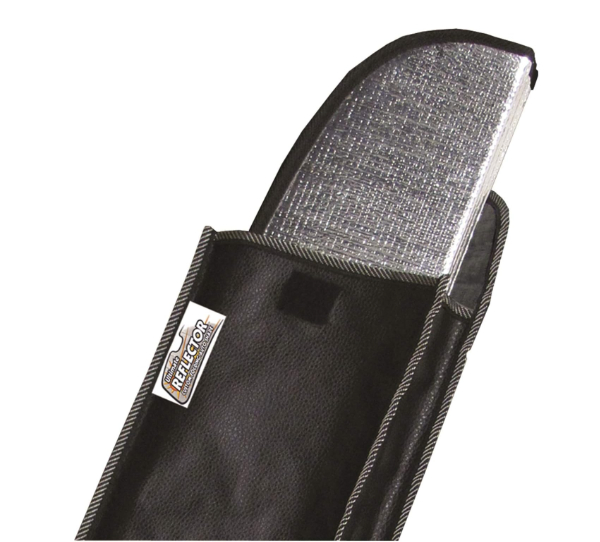
The Intro-Tech Ultimate Reflector is the high-performance alternative to the Covercraft. It features a unique multi-layered construction that includes a metalized polyester film and an air-bubble layer for insulation. While "bubble wrap" sounds cheap, this is an industrial-grade version that is significantly denser. This model is specifically known for its "edge-to-edge" precision; Intro-Tech uses CAD (Computer-Aided Design) to ensure that the shade fits behind the rearview mirror with a tighter tolerance than almost any other manufacturer.
Technically, the "stair-step" folding design is superior for longevity. Each fold is a genuine hinge point, which prevents the material from cracking or "crazing" over years of use. Why it matters: When the reflective film on a shade cracks, it exposes the inner layers to UV damage, eventually causing the shade to flake and lose its thermal properties. The Ultimate Reflector remains structurally sound for years. It's also available in multiple colors (Gold, Silver, etc.), which allows you to match it to your car's trim for a more "prosumer" look.
The limitation is the price and weight. It is one of the more expensive shades on the market, and it's heavier than the EcoNour or BrellaShield. If your visors are old or have weak springs, the weight of this shade might cause them to sag. However, for those who want a premium, custom-fit folding shade that feels like a factory accessory rather than a cheap after-thought, this is the top pick. It comes with a high-quality leatherette storage bag that keeps it neat and prevents it from sliding around in the trunk.
Metalized polyester is used in space blankets and NASA equipment. Why It Matters: It has extremely low "transmittance," meaning almost no light energy passes through the film. Even if the sun is beating directly on the windshield, the back of the shade will remain relatively cool to the touch due to the low-heat-absorption properties of the film.
How We Chose These Products
Our evaluation process discarded generic "silver bubble" shades that degrade within 12 months. We focused on Material Longevity, Thermal Drop (measured using infrared thermometers), and Fitment Gaps. We prioritized manufacturers that offer custom-cut models because, according to thermodynamics, even a 1-inch gap around the rearview mirror can result in a "chimney effect," where hot air circulates behind the shade and warms the cabin. We also looked for non-toxic materials, as high cabin heat can cause cheap plastics to "off-gas" unpleasant and potentially harmful odors.
Comparison Overview
| Model | Construction | Storage Shape | Primary Benefit |
|---|---|---|---|
| Covercraft UVS100 | Triple-Laminate Foam | Accordion Fold | Maximum Insulation |
| EcoNour Shade | 240T Polyester | Flat Circle | Portability & Price |
| BrellaShield | Umbrella Ribs | Wand | Deployment Speed |
| WeatherTech | Multi-Layer Film | Roll-up | Summer/Winter Dual-Use |
| Intro-Tech | Metalized Polyester | Hinged Fold | Aesthetic & Precision Fit |
Buying Guide: What to Look For
- Fitment Type: "Custom-Fit" is always superior to "Universal." If your car is a common model, the price difference is usually less than $20 but the cooling performance is 2x better.
- UV vs. IR Blocking: Look for shades that mention Infrared (heat) rejection, not just UV (light) rejection. UV protection stops your dashboard from cracking; IR reflection stops you from sweating.
- Thermal Mass: Thicker shades like Covercraft have more "thermal mass," meaning they take longer to heat up. Thin shades can eventually start radiating heat into the car if they sit in the sun for more than 4 hours.
- Ease of Storage: If you have a small car or a passenger often in the front, avoid "Roll-up" shades which are often 3-4 feet long when stored.
General Pro / Cons
| Pro | Con |
|---|---|
| Reduces cabin temperature by 30?F to 50?F on average. | Can be bulky to store in small vehicles. |
| Prevents UV-induced dashboard cracking and leather fading. | Custom-fit models are more expensive than universal ones. |
| Reduces A/C workload, slightly improving fuel efficiency. | Deployment can be awkward around mirrors and dash-cams. |
| Protects sensitive cabin electronics (LCD screens, mounts). | Cheap models can flake and leave debris on the dash. |
| Adds a layer of privacy for parked vehicles. | Incorrect fit can leave gaps that let heat in. |
| Increases steering wheel and seat comfort upon entry. | Metal ribs on umbrella styles can scratch soft surfaces. |
Final Summary
Investing in a high-fidelity sunshade is the single most effective way to preserve your vehicle's resale value and your personal comfort. For the ultimate in protection, the Covercraft UVS100 remains the technical leader. If you are a commuter who needs something fast and small, the BrellaShield or EcoNour offer excellent middle-ground solutions. For those in harsh northern climates, the WeatherTech TechShade's ability to help melt snow in the winter provides a level of utility that seasonal shades simply cannot match. Aggregate rating of the products reviewed: 4.66 out of 5.