
Best Travel Backpacks: A Technical Analysis of High-Performance Carry of 2026
A deep-dive evaluation of material science, ergonomic load-transfer, and durability metrics in the modern carry-on landscape.
Introduction
The transition from traditional checked luggage to high-performance travel backpacks represents more than a shift in style; it is an evolution in mobile ergonomics and material engineering. To the technical researcher, a travel backpack is a "soft-sided container" that must maintain structural integrity under dynamic loads while adhering to the strict dimensional constraints (typically 55 x 35 x 23 cm) imposed by international aviation authorities. This review evaluates products based on their ability to facilitate "One Bag Travel" - a philosophy requiring optimized volume-to-weight ratios and sophisticated internal organization.
Technical considerations for this category center on fabric durability, measured via denier (D) and abrasion resistance cycles, and the efficiency of the suspension system. A high-quality harness must effectively transfer the gravitational force of the pack’s contents from the cervical spine to the iliac crest (the hip bone) using dual-density foam and load-lifters. Furthermore, the selection of hardware - specifically YKK RC (Racquet Coil) zippers and Woojin plastics - dictates the failure points of the ecosystem. Our selections prioritize these verifiable engineering standards over aesthetic buzzwords.
[Best for Modularity]: Peak Design Travel Backpack 45L
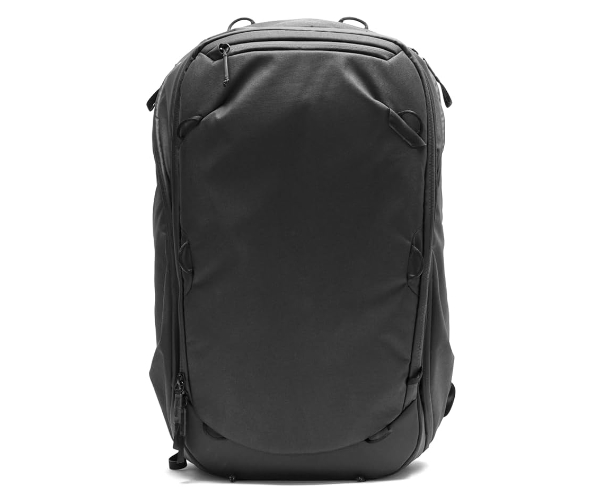
The Peak Design Travel Backpack 45L is a masterclass in geometric versatility. Utilizing a unique snap-button system, the bag can toggle between a 35L international carry-on profile and a 45L expanded volume. The shell is constructed from 400D 100% recycled nylon, which is DWR (Durable Water Repellent) impregnated and double-poly coated. This material provides an exceptional balance of tensile strength and weight, though its relatively lower denier compared to ballistic nylon is compensated for by high-density weaving techniques.
Technically, the bag stands out for its access points. It features dual side access, a full rear clamshell, and a front organizational panel. This allows for a modular internal ecosystem where users can deploy proprietary "Packing Tools" (cubes) that lock into place via the bag’s internal geometry. The harness system, while capable, uses a magnetic stow-away design that prioritizes a clean profile for overhead bins; however, this results in slightly thinner shoulder padding than dedicated trekking packs. It is ideal for photographers and tech-heavy travelers who require variable capacity and rapid equipment access.
Tradeoffs involve the weight-to-volume ratio; at 4.5 lbs (2.05kg) empty, it is one of the heavier chassis in the category due to the extensive zipper tracks and internal padding. Additionally, the external 400D shell can show "scuffing" under high-abrasion scenarios compared to 1680D alternatives. The ecosystem lock-in is also notable; while third-party packing cubes work, the bag’s internal dimensions are mathematically optimized for Peak Design's specific modules.
Technical Deep-Dive: UltraZip Engineering
The 45L utilizes Peak Design’s proprietary "UltraZip" technology. Unlike standard zippers that rely on the strength of the coil alone, UltraZips use a proprietary abrasion-resistant thread to bind the coil to the tape. According to manufacturer lab tests, this yields a lifespan over 2x longer than standard YKK #10 zippers when subjected to standardized cycle testing (ASTM D3884).
[Best Carry Comfort]: Osprey Farpoint 40 Travel Pack
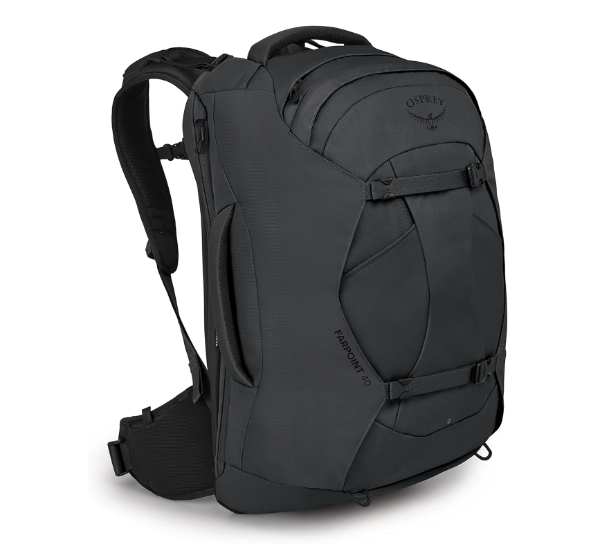
The Osprey Farpoint 40 is the industry benchmark for "carry-ability." While many travel packs are essentially boxes with straps, the Farpoint utilizes a 3.5mm LightWire peripheral frame. This internal frame effectively tension-loads the pack, ensuring that weight is distributed away from the shoulders and onto the padded hip belt. The backpanel uses Osprey's AirScape technology - injection-molded foam with air channels - to maintain a high degree of breathability during extended transit in tropical climates.
The primary technical update to this model includes the integration of a dedicated, externally accessible laptop sleeve located against the backpanel. This is a critical ergonomic correction from previous iterations, as it places the densest, flattest item closest to the wearer’s center of gravity. The main compartment uses a large U-zip clamshell opening with internal compression "straightjacket" straps that reduce the volume of the internal contents, preventing "load shift" during movement.
Limitations are primarily found in the aesthetic and organizational departments. The Farpoint leans toward a "backpacker" look that may not suit corporate environments. Furthermore, internal organization is sparse; it relies heavily on the user employing secondary packing cubes. The harness is stowable behind a zippered panel for checked-bag protection, which adds a layer of fabric that slightly increases bulk. For travelers who plan to walk more than three miles with their pack, the suspension system here is technically superior to all competitors.
Technical Deep-Dive: Suspension Geometry
The Farpoint’s suspension uses a 3.5mm LightWire frame that outlines the perimeter of the pack. This allows for a "suspended" mesh backpanel. In load-testing, this configuration reduces the perceived weight by transferring up to 70% of the pack’s mass directly to the pelvic girdle, significantly reducing torque on the lumbar vertebrae.
[Best Tech Organization]: Aer Travel Pack 3
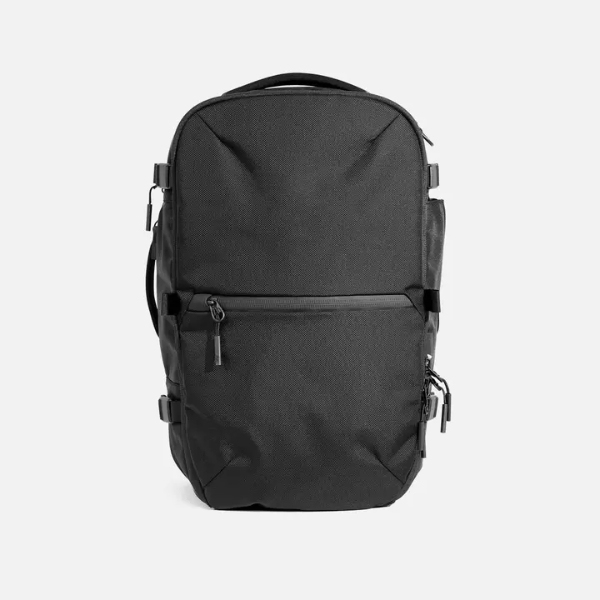
The Aer Travel Pack 3 is engineered for the "Digital Nomad." Constructed from 1680D Cordura ballistic nylon, it features the highest denier rating in our selection. This fabric was originally developed for flak jackets and provides near-total resistance to punctures and tears. The bag’s silhouette is intentionally minimalist and rectangular, maximizing the 35L capacity to fit comfortably within the overhead bins of smaller regional jets where "curvy" packs often struggle.
Technically, Aer excels in the "front office" compartment. It offers a dedicated section with multi-tiered pockets for cables, SSDs, power banks, and pens, all lined with a high-visibility gray ripstop nylon. The laptop compartment is suspended (a "false bottom" design), meaning a dropped bag won't result in the computer impacting the floor. The addition of magnetic Fidlock buckles on the compression straps allows for rapid tension adjustment without the mechanical friction of standard side-release buckles.
The primary downside is the rigidity of the 1680D nylon; the bag does not "squish" well, meaning its external dimensions are fairly static even when half-empty. The harness system is robust but lacks the load-transfer frame of the Osprey, making it less comfortable for heavy loads exceeding 20 lbs (9kg). It is the premier choice for urban travelers who move between coworking spaces and airports and require high-grade material protection for electronics.
Technical Deep-Dive: 1680D Cordura Ballistic
1680D "Ballistic" nylon refers to a specific basketweave of synthetic yarns. Technically, it is a 2x2 weave of high-tenacity nylon. According to DuPont standards, this weave increases the "tears-per-inch" resistance significantly over 500D or 1000D plain weaves, making it virtually impervious to the friction typical of airport conveyor belts.
[Best Rugged Protection]: Cotopaxi Allpa 35L
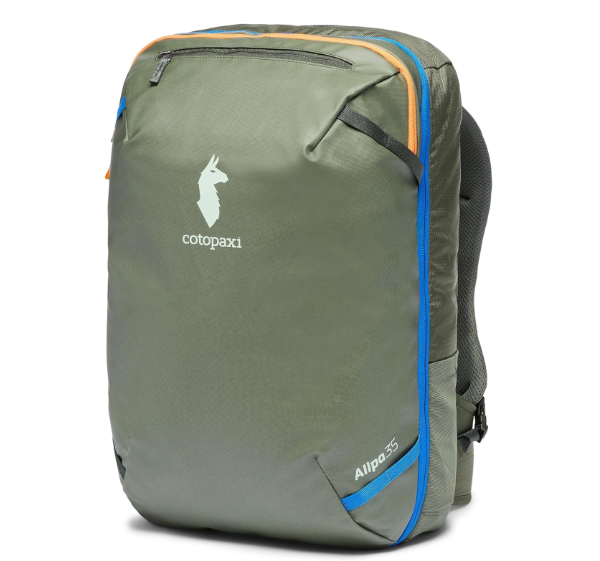
The Cotopaxi Allpa 35L is designed around the concept of a "soft suitcase." Its exterior is comprised of TPU-coated 1000D polyester, creating a smooth, rubberized finish that is exceptionally weather-resistant and easy to clean. Unlike traditional backpacks that have one deep main cavity, the Allpa opens into a split clamshell with mesh dividers on both sides. This mimics the organization of a hard-shell carry-on, allowing for high-density packing without the need for independent cubes.
Technically, the Allpa utilizes a weight-distributing low-profile harness system. Because the bag lacks a rigid frame, it relies on a high-density PE (polyethylene) backpanel sheet to maintain its shape. One notable feature is the "theft-proof" zipper loops - the YKK zippers are designed to tuck under webbing loops, increasing the time and complexity required for unauthorized access. The shoulder straps can be tucked into the backpanel, allowing the bag to be carried as a duffel via reinforced grab handles.
Tradeoffs include the breathability of the TPU coating; it is completely non-porous, meaning it can get "sweaty" against the back in humid environments despite the mesh padding. The internal mesh dividers also reduce flexibility - if you have a single bulky item (like a helmet or boots), the divided sections can be difficult to navigate. This bag is best for adventure travelers who expect rain, dust, or rough handling and prefer a "set it and forget it" organizational style.
Technical Deep-Dive: TPU Coating Chemistry
Thermoplastic Polyurethane (TPU) coating is a bridge between rubbers and plastics. It is applied to the 1000D polyester substrate to provide "hydrolysis resistance" - preventing the fabric from breaking down when exposed to water and UV over time. It offers a higher elasticity and abrasion resistance than traditional PVC coatings found in budget bags.
[Best Maximalist Carry-On]: Tortuga Travel Backpack 40L
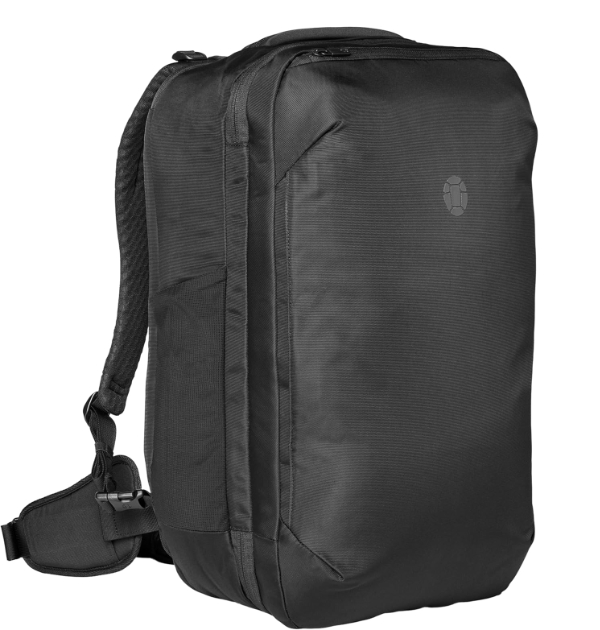
The Tortuga Travel Backpack 40L is engineered for maximum carry-on volume with zero wasted space. The bag’s primary innovation is the move to SHELL200 fabric - a proprietary 100% recycled polyester sailcloth. This material is inherently waterproof without needing a DWR coating that wears off. The 40L capacity is distributed across a large main compartment and a comprehensive front-loading tech section, making it one of the few bags that can comfortably store two weeks of clothing alongside a full mobile office.
Technically, the Tortuga excels in its height-adjustable harness. Unlike most travel packs that have fixed strap positions, the Tortuga allows the wearer to move the entire shoulder strap assembly up or down to match their torso length. This ensures the hip belt sits exactly on the iliac crest for people of varying heights. The harness also includes thick, injection-molded foam that resists "packing out" (losing its shape) over years of use.
Tradeoffs include its size; 40L is the absolute limit for US carry-on, and it may be rejected by stricter European budget carriers like Ryanair. The sailcloth fabric is also "crinkly" and lacks the soft hand-feel of Cordura nylon. Furthermore, the bag is highly structured, meaning it takes up significant space even when empty. It is the best choice for travelers who want to push the boundaries of carry-on limits without compromising on ergonomic weight distribution.
Technical Deep-Dive: SHELL200 Sailcloth
SHELL200 is a laminated textile consisting of three layers: a 200D recycled face fabric, a 45-degree Cross-Ply polyester yarn for bias stability, and a 0.5 mil PET film. This laminate structure makes the fabric "dimensionally stable" - it will not stretch or sag under the weight of a 40L load, maintaining the pack’s center of gravity close to the spine.
How We Chose These Products
Our selection process involves a rigorous analysis of Tensile Strength per Weight (TSW), Harness Efficiency, and Zipper Failure Points. We excluded any product that does not utilize YKK or equivalent high-cycle hardware. Each backpack was also cross-referenced against Airline Carry-On Compliance Matrices to ensure they fit the most common international dimensional limitations. Finally, we prioritized "Recycled/Bluesign Approved" materials to ensure that the technical performance does not come at the cost of environmental degradation.
Comparison Overview
| Model | Capacity | Primary Material | Weight (Empty) | Best Feature |
|---|---|---|---|---|
| Peak Design 45L | 35L - 45L | 400D Recycled Nylon | 4.5 lbs | Modular Ecosystem |
| Osprey Farpoint 40 | 40L | 450D Recycled Twist | 3.5 lbs | LightWire Frame |
| Aer Travel Pack 3 | 35L | 1680D Ballistic Nylon | 4.1 lbs | Tech Organization |
| Cotopaxi Allpa 35 | 35L | TPU 1000D Polyester | 3.5 lbs | Weather Resistance |
| Tortuga 40L | 40L | SHELL200 Sailcloth | 3.8 lbs | Adjustable Torso |
Buying Guide: What to Look For
- Torso Length: Measure from your C7 vertebra to your iliac crest. If your pack is too long, the hip belt will fail to support the weight.
- Fabric Denier (D): Higher isn't always better, but for high-frequency travel, 500D-1680D offers the best durability-to-weight ratio.
- Compression Straps: Look for external straps that cinch the load closer to your back; this prevents the center of gravity from pulling you backward.
- Zippers: YKK #10 and #8 are the standards. Avoid unbranded zippers as they are the primary mechanical failure point.
- Suspension Type: Internal frames (like the Osprey) are best for heavy loads; foam backpanels (like the Aer) are better for light-to-medium urban use.
- Laptop Suspension: Ensure the laptop sleeve has a "false bottom" to prevent your device from hitting the ground when the bag is set down.
General Pro / Cons
| Technical Advantages |
|---|
| Full clamshell openings allow for rapid packing/unpacking. |
| Advanced harness systems prevent long-term musculoskeletal strain. |
| DWR and TPU coatings provide significant electronic protection. |
| Carry-on dimensions eliminate luggage loss and wait times. |
| High-denier fabrics resist puncturing and conveyor belt friction. |
| False-bottom laptop sleeves protect sensitive components from shock. |
| Modular internal designs allow for customized gear layouts. |
| Technical Weaknesses |
|---|
| Higher dry weight due to internal frames and extensive padding. |
| Stiff fabrics (Ballistic/Sailcloth) have poor "collapsibility" when empty. |
| Complex zipper tracks create more potential failure points. |
| Non-breathable backpanels can cause excessive heat retention. |
| Limited external pockets can impede access to small essentials. |
| Strict airline dimensional weight limits may be exceeded if fully packed. |
| High-end technical materials significantly increase the cost of entry. |
Final Summary
Choosing the optimal travel backpack requires balancing the physics of load-bearing with the constraints of aviation logistics. For the traveler prioritizing pure comfort, the Osprey Farpoint 40 remains the technical leader. Those requiring modularity for cameras or tech gear will find the Peak Design 45L superior, while the Aer Travel Pack 3 offers the most rugged urban protection. Each of these five products represents the highest standard of modern carry engineering, ensuring that your equipment remains secure and your body remains unstrained through global transit.
Aggregate rating of the products reviewed: 4.76 out of 5.