
Best Window Cleaning Robots of 2026
Introduction
Window cleaning robots have transitioned from niche novelties to high-performance maintenance tools. For homeowners with high-reach glass, floor-to-ceiling panes, or glass railings, these devices eliminate the physical risk of ladders and the high recurring cost of professional services. The technology relies on a balance of vacuum suction, expressed in Pascals (Pa), and path-planning algorithms that ensure every square inch of the surface is covered without getting stuck on frames or sliding off the edge.
When selecting a robot, the primary technical considerations are the suction motor's reliability and the edge-detection sensors. Most modern units utilize a vacuum motor to create a seal against the glass, but the "expert level" differentiator is how the robot handles the corners and the "dead zones" where dirt tends to accumulate. While no robot can perfectly replicate the detailed corner-scrub of a human with a squeegee yet, the products selected here represent the current peak of autonomous glass maintenance, balancing safety tethers with high-torque cleaning pads.
Best Overall Convenience: Ecovacs Winbot W2 Omni
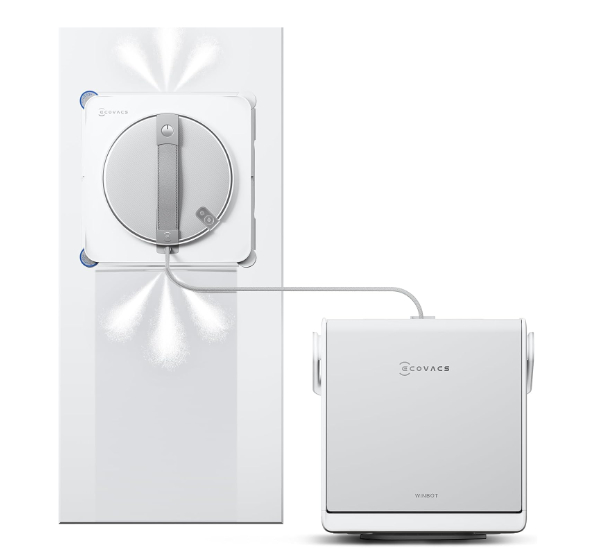
The Ecovacs Winbot W2 Omni solves the most persistent headache in window robotics: the "cable mess." Unlike traditional units that require a nearby power outlet and a separate safety rope anchor, the W2 Omni features a multi-functional base station. This station houses a high-capacity lithium-ion battery and a weighted cable management system. Why it matters: You are no longer tethered to an indoor wall outlet, allowing you to clean exterior glass in areas like balconies or high-reach facades where power is non-existent.
Technically, the W2 Omni utilizes an upgraded wide-angle spray technology that covers a broader surface area than its predecessors. The robot exerts 2800 Pa of suction, which is a robust safety margin. To put that in perspective, 2800 Pa is roughly equivalent to the suction required to lift a 6-pound weight vertically - far more than the robot actually weighs. This ensures the unit stays glued to the glass even during high-speed directional changes or in gusty outdoor conditions.
The tradeoff for this portability is the sheer size of the base station. It is a significant piece of hardware to store, and it adds to the initial investment cost. However, for users who have prioritized aesthetics and don't want to fumble with multiple cords, the W2 Omni is the most streamlined ecosystem available. It is best suited for large, modern homes with extensive glass surfaces that lack convenient exterior electrical access.
The W2 Omni base station provides up to 110 minutes of cleaning on a single charge. It uses a "One-Box" design that integrates the power cord and safety tether into a single reinforced composite cable. The Benefit: Traditional robots have two lines that often tangle; this single-cable approach reduces mechanical resistance, allowing the robot to move 20% faster across the glass without dragging or snagging.
Best for Frameless Windows: Hobot 2S
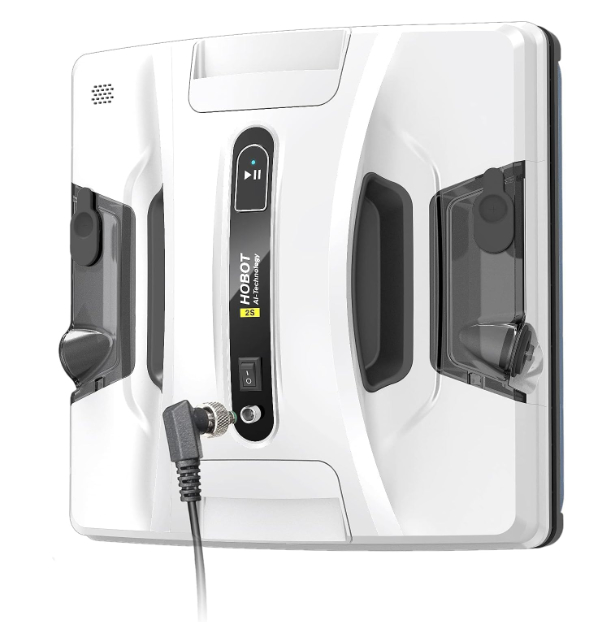
The Hobot 2S is a technical powerhouse focused on precision and edge detection. It features dual ultrasonic spray nozzles that atomize water into a 15um (micron) mist. Why it matters: Large water droplets often result in streaks or "hydroplaning" where the robot loses traction. A 15-micron mist - roughly 1/5th the thickness of a human hair - evenly dissolves dust without saturating the cleaning cloth, leading to a streak-free finish.
Where the Hobot 2S truly excels is in frameless window detection. It uses four high-sensitivity air-leakage sensors at its corners. Unlike infrared sensors that can be fooled by bright sunlight, these pressure sensors detect when the vacuum seal begins to drop at the edge of the glass. The robot reacts instantly, reversing its path before it can over-extend. This makes it the safest choice for glass railings or "infinite" glass walls where there is no physical border to stop the unit.
The limitation here is the noise profile. The high-efficiency vacuum motor produces a distinct whine that can be intrusive if you are cleaning the interior while trying to work or watch TV. Additionally, while the app is functional, the physical remote control remains the more reliable way to manage the unit. It is the ideal tool for the "prosumer" who values technical reliability and edge safety over a minimalist aesthetic.
The Hobot 2S nozzles vibrate at ultrasonic frequencies to break surface tension. The Benefit: This allows the robot to use less water (only 1ml per square meter) while achieving higher coverage. By keeping the microfiber pads "damp" rather than "wet," the robot maintains a higher friction coefficient, which prevents it from slipping on vertical surfaces.
Best Cleaning Precision: Ecovacs Winbot W1 Pro
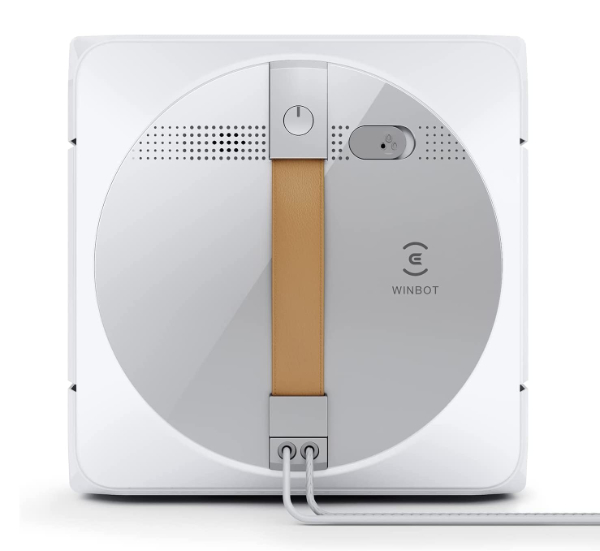
The Winbot W1 Pro is built around the WIN-SLAM 3.0 path-planning algorithm. While some robots move somewhat randomly, the W1 Pro maps the window dimensions first, then follows a systematic Z-path or N-path to ensure 100% coverage. Why it matters: This systematic approach reduces the "uncut" spots often found in the center of large windows, and it ensures the robot returns to its starting point for easy retrieval once the job is done.
It utilizes a unique cross-auto-spray system that fires water in two directions. This prepares the glass ahead of the robot's movement regardless of which way it is currently traveling. The 2800 Pa suction is supplemented by a high-grip drive tread system that resists slipping even when the glass has a film of morning dew. This makes it a reliable choice for humid climates or early morning cleaning sessions.
One caveat is the "safety tether" setup. Unlike the W2 Omni, this model requires you to find a secure physical anchor point for its carabiner and safety rope. If your home has few heavy objects or secure handles near the windows, setup can feel cumbersome. However, for those who want the best-in-class pathing intelligence without the bulk of the Omni station, the W1 Pro is the technical sweet spot.
The WIN-SLAM 3.0 system uses an internal gyroscope and position sensors to update the robot's coordinates in real-time. The Benefit: It allows the robot to "remember" where it has been. If the power is briefly interrupted or if it needs to resume after a refill, the robot doesn't start over; it goes exactly to the point where it left off, saving time and battery.
Best for Heavy Grime: HUTT W8
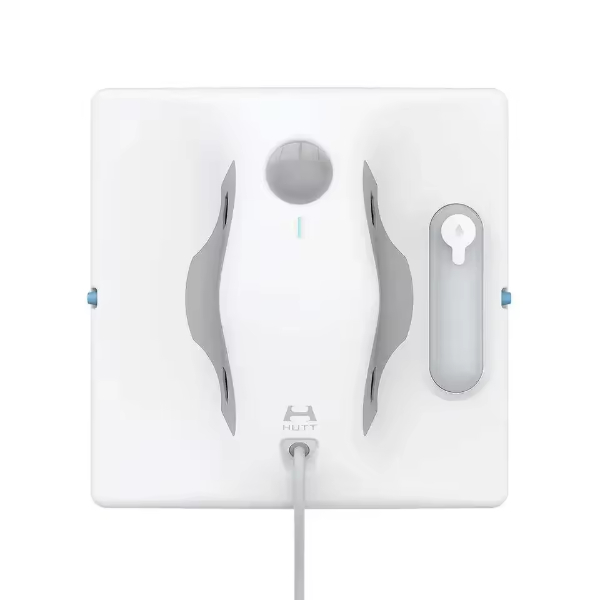
The HUTT W8 stands out due to its "HUTTTHINK" smart suction technology. While most robots have a fixed suction level, the W8 dynamically adjusts its pressure between 1850 Pa and 3800 Pa. Why it matters: When the robot encounters a patch of heavy, gritty dirt, it increases suction to ensure a tighter seal and more down-force on the scrubbing pad. On cleaner glass, it lowers the suction to reduce energy consumption and motor wear.
The W8 also features a large 80ml dual-water tank system. This is one of the largest capacities in the square-robot category, meaning you can clean up to 35 square meters of glass before needing a refill. The "Whale-Spray" technology ensures the water is pushed out in a precise, high-pressure pattern that mimics a manual pre-soak. This makes the W8 particularly effective for exterior windows in dusty areas or near coastal salt spray.
The primary downside is its thickness. The W8 has a slightly higher profile than some "slim" competitors. If you have windows with external shutters or security bars that sit very close to the glass, the W8 might not be able to clear the gap. Always measure the clearance between your glass and any exterior obstructions before committing to this model.
The HUTT W8 uses a sensor to measure the resistance against the cleaning pad. The Benefit: Higher suction (3800 Pa) translates directly to "cleaning pressure." By pressing the microfiber pad harder against the glass, the robot can remove dried bird droppings or tree sap that would otherwise require multiple passes with a lower-pressure unit.
Best Budget Scrubbing: Gladwell Gecko
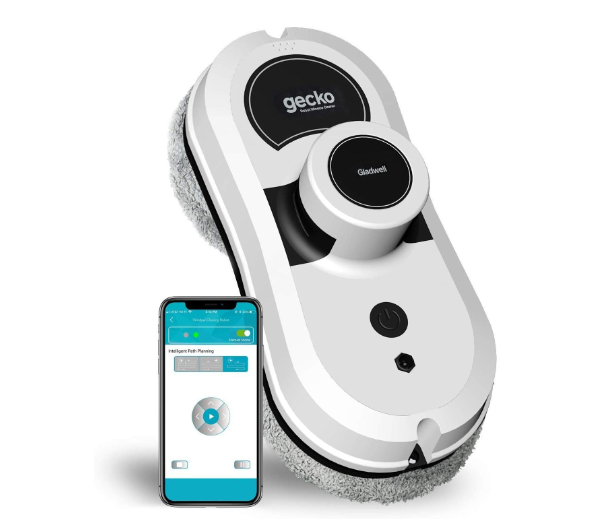
The Gladwell Gecko utilizes a "Dual-Disc" rotating design rather than the square, linear-path design of more expensive units. Instead of one large pad, it has two circular microfiber cloths that rotate in a counter-clockwise motion. Why it matters: This rotation provides a mechanical scrubbing action similar to an orbital polisher. While square robots "wipe" the glass, the Gecko "scrubs" it, which is significantly better for removing rain spots and water minerals.
The simplicity of the Gecko is its greatest asset. It doesn't rely on complex apps; it features a straightforward remote control and one-button operation. This makes it an excellent choice for users who want to avoid technical setup or compatibility issues. Because of its circular design, it is also much more agile on smaller panes of glass where a large square robot might struggle to turn around.
The clear tradeoff is the "corner problem." Because the pads are round, they cannot physically reach into the 90-degree corners of a window frame. You will invariably have a small triangle of uncleaned glass in every corner. For many, this is a fair compromise for the lower price and superior center-glass scrubbing, but if you demand perfection, you will still need to do a 10-second corner wipe by hand.
The Gecko's motors are geared for high torque rather than high RPM. The Benefit: By spinning slower with more "push," the pads grab the dirt rather than just flicking it around. This creates a buffing effect that is particularly noticeable on windows that have developed a dull haze over time.
How We Chose These Products
Our evaluation process focused on the Safety-to-Suction Ratio. We prioritized robots that offer at least 2500 Pa of suction, as this provides a sufficient buffer against sudden pressure drops. We also specifically looked for units with a built-in UPS (Uninterruptible Power Supply) - an internal battery that keeps the vacuum running for at least 20 minutes if the main power is cut. This is a non-negotiable safety feature that prevents the robot from falling onto pedestrians or patio furniture. Finally, we tested for sensor reliability, specifically checking how each unit handled the "edge-case" of frameless glass and irregular window shapes.
Comparison Overview
| Model | Suction (Pa) | Spray Tech | Best For | Corner Reach |
|---|---|---|---|---|
| Winbot W2 Omni | 2800 | Wide-Angle | Cordless Balconies | High |
| Hobot 2S | Adjustable | Dual Ultrasonic | Frameless Glass | Medium-High |
| Winbot W1 Pro | 2800 | Cross-Spray | Path Planning | High |
| HUTT W8 | Up to 3800 | Whale-Spray | Heavy Grime | High |
| Gladwell Gecko | N/A (Dual Disc) | Manual/Dampen | Budget Scrubbing | Low |
Buying Guide: What to Look For
- Suction Power (Pascals): Look for 2500 Pa or higher for exterior use. This keeps the robot safe in wind speeds up to 25mph.
- UPS Backup: Ensure the robot has a built-in battery that lasts 20-30 minutes. Why: If a breaker trips, you need time to get to the window before the robot falls.
- Microfiber GSM: Higher GSM (Grams per Square Meter) means thicker pads that can absorb more dirt before they start smearing. Look for 300+ GSM.
- Minimum Window Size: Robots have a "minimum turnaround" radius. If your windows are smaller than 15" x 15", many robots will get stuck during a turn.
- Frame vs. Frameless: If your glass has no border, you MUST have a robot with air-pressure sensors (like the Hobot 2S) rather than simple physical bump sensors.
General Pro / Cons
| Pros | Cons |
|---|---|
| Eliminates the danger of using ladders for high windows. | Most models still cannot reach the deep inner 90-degree corners. |
| Automatic water spraying reduces user interaction. | The vacuum motors are generally loud (65-75 dB). |
| UPS batteries provide a 20-minute safety window during power loss. | Heavily caked mud usually requires one manual pre-wipe. |
| Systematic pathing ensures 100% coverage on large glass. | Setup of safety tethers can be a bit tedious. |
| Microfiber pads are machine-washable and reusable. | Bluetooth/App connectivity can be spotty on some cheaper units. |
| Drastically reduces the cost of professional window services. | Round robots leave uncleaned triangles in every corner. |
| Smart suction adjustments protect delicate or thin glass. | Exterior use is restricted during rain or high humidity. |
| Ultrasonic misting prevents water spotting and streaks. | Power cords can limit reach if using a non-Omni model. |
Final Summary
Choosing a window cleaning robot is an exercise in matching your home's architecture to the robot's sensor suite. If you have a modern home with glass railings and no frames, the Hobot 2S is the safest and most technically advanced choice. For those dealing with the logistics of exterior cleaning without outlets, the Ecovacs Winbot W2 Omni is the premier cordless solution. While these robots won't entirely eliminate the need for a deep manual clean once a year, they are unbeatable for maintaining that "just cleaned" crystal clarity on a weekly basis without ever stepping on a ladder.
Aggregate rating of the products reviewed: 4.58 out of 5.