
Best Windsurfing Rigs of 2026
A comprehensive technical guide to the most efficient, durable, and high-performance windsurfing rigs currently available for flatwater, wave, and freeride disciplines.
Introduction
The windsurfing rig is the engine of the sport, a sophisticated assembly of a sail, mast, boom, and base that translates aerodynamic lift into hydrodynamic thrust. Unlike recreational sails of the past, modern rigs leverage advanced material science - such as Technora laminates and pre-preg carbon fiber - to maintain profile stability across a staggering range of wind speeds. Selecting the right rig requires understanding the synergy between the sail’s luff curve and the mast’s bend characteristics (IMCS), as a mismatch can lead to a "dead" feeling or a sail that refuses to twist and release excess pressure.
In this guide, we evaluate rigs based on their technical construction, ease of tuning, and disciplinary focus. Whether you are looking for an all-in-one package to transition from beginner to intermediate, or a world-class wave sail designed for high-tensile durability, the following recommendations represent the current peak of windsurfing technology. We have prioritized products that offer verifiable performance benefits, such as integrated visual trimming systems and weight-optimized panel layouts, ensuring that your time on the water is spent planing rather than adjusting gear.
Best for Progression: Severne Synergy
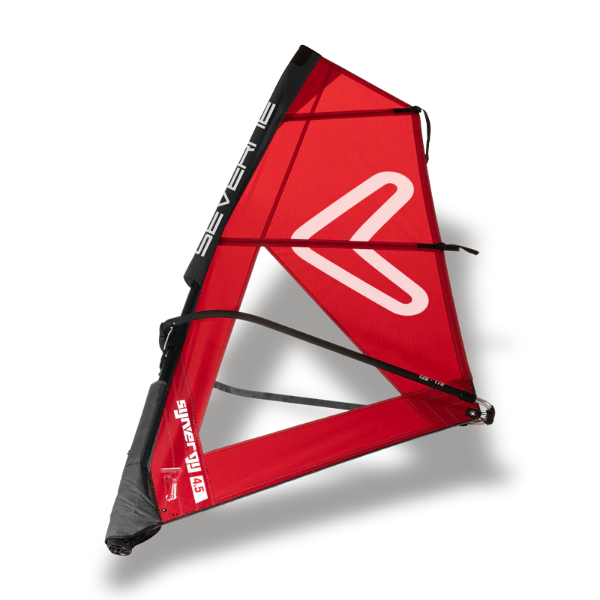
The Severne Synergy is engineered specifically to eliminate the "guessing game" of rig compatibility. As a complete package, every component - from the 2-piece Epoxy RDM mast to the alloy clamp-on boom - is designed to work in perfect harmony. The sail itself is constructed from high-grade Dacron, providing a soft, forgiving feel that absorbs gusts and reduces fatigue for sailors still perfecting their stance. Its standout feature is the printed rigging guide directly on the sail, which provides visual cues for downhaul and outhaul tension.
Technically, the Synergy excels by utilizing a reduced diameter mast (RDM) which makes the rig significantly lighter and easier to uphaul than standard diameter systems. The sail's geometry is "balanced," meaning the center of effort remains stable rather than pulling the rider forward, a common issue in entry-level rigs. While it is marketed toward progression, the high-tension batten layout ensures that it doesn't "bag out" when the wind picks up, allowing for genuine planing performance in moderate breezes.
The primary limitation is the ceiling of the materials; while Dacron is virtually indestructible and great for learning, it lacks the "crisp" responsiveness and top-end speed of Monofilm or X-Ply sails found in advanced freeride categories. Additionally, as an integrated system, you are locked into Severne's specific component geometry, which might require a full upgrade if you transition to high-carbon competition masts later. However, for those seeking the most painless path from uphauling to planing, the Synergy is unmatched.
The Synergy utilizes a "Fixed-Length Extension" system. Most rigs require precise millimeter adjustments on the mast extension to achieve correct downhaul. Severne pre-sets the luff length so that the sailor simply pulls the downhaul until the sail meets the base. This ensures the 22-degree X-ply fibers in the high-load zones are correctly tensioned every time, maintaining the intended aerodynamic foil shape without needing a tuning bench.
Best Versatility: Duotone E_PACE
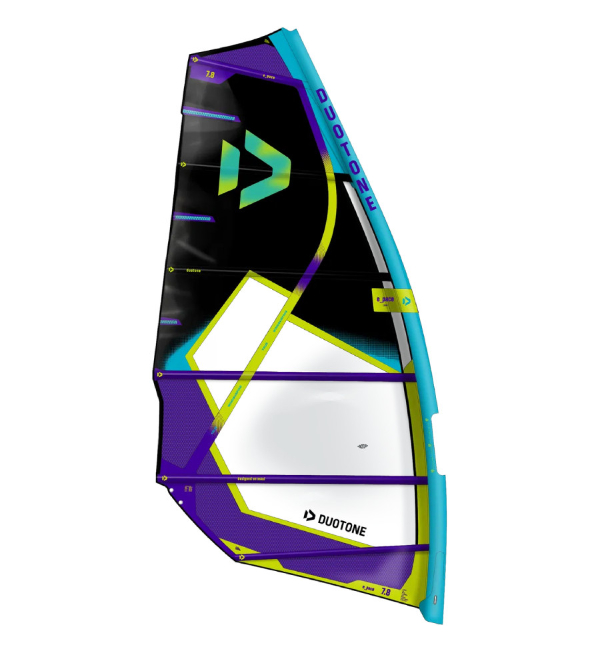
The Duotone E_PACE is arguably the most adaptable no-cam sail on the market, defined by its "3-IN-1" design philosophy. Unlike most sails that have a narrow "sweet spot," the E_PACE features a significantly reduced luff curve in the upper section. This allows the sailor to drastically change the sail's personality via downhaul tension. At "MIN" trim, the sail is deep and powerful, mimicking the low-end grunt of a larger sail for light-wind planing or foiling. At "MAX" trim, the leech opens up (twist), allowing the sail to handle extreme over-powered conditions with speed and stability.
From a construction standpoint, the E_PACE features "iROCKET 2.0" batten tensioners, which are factory-calibrated using a torque wrench. This ensures the foil profile is symmetrical and stable from day one. The inclusion of the VTS 2.0 (Visual Trim System) provides a "quick rigging patch" at the top of the sail, allowing users to see exactly when they have reached the correct downhaul tension for the current wind conditions without needing to measure the mast length.
The downside of this versatility is the technical demand on the rider. To truly access the E_PACE's range, you must be comfortable active-tuning your rig. If you set-and-forget, you might find the sail feels slightly "neutral" or lacks the specialized punch of a dedicated wave or race sail. It is best suited for freeriders who sail in varied conditions and want one rig to cover everything from light-wind cruising to high-speed blasting. It also features a dedicated clew eyelet for foiling, making it a future-proof investment.
The VTS 2.0 system works by monitoring the "Loose Leech" - the area of the sail between the top battens that goes slack under tension. By precisely controlling this slack, the E_PACE manages its "twist." An open leech allows the sail to "exhaust" excess wind pressure vertically, preventing the center of effort from shifting. Duotone's 3D Top Cap further enhances this by allowing the mast to bend both horizontally and vertically, neutralizing gusts before they reach the rider's hands.
Best Wave Performance: Goya Banzai 11 Pro Carbon
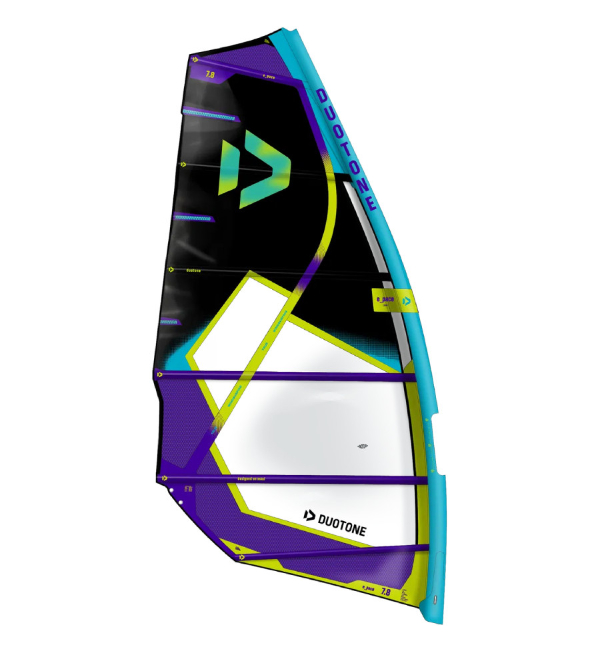
The Goya Banzai Pro is the flagship "power" wave sail, favored by world-tour professionals for its explosive lift and immediate responsiveness. Built with a "Pro Carbon" construction, the sail incorporates ultra-low stretch Warp Carbon fiber filaments. These tendons are arrayed along the primary load paths of the sail, ensuring that the profile remains locked even when hitting a lip or landing a jump. Unlike traditional sails that use heavy reinforcements everywhere, the Banzai uses Scrim panels in the upper body to keep the "swing weight" low, making the rig feel exceptionally light in maneuvers.
What sets the Banzai apart is its "fingertip" control. The lift is positioned slightly higher and further back than neutral sails, providing a "back-hand" pressure that acts like a throttle. This allows the sailor to drive the board into turns with more precision. The window is made of Bi-Ply - two layers of film with UV inhibitors - which offers the clarity of Monofilm but with significantly higher resistance to the creasing and cracking typical of wave-sailing environments.
Because this is a high-performance wave rig, it requires a high-quality RDM mast (ideally 70% carbon or higher) to achieve the intended flex. Using a low-carbon or SDM mast will ruin the sail’s "organic" feel. It is a specialized tool; while it can be used for flatwater sailing, its 4-batten layout is optimized for agility over straight-line speed stability. For dedicated wave riders and high-wind specialists, however, the Banzai’s blend of power and durability is the industry standard.
Traditional X-Ply uses a mesh to prevent tears, but it still allows the PET film to stretch under high load. Goya’s Warp Carbon tendons are linear fibers that possess a much higher modulus (stiffness). By aligning these with the diagonal loads from the clew to the head, Goya eliminates "crimp" and deformation. This ensures the sail’s "draft" (the deepest part of the foil) doesn't migrate backward as the wind increases, maintaining a stable pull.
Best No-Cam Speed: GA Sails Matrix
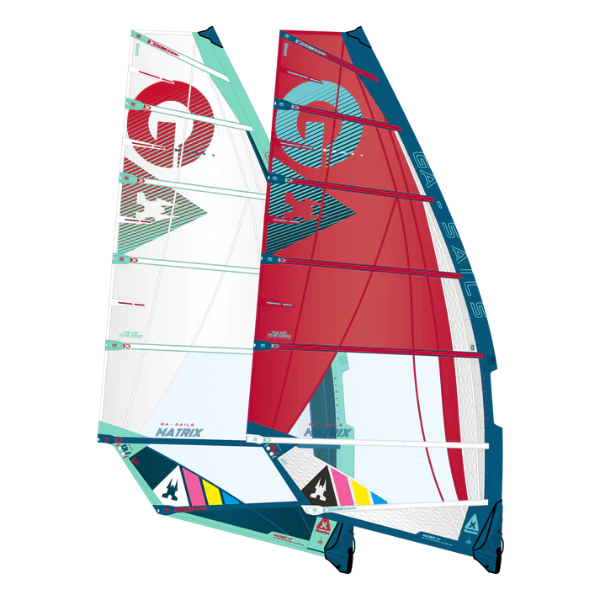
The GA Sails (Gaastra) Matrix bridges the gap between easy-handling freeride sails and high-tension race sails. It is a 7-batten, no-cam design that prioritizes top-end speed and stability in choppy water. For the current season, GA has introduced a "Continuous Radial Panel Layout." By aligning the sail panels radially from the corners, they have eliminated most of the cross-seams that typically create weak points and disrupt airflow. This results in a cleaner, more aerodynamic foil that feels "locked-in" even at high speeds.
The Matrix utilizes a triple luff panel construction - a mix of 2-Ply, X-Ply, and Monofilm. This specific layering ensures that the high-load area near the mast is stiff and responsive, while the rest of the sail remains light. In performance tests, the Matrix displays a "freerace" character, meaning it wants to be driven hard and fast. Its wide foot and race-inspired outline provide significant downforce, which helps keep the board stable when trying to break speed records on flat water.
The trade-off for this speed is weight and rotation. With 7 battens, the Matrix is heavier than a wave or simple freeride sail, and the battens require more wind pressure to "pop" across the mast during a gybe. It also has a larger "luff sleeve" than entry-level rigs, which can hold more water and make waterstarting slightly more difficult. It is the ideal rig for the intermediate-to-advanced sailor who wants slalom-level speed without the rigging headache of cambered inducers.
In traditional horizontal panel sails, the stitches often run perpendicular to the tension lines, leading to "stretching" at the seams. GA Sails' Radial Panel Layout ensures the Technora fibers in the laminate follow the curved path of the load radiating from the clew. This maximizes the "stiffness-to-weight" ratio, allowing the sail to use thinner films without sacrificing the structural integrity required for 30+ knot speeds.
Best All-Around Freeride: NeilPryde Ryde
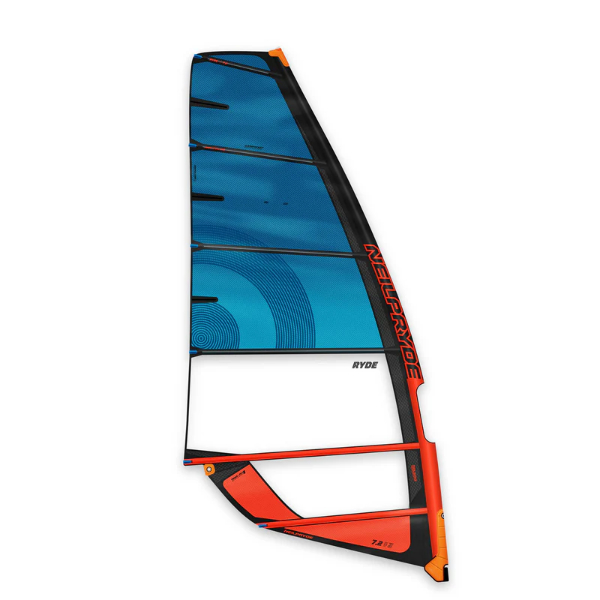
The NeilPryde Ryde is the quintessential freeride "plug-and-play" rig. It is designed specifically for flat-water blasting, easy gybing, and waterstarting. While many sails in this category try to be "everything," the Ryde focuses on being the most user-friendly. It features a 6-batten layout that provides a stable profile but remains significantly lighter and more maneuverable than the 7-batten Matrix. The Ryde's hallmark is its "crisp" feel - it reacts instantly to the slightest gust, making it easy to get onto the plane without aggressive pumping.
Construction-wise, the Ryde uses Internally Printed Laminated Film. This isn't just for aesthetics; by printing the graphics inside the laminate, the sail remains resistant to the fading and "ghosting" often seen in cheaper Monofilm sails. It also features NeilPryde’s "Continuous Luff" construction, where the luff panel is a single piece of X-Ply. This eliminates a major seam, providing better stitch-holding and a more uniform flex that matches NeilPryde's proprietary mast curves perfectly.
Honest limitations include its specific mast requirement. NeilPryde sails are historically designed with a "Flex-Top" or "Progressive" bend curve that is distinct from the "Constant Curve" used by many other brands. If you attempt to rig the Ryde on a generic mast, the profile may become unstable in high winds. However, when paired correctly, it offers a refined, luxurious sailing experience that makes long sessions on the water feel effortless.
The Ryde utilizes tubular battens in its mid-section. Unlike solid fiberglass rods, tubular battens are hollow, which drastically increases their stiffness-to-weight ratio. This stiffness is critical for a freeride sail because it prevents the draft from "collapsing" when the sailor sheets in hard. By using hollow tubes, NeilPryde maintains a rigid foil structure without the weight penalty that would normally make the rig feel "nose-heavy" during transitions.
How We Chose These Products
Our selection process involves rigorous cross-referencing of manufacturer whitepapers with independent tensile strength tests and "on-water" performance data from professional riders. We evaluated products based on three primary pillars:
- Structural Synergy: We prioritized rigs where the sail and mast are engineered as a unit, specifically looking for manufacturers that provide clear IMCS (stiffness) and bend curve data.
- Material Durability: We favored sails utilizing high-modulus fibers (Technora, Carbon, Dyneema) and multi-layered laminates like Bi-Ply over traditional single-layer Monofilm, which degrades rapidly under UV exposure.
- Tuning Range: A high-quality rig must be adaptable. We selected products that feature visual trim indicators and adjustable geometries to handle a wide range of wind speeds.
Comparison Overview
| Product | Primary Use | Battens | Core Material | Mast Type |
|---|---|---|---|---|
| Severne Synergy | Progression | 3-4 | Dacron | RDM (Included) |
| Duotone E_PACE | Versatile Freeride | 6 | VTS Monofilm / HD | RDM / SDM |
| Goya Banzai Pro | Wave / Maneuver | 4 | Warp Carbon / Scrim | RDM (High Carbon) |
| GA Sails Matrix | Freerace / Speed | 7 | Radial X-Ply / Mono | SDM / RDM |
| NeilPryde Ryde | Flatwater Blasting | 6 | Printed Laminated Film | RDM / SDM (NP Curve) |
Buying Guide: What to Look For
- Mast Bend Curve (The "Secret" Spec): Ensure your mast matches your sail. Most brands use "Constant Curve," but some (like NeilPryde or older Gaastra) may require "Flex-Top." A mismatch will prevent the sail from twisting correctly, making the rig feel heavy and unstable.
- Carbon Content: For masts, 35% carbon is standard for durability/beginners. 70-100% carbon provides faster "reflex," meaning the rig snaps back into shape after a gust, significantly improving speed and handling.
- RDM vs. SDM: Reduced Diameter Masts (RDM) are thicker-walled and nearly unbreakable; they are preferred for wave and freeride. Standard Diameter Masts (SDM) provide more stiffness and are preferred for large race sails (7.0m+).
- Boom Material: Aluminum is cost-effective but flexes under load. Carbon fiber booms are much stiffer, maintaining the sail's profile and saving your forearms from fatigue during long sessions.
- Extension Compatibility: Verify your base system (Euro-pin vs. US-cup). Euro-pin is the modern global standard for its reliability and ease of one-handed release.
General Pro / Cons
| General Strengths |
|---|
| Extreme wind range via active tuning |
| Lightweight handling in modern RDM setups |
| UV-resistant laminates extend gear life |
| Visual trim systems simplify rigging |
| High-modulus fibers prevent draft migration |
| Integrated packages reduce compatibility errors |
| General Weaknesses |
|---|
| High carbon components are fragile to impact |
| Brand-specific mast curves limit interchangeability |
| Technical rigs require precise tuning knowledge |
| Increased batten counts add noticeable weight |
| Premium materials significantly increase cost |
| Large rigs can be physically demanding to uphaul |
Final Summary
Modern windsurfing rigs have evolved into highly specialized pieces of equipment. For those starting their journey, the Severne Synergy provides an foolproof entry point. Advanced sailors seeking top-end speed will find the GA Sails Matrix's radial construction revolutionary, while wave enthusiasts should look no further than the Goya Banzai Pro. For the majority of freeriders, the Duotone E_PACE and NeilPryde Ryde offer the best balance of speed, handling, and tuning range. Choosing between them often comes down to your existing mast collection and whether you prioritize the "3-in-1" versatility of Duotone or the "crisp" flatwater response of NeilPryde.
Aggregate rating of the products reviewed: 4.64 out of 5.